
Custom 3D Printed Designs With Makerbot’s Customizer

custom

Although having a 3D printer means you can create custom object of your own design, that doesn’t change the fact that most object printed on Makerbots and RepRaps are copies, or slight derivations, of already existing object. If you need a gear, just go grab an OpenSCAD file for a gear, and a custom smart phone case can be easily made by modifying an already existing one. The problem with this approach, though, is you’ll need to learn OpenSCAD or another 3D design tool. Enter the Makerbot Customizer, a web app that allows you to create custom versions of other people’s work right in your browser.

The idea behind Customizer is simple: someone creates an OpenSCAD file with a few variables like the number of teeth on a gear or the number of turns on a screw. Customizer takes this OpenSCAD file, puts sliders and radio buttons on a web page, and allows you to create custom objects based on user-created templates.

Already we’ve seen a lot of Hackaday readers send in some pretty cool customizable things, like [Bryan]’s coil form for DIY inductors and [Greg]’s customizable PVC pipe couplers. If you already know OpenSCAD, it’s easy to create your own objects that are customizable by anyone on the Internet.
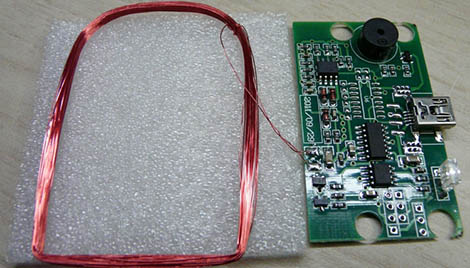
Turning An $8 RFID Reader Into Something Useful

[Fabien] ran across a very, very inexpensive RFID reader on Deal Extreme a while ago and with money to burn, added it to his cart. When the USB RFID reader arrived, he noticed something fairly odd about it (French, Traduction). The RFID reader presented itself to his computer as a USB HID device that spit out characters into a text editor whenever an RFID card was waved above the coil. The only problem was these characters weren’t the hex values recorded on the RFID card. So what’s going on here?

As it turns out (Anglais), this random piece of Chinese electronica sends 10 bytes of data to the computer, just like this well-documented RFID reader. Apparently, both these RFID readers take the hex value of an RFID card, convert those bytes to base 10, and pass each digit through a lookup table. Exactly why it does this is anyone’s guess, but since [Fabien] figured out how it worked, he could also figure out how to reverse the process.

Unfortunately, the RFID reader in question is currently out of stock at Deal Extreme. Seeing as how most of the electronics available there are remarkably similar and differ only in the name printed on the enclosure, though, we wouldn’t be surprised if a nearly identical RFID reader was available elsewhere.

Playing With The Minecraft API And A Raspberry Pi

mine

It hasn’t been a week since Minecraft for the Raspberry Pi has been released, and already we’re seeing some cool builds that bridge our analog world with Minecraft voxel land. [Martin] got his hands on the Raspi version of Minecraft and decided to take advantage of the API Mojang threw into the build by making a huge analog block clock that keeps real world time in the Minecraft universe.

Basically, [Martin] created a small Python script that draws the face and hands of a clock in a Minecraft world. The Minecraft API comes with neat functions such as drawCircle, and drawLine, so making a real clock face is as simple as getting the system time and doing a bit of trig.

After the break you can check out [Martin]’s Minecraft clock in action. If you’re running the Pi version of Minecraft, you can also get this running on your machine with the code on [Martin]’s git.

Continue reading “Playing With The Minecraft API And A Raspberry Pi”

An Awesome, Futuristic, All-in-one Robot Chassis

bot

No matter how many advances in electronics we find, we’re constantly surprised at the lack of progress in robot chassis. Sure, it should be a simple task to make a capable robot that looks cool, but aside from the Veter project team, no one else seems to be advancing the state of robot mechanics.

We’ve seen robotic chassis and hardware from the Veter team before, and this new version brings a whole lot more to the table. While the camera. GPS, compass, and ultrasonic sensors are the same from the previous build, there’s a whole lot more software inspired by [Sebastian Thrun]’s autonomous car class to make this build a little more capable.

While the Veter team is using a Beagleboard for their on-board computer, it should be possible to change the hardware over to a more economical Raspberry Pi. Even then, it won’t be a cheap build, but we doubt you’ll find a better robotics platform for less.

Pulse Jet Snowmobile, Or, What Swedes Do During Hibernation

Sweden is coming out of the depths of a cold, dark winter. What better time, then, to enjoy the last few weeks of frigid temperatures, short days, and frozen lakes and rivers? That’s what Orsa Speed Weekend is all about; tearing across a frozen lake by any means necessary, including jet powered snowmobiles.

This pulse jet comes from the fruitful minds at Svarthalet Racing (Google Translation) who have put an amazing amount of work into their fuel-injected pulse jet snowmobile during these last cold winter months. They’ve even gone so far as to do some analysis regarding how much horsepower their snowmobile has. Surprisingly, it’s not much more horsepower than a small car, but that’s due to the hilarious inefficiency of pulse jets compared to more conventional engines.

This isn’t the first time we’ve seen jet powered snowmobiles build for Orsa Speed Weekend. We’ll just hope this year a few more videos will show up in our tip line.

Weightless, The Hopefully-not-vaporware Internet Of Things Chip

Weightless

Imagine a single chip able to interface with your Ethernet, USB, and serial devices, turn those connections into wireless radio signals with miles of range, able operate off a single AA battery, and costs less than $2. That’s the promise of the Weightless special interest group that wants to put several hopefully not vaporware radio chips in the hands of everyone on the planet.

Long-range wireless networks are a tricky thing; for home networks, Bluetooth and WiFi reign supreme. Venturing into the outdoors, or really any place more than a few hundred feet from a WiFi repeater is a challenge, though. If you’re trying to send data to a fleet of automobiles, track an endangered animal, or make a smart power grid, your only real option is a cell phone tower with very high costs in hardware and battery life.

Weightless hopes to change that with a small radio chip that includes a MAC, PHY, and all the components necessary to turn just about any digital connection into a wireless link between devices. The radio will operate in the spectrum left behind by UHF TV (470 – 790MHz), and the folks working on already have some reference designs etched into silicon.Don’t expect this to replace WiFi, cellular, or Bluetooth, though: according to the getting to know Weighless book, the designers are aiming for a data rate of only a few kB/s.

Still, it’s a great use of now unused spectrum, and would fill a huge gap in what is readily possible with homebrew Internet of Things things.

Tip ‘o the hat to [Mark] for sending this one in.

Building A Six-channel Floppy Drive Synth From Start To Finish

floppy

We’ve seen scores of floppy drives play music, but never before have we seen a project as clean as [Rupert]’s Moppyduino. It’s an Arduino-based board that controls the stepper motors in six separate floppy drives, coaxing them in to playing music from a MIDI file.

The Moppyduino is more than just a convenient way to control the stepper motors in six floppy drives. It’s also a great example of what can be done with home PCB fabrication; the entire project was designed and constructed in [Rupert]’s workshop.

After designing the circuit, [Rupert] printed it out on a laser printer onto a plastic transparency sheet. This was transferred over to a copper clad board, etched, and drilled. After assembly, [Rupert] attached a USB FTDI controller to receive data converted from MIDI data with a Java app.

The end result – housed in a custom Corian enclosure – is one of the best looking floppy drive synths we’ve ever seen. You can check out the process of building this awesome instrument after the break.

Continue reading “Building A Six-channel Floppy Drive Synth From Start To Finish”