Listening In On Weather Balloons With RTL SDR

sonde

Every day, twice a day, over 800 weather balloons are launched around the world at exactly the same time. The data transmitted from these radiosondes is received by government agencies and shared with climatologists and meteorologist to develop climate models and predect the weather. Near [Carl]’s native Auckland, a weather balloon is launched twice a day, and since they transmit at 403 MHz, he decided to use a USB TV tuner to receive data directly from an atmospheric probe.

The hardware portion of this project consisted of building a high gain antenna designed for 162 MHz. Even though the radiosonde transmits at 403 MHz, [Carl] was easily able to receive on his out-of-band antenna.

For the software, [Carl] used SDRSharp and SondeMonitor, allowing him to convert the coded transmissions from a weather balloon into pressure, temperature, humidity, and GPS data.


A Pirate Box For Sharing Files

This is [illwill]’s Pirate Box, the newest addition to the network over at NESIT, the Meriden, CT hackerspace.

A pirate box is a completely anonymous wireless file server, kind of like a wireless version of a dead drop. It’s the perfect device for transferring files at a LAN party or hackerspace. The guts of [illwill]’s portable server comes from an old Fonera router NESIT had lying around. After installing OpenWRT, connecting a few batteries, and finding a wonderful lunch box / treasure chest enclosure on ebay, [illwill] had a portable file server perfect for sharing files.

The pirate box isn’t connected to the Internet. Instead, users can connect to each other and the 16GB USB drive by simply connecting to the router’s WiFi and opening up a browser. All web page requests are redirected to the Pirate Box page, where users can chat and share files. The folks at NESIT uploaded a few public domain files to their pirate box, but they’re anxiously waiting to see what files other users will upload.XVID.AC3.HQ.Hive-CM8.

Finally, TI Is Producing Simple, Cheap WiFi Modules

Ever responsive to the hobbyist market, Texas Instruments is releasing a very inexpensive, very simple WiFi module specifically designed for that Internet of Things.

The TI SimpleLink TI CC3000 WiFi module is a single-chip solution to putting 802.11b/g WiFi in just about every project you can dream up. Just about everything needed to put the Internet in a microcontroller is included in this chip – there’s a TCP/IP stack included on the chip, along with all the security stuff needed to actually connect to a network.

The inexpensive micocontroller WiFi solutions we’ve seen – including the very cool Electric Imp – had difficult, or at least odd, means of putting WiFi credentials such as the SSID and password onto the device. TI is simplifying this with SmartConfig, an app running on a phone, tablet, or PC that automagically takes care of setting up a link in a wireless network.

Best of all, the CC3000 only costs $10 in quantities of 1000. Compare that to other Internet of Things WiFi solutions, and it looks like we might be seeing and easy and cheap way to connect a project to the internet this year.

Hackaday Retro Roundup: Ultraportables Edition

front

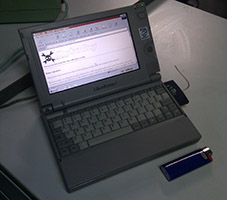
A few months ago, we rolled out an updated Hackaday, a badly needed new layout replacing the HTML and CSS that had remained unchanged since 2004. Of course a few people didn’t like change and complained about slow load times. We’ve experienced a slightly slower load time as well, so we’ll just wait until the year 2020 when our computers are many times faster and our Internet is provided by Google Fiber. Until then, our pokey battlestations and vintage computers can still check out a few classic hacks on our retro site. Here’s a few retro successes – Hackaday readers who pulled out their old tech and loaded up the retro site – that have come in over the past weeks and months.

Continue reading “Hackaday Retro Roundup: Ultraportables Edition”

Ask Hackaday: We Might Have Some FPGAs To Hack

rear

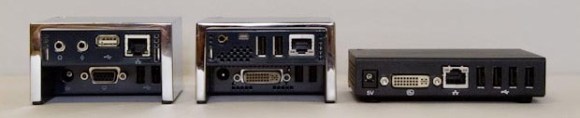
[Chris] is an IT guy for a medical clinic up in Alaska, and until very recently the systems he monitored, fixed, and beat with a wrench included over 100 Pano Logic “Zero Client” thin clients. Pano Logic just went out of business and all support for these little boxes have been cut off, leaving [Chris] with a hundred or so very interesting pieces of hardware.

The idea behind these “zero clients” is the ideal of a thin client – take all the storage, processing, RAM, and other goodies and move them to a server. Pano Logic took this one step further than other thin clients, removing the CPU, memory, and basically everything you’d find in a thin client. What was left was a Spartan-6 FPGA, a few chips to drive the USB ports, a pair of HDMI chips, and a few DDR2 modules. Basically, [Chris] has about 150 FPGA dev boards just sitting in a storage room. The only thing that is needed is a bunch of software and an extreme amount of cleverness.

After opening one of these zero clients, [Chris] found a Spartan-6 FPGA right next to what he thinks is a 6-pin programming port. Along with the FPGA are a few other chips that would make any FPGA dev board a very neat tool:

We’re going to agree with [Chris] these Pano Logic zero clients show a lot of potential. If you’re up to the challenge of creating a very, very cheap FPGA dev board out of some discarded hardware, head on over to ebay or chat up your local IT guy.

Turning A Broken Bass Into A Headless Bass

bass

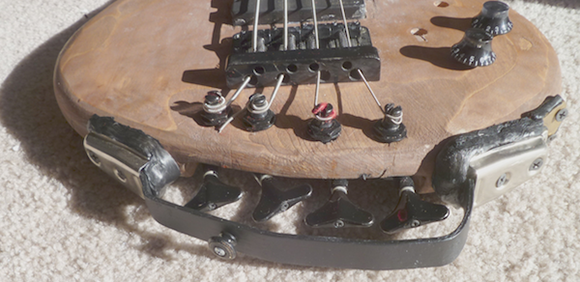
A while back [Michael] inherited a broken bass guitar from a friend. The headstock for this bass was cracked right down the middle, and the friend attempted a repair with a bolt and a couple of washers. After trying to figure out what the addition of a bolt was trying to accomplish, [Michael] set to work repairing this bass and ended up doing a headless conversion.

A headless bass, just as the name implies, does away with the headstock and moves the tuners to the other side of the guitar – in [Michael]’s case, right below the bridge. After sawing off the broken headstock above the truss rod, [Michael] made a string retainer and bolted it on to the remainder of the neck.

The tuners had to be moved, of course, so [Michael] routed out a section of the body below the bridge. Four holes were drilled and the original tuners slipped right in. The result is a perfectly functional bass that would fit right in to the tour van of an 80’s metal band.

You can check out [Michael]’s bass down in the pocket.

Continue reading “Turning A Broken Bass Into A Headless Bass”

A Really, Really Tiny Tube Amp

After building his first tube amp from a kit, he set to work on his next amp build. Since tube amps are a much more experimental endeavor than their solid state brethren, [Jarek] decided to make his next amp unique with military surplus subminiature tubes, and in the process created the smallest tube amp we’ve ever seen.

Instead of bulky 12AX7s and EL34s tubes usually found in tube amp build, [Jarek] stumbled upon the subminiature dual triode 6021 tube, originally designed for ballistic missiles, military avionics, and most likely some equipment still classified to this day. These tubes not only reduced the size of the circuit; compared to larger amps, this tiny amplifier sips power.

The 100+ Volts required to get the tubes working is provided by a switched mode power supply, again keeping the size of the final project down. The results are awesome, as heard in the video after the break. There’s still a little hum coming from the amp, but this really is a fabulous piece of work made even more awesome through the use of very tiny tubes.

Continue reading “A Really, Really Tiny Tube Amp”