Letting [Euler] Help Out With PCB Fabrication

drillin

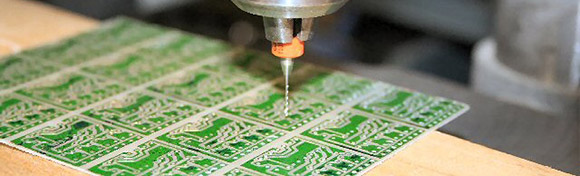
Since [Alessio] has been etching his own PCBs, he’s hit upon the most tedious part of the process, and the reason homebrew SMD boards are so awesome: drilling your own boards is a pain. While [Alessio]’s CNC mill takes care of most of the work, aligning the pre-drilled boards and correcting for any scaling issues from the mask is a bit difficult. With the help of a transform matrix, though, drilling PCBs has never been easier.

While the Gcode running the mill may be accurate, the actual manufactured PCBs might not be. If the extents on [Alessio]’s board aren’t exactly aligned with the axes of the CNC mill, the drill holes end up where they’re supposed to be. To solve this problem, [Alessio] wrote a PCB drilling transformational matrix calculator. The basic idea is by drilling just a few holes, [Alessio] is able to calculate any offset required in the Gcode with the help of a little bit of linear algebra.


LED Ice Cubes Prevent Alcohol Induced Blackouts

cube

On November 23rd last year, [Dhairya] attended a little shindig at MIT. Three drinks into the night, he blacked out and woke up in the hospital the next day. It was an alcohol-induced blackout, and like all parties at MIT, there’s an ingenious solution to [Dhairya]’s problem.

[Dhairya] came up with an alcohol-aware ice cube made of a coin cell battery, an ATtiny microcontroller, and an IR transceiver are molded into an edible gelatin ice cube. The microcontroller counts the number of sips per drink, and after one glass of adult beverage changes the color of the flashing LED from green to yellow. After two drinks the LED changes from yellow to red, signaling [Dhairya] to slow down.

If [Dhairya] feels the night is too young and keeps on drinking, the IR transmitter signals to his cell phone to send a text to a friend telling them to go take [Dhairya] home.

Less than three weeks after waking up in the hospital, [Dhairya] tested out his glowing ice cubes at another party. Everything performed wonderfully, even if he admits his creation is a little crude. A neat piece of work, and we can’t wait to see an update to this project.

Continue reading “LED Ice Cubes Prevent Alcohol Induced Blackouts”

Turning A Game Boy Into An Android Gamepad

gameboy

[Chad] has been messing around with emulators on his phone, but as anyone with a smart phone knows, even the most advanced touchscreen controls are terrible. Wanting something that pays tribute to the classic systems he was emulating, he decided to turn a classic old school brick Game Boy into an Android gamepad.

After gutting an old DMG-01, [Chad] set to work turning the D-pad and buttons in the Game Boy into something his Galaxy Nexus could understand. He chose a Bluetooth connection to provide input for his emulators, with the hardware generously donated from a Nintendo Wiimote.

The Game Boy PCB was cut up and a few leads attached to the Wiimote PCB. After modifying the case to include space for the Wiimote and a cell phone mount, [Chad] had a functional game pad, perfect for his adventures in emulation.

You can see [Chad]’s demo of his game pad after the break,

Continue reading “Turning A Game Boy Into An Android Gamepad”

[Ben Krasnow] Builds A CT Scanner

gif

After building a homebrew x-ray backscatter imager, [Ben Krasnow] realized he had nearly all the components to build his own CT scanner, able to make a 3D model of the inside of a frozen chicken.

Basically, a CT scanner takes dozens of x-rays of an object and reassembles them with the help of fancy algorithms to allow doctors to peer inside a human body. The CT scanners you’ll find at your local hospital are monstrous devices, rotating an x-ray tube and sensor around a patient with the help of some very heavy duty electromechanical engineering. [Ben] wanted to keep his build rather small, so instead of rotating the x-ray tube and screen around an object, he simply made a stepper motor-driven lazy suzan to rotate his frozen bird.

[Ben] set a digital camera off to the side of his build and captured 45 images of a rotating chicken. After correcting for the perspective distortion, the images were thrown into 3D Slicer to create a true 3D representation of a x-rayed chicken.

Continue reading “[Ben Krasnow] Builds A CT Scanner”

Turning A Tiny Router Into A Webradio

tplink

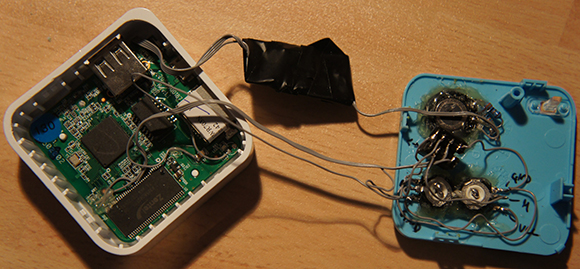
While the hacking zeitgeist is focused nearly entirely on all those new ARM dev boards that include the Raspberry Pi, some people out there are still doing it old school by modifying existing electronics to suit their needs. [Peter] picked up one of those very inexpensive TP-Link 703n wireless routers we’ve seen before and modified it into a standalone web radio, complete with volume and tuner knobs.

The TP-Link 703n is a wireless router smaller than a credit card available from the usual Chinese resellers for about $20. Able to run OpenWRT, this very inexpensive piece of hardware can be transformed into a device comparable to the Raspberry Pi; a complete Linux system with a few GPIO pins.

[Peter] took his 703n router and added an ATtiny85 connected to two pots and the internal UART. This, along with a script to read the values from the pots, tells the router what station to tune into and what volume to play it. The audio is handled by a USB soundcard with an internal speaker, making [Peter]’s build one of the smallest purpose-built Internet radios we’ve seen.

You can see [Peter]’s radio in action after the break.

Continue reading “Turning A Tiny Router Into A Webradio”

Giving The Hexbug Spider A Set Of Eyes

spider

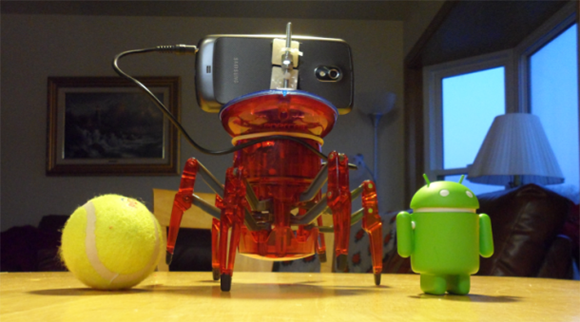
The Hexbug Spider is a neat little robot toy available at just about any Target or Walmart for about $20. With a few extra parts, though, it can become a vastly more powerful robotics platform, as [eric] shows us with his experiments with a Hexbug and OpenCV.

Previously, we’ve seen [eric] turn a Hexbug spider into a line following robot with a pair of IR LEDs and a drop-in replacement motor driver. This time, instead of a few LEDs, [eric] turned to an Android smartphone running an OpenCV-based app.

The smartphone app detects a user-selectable hue – in this case a little Android toy robot – and sends commands to the MSP430-powered motor control board over the headphone jack to move the legs. It’s a neat build, and surprisingly nimble for a $20 plastic hexapod robot.

You can see the OpenCV-controlled Hexbug in action after the break, along with a video build log with [eric] showing everyone how to tear apart one of these robot toys.

Continue reading “Giving The Hexbug Spider A Set Of Eyes”

Signing Your 3D Prints

print

For all the 3D models out on the Internet, including the STL files on Thingiverse that are copied by other makers every day, there hasn’t been a good way to put your John Hancock on a three-dimensional piece of plastic you’ve designed. [Chris] has been thinking about the fact that an STL file released on the Internet is completely out of the creator’s hands for a while now, and he finally came up with a good solution to signing 3D prints.

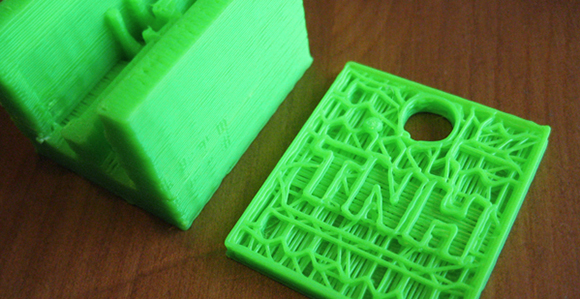
[Chris] had been looking into ‘stamping’ a maker’s mark on the first few layers of a print, but this wasn’t always practical. Sometimes the bottom of a print needs to be a smooth surface, so [Chris] moved his initials up a few layers into the main body of the print.

By subtracting a 1.0 mm-thick version of his initials from the interior of a print, [Chris] is able to put his maker’s mark on the inside of a 3D object, visible only for a short time during the production process.

The signature isn’t impossible to remove, but it does give a little bit of credit to the original designer, all without some strange DRM scheme or metadata attached to an STL file.

You can check out [Chris]’ printer laying down a few layers of his logo after the break.

Continue reading “Signing Your 3D Prints”