MIDI Swiss Army Knife Built From An MSP430

[youtube=http://www.youtube.com/watch?v=0hvQUXcXlEg&w=470]

Hot off the heels of his web server for the TI MSP430, [Rob] shared a MIDI booster pack for the MSP430 LaunchPad, an exceedingly inexpensive and ever more capable microcontroller that is getting somewhat of a cult following.

[Rob]’s MIDI booster pack contains a MIDI in and out port as well as just about whatever MIDI manipulation apps his mind can dream up. So far, [Rob] has a MIDI arpeggiator, a harmonizer, an echo, filter, s MIDI monitor that displays incoming messages on a Nokia LCD, and a controller that interfaces with a light sensor or joystick to manipulate MIDI variables.

Back in the 80s (and 90s, and even into the aughts), a dedicated MIDI arp or harmonizer was a crazy expensive piece of kit, especially considering how simple the device is. Those dedicated rackmount boxes can now be replaced with a TI LaunchPad and [Rob]’s booster pack.

You can check out the arp and harmonizer in action after the break.

Continue reading “MIDI Swiss Army Knife Built From An MSP430”
A Hardware Random Number Generator For Your FPGA

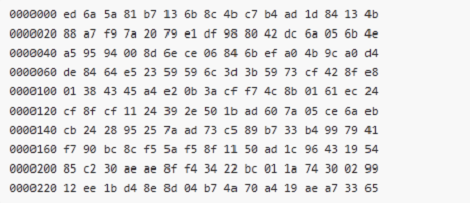
[Zach] sent in a project he’s been working on that brings hardware random number generators to common hardware you might have lying around. It’s called Whirlyfly and it turns an FPGA dev board into a hardware random number capable of outputting random bits over a USB connection at 3 Mbps.

Previously, the whirlygig ran on a custom CPLD that interfaced to a *nix box and provided high quality random numbers via /dev/hw_random. [Zach]’s efforts takes the core of the whirlygig and ports it to the very popular and inexpensive Papilio One FPGA dev board.

As for what [Zach] can do with his random number generator, it’s extremely easy to write a Monte Carlo experiment to approximate the value of π with a better accuracy than [Ptolemy] was able to muster 1900 years ago. There’s also the aspect of encryption, and – why you would do this we have no idea – making an uncompressable file is also possible.

Static Testing Hybrid Rockets For A Flight To Space

A team of rocketry enthusiasts at Boston University have been working on a small hybrid rocket motor that serves as a test bed for a larger, yet-to-be-designed power plant that will hopefully launch a rocket into space.

The static tests of the BURT Mk. II began last April with a series of tests using HTPB solid fuel and Nitrous Oxide as the oxidizer. The team had a series of failures – mostly due to the JB Weld seal on the igniter leads blowing out – but managed a 10 second burn on April 21st.

For later tests, a vector drive system built by a complimentary Boston University engineering group was used to control the direction of the thrust up to 12 degrees away from the axis of the engine. That’s an impressive bit of kit, especially considering the exhaust from the rocket reaches over 5000 degrees Fahrenheit.

Even though it’s summer now and the Boston University team is on a much deserved break, we can’t wait to see what the BURT team comes up with next year. Hopefully we’ll see a flight test that reaches the team’s goal of the Karman line.

Continue reading “Static Testing Hybrid Rockets For A Flight To Space”

Sending A Raspberry Pi To 130,000 Feet

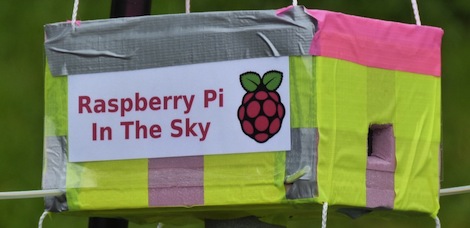
We knew this wouldn’t take long. [David] sent a high altitude balloon into the upper atmosphere last weekend using a Raspberry Pi as the brains of the payload.

[David]’s payload consisted of a Raspberry Pi, natch, with a Logitech webcam, GPS receiver, and six AA batteries wired into a LDO regulator with a monstrous heat sink to keep everything in the EPX foam enclosure relatively warm in the frigid rarefied air of near space.

A high altitude balloon isn’t much fun without some real-time data coming down from the upper atmosphere, so [David] used a Radiometrix NTX2 transmitter module (anyone know of an equivalent part for the USA?) that transmits a measly 10 milliwatts. Even though the transmitter has an ‘official’ range of 500 meters, [David] got word of image data being received in Northern Ireland, over 500 km away.

We’re pretty impressed with [David]’s flight  – and the fact that his flight is now 12th place on the list of UK balloon altitude records – but now we’re wondering what could be done with another Raspi flight to near space. [David] had a lot of computing horsepower up there, enough to get images from a webcam and send them down to earth. Now we’re wondering what else could be done with a Raspberry Pi in space.

You can check out the GoPro video of the very fast decent after the break, or check out the received images on [David]’s Flickr.

Continue reading “Sending A Raspberry Pi To 130,000 Feet”

Lightweight Web Server Using The MSP430

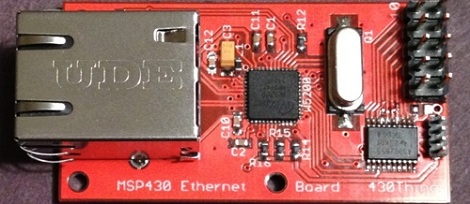
Need a tiny web server? [Rob] over on the 43oh forums made an Ethernet booster pack for the very popular TI MSP430 microcontroller. If that’s not enough, [Rob] also put together an all-in-one solution with a MSP430 and Ethernet controller that can be powered by a battery. Along with the web server that fits in just 5k of flash, we’re going to say [Rob] has a very good solution for remote sensing and data logging.

For his Ethernet-enabled 430, [Rob] chose to use the WIZnet W5200 Ethernet controller. This chip communicates with the 430 via and SPI interface and has a hardware TCP/IP stack that supports TCP, UDP, and PPPoE, offloading all the low-level stuff off of the 430 and onto the Ethernet controller.

After the break there are a pair of videos of [Rob] showing off his tiny web server. A few neat features include a full memory dump of the 430, as well as a reading the states of all the pins via an HTML page. If you’re looking for a way to collect data over Ethernet, we don’t think you could do better than [Rob]’s tiny 430-based web server. Also, if you’d like to control a few devices over the Internet, [Rob] included a few optoisolators  for lights or appliances.

The code is available on the 43oh forum page, but [Rob] says he’ll clean that up and put it in a Git.

Continue reading “Lightweight Web Server Using The MSP430”

Finger Recognition On The Kinect

The Kinect is awesome, but if you want to do anything at a higher resolution detecting a person’s limbs, you’re out of luck. [Chris McCormick] over at CogniMem has a great solution to this problem: use a neural network on a chip to recognize fingers with hardware already connected to your XBox.

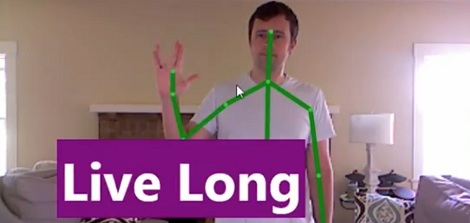
The build uses the very cool CogniMem CM1K neural network on a chip trained to tell the difference between counting from one to four on a single hand, as well as an ‘a-okay’ sign, Vulcan greeting (shown above), and rocking out at a [Dio] concert. As [Chris] shows us in the video, these finger gestures can be used to draw on a screen and move objects using only an open palm and closed fist; not too far off from the Minority Report and Iron Man UIs.

If you’d like to duplicate this build, we found the CM1K neural network chip available here for a bit more than we’d be willing to pay. A neural net on a chip is an exceedingly cool device, but it looks like this build will have to wait for the Kinect 2 to make it down to the consumer and hobbyist arena.

You can check out the videos of Kinect finger recognition in action after the break with World of Goo and Google Maps.

Continue reading “Finger Recognition On The Kinect”

Make A Game For A Retro Console, Win Prizes

For all you old-school console hackers out there, there’s a homebrew coding competition being held by NeoTeam for all the retro (and not so retro) consoles of yesteryear. If you’ve ever programmed for the NES, GBA, PC Engine, N64, or even the Dreamcast, now’s your chance to write a game or app and hopefully win a small prize and a great deal of street cred.

Last year, the Neo Coding Competition saw some very cool entries such as [smealum]’s amazing work in bringing Minecraft to the Nintendo DS ([smealum]’s non-forum DScraft page is here). DScraft won [smealum] a cool $500 USD, but the bragging rights for bringing Minecraft to the DS are far more valuable than any monetary reward.

There are two categories for the competition, an app division and a game division. All the retro platforms are open for development in this contest, so if you want to write something for your Master System, NES, 32X, or Saturn, you better get started: the contest ends August 20th.