Hackaday Podcast 197: Decoding VHS, Engineering The TV Guardian, And Gitting Code Into Your ESP32s

This week, Editor-in-Chief Elliot Williams and Assignments Editor Kristina Panos delighted in the aural qualities of Kristina’s brand new, real (read: XLR) microphone before embarking on creating a podcast highlighting the best of the previous week’s hacks.

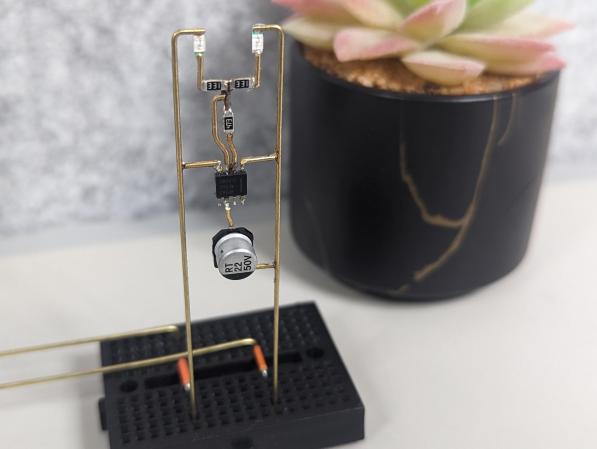
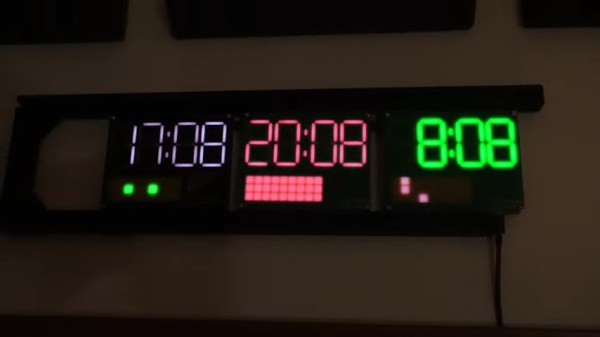
This week in the news, NASA returned to the Moon with Artemis I, and this time, there are CubeSats involved. After that, it’s on to the What’s That Sound results show, marred by Kristina’s cheating scandal (listening ahead of time) and Elliot’s reading the filename aloud before we started recording. Finally, we move on to the hacks — they start with a trip to the 90s both sonically and visually, and end with a really nice alarm clock that’s decidedly 70s, and definitely Hackaday.

Check out the links below if you want to follow along, and as always, tell us what you think about this episode in the comments!

And/or download it and listen offline.

Continue reading “Hackaday Podcast 197: Decoding VHS, Engineering The TV Guardian, And Gitting Code Into Your ESP32s”

There’s Nothing Square About This Rectangular Guitar

We kind of already knew this, but it seems that [Uri Tuchman] really can build absolutely anything. This fall, he was asked to compete in the Great Guitar Build-Off competition, which involves a fully-customizable kit guitar sent to each entrant as a starting point. In order to allow for maximum creativity, the wooden parts like the body and the headstock are square. And quite creatively, [Uri] kept them that way. Square, that is.

While yes, the body rising out of the squareness is in fact a Les Paul profile, there are a ton of details that make this a [Uri Tuchman] instead. For starters, everything is square, beginning with the custom brass knobs for the volume and tone potentiometers. We’re not sure if it came with humbuckers, but that sure is a happy accident if so. If only the neck blank had been square, [Uri] could have made a lap steel. Once it was finished, [Uri] took it to a luthier to have it set up, fine-tuned, and assessed for quality. Of course, it passed with flying Vs colors.

There are plenty of other [Uri] hallmarks, like the bird on the neck plate, and another hiding in the hand-drawn and hand-carved pickguard, so be sure to check it out after the break.

Continue reading “There’s Nothing Square About This Rectangular Guitar”

Osprey Keyboard Lets The NRF52840 Spread Its Wings

While most people don’t care whether they use one finger or ten, some people want to better themselves by learning how to touch-type. And honestly, there’s no easier way to do that than by getting into the ergo keyboard game. Even if you consider yourself a touch-typist already, an ortholinear or column-staggered keyboard may teach you otherwise, as you find yourself trying to type ‘c’ with your index finger (for example) and failing miserably.

[ebastler] chose the best of all routes and decided to build his own perfect keyboard, called the Osprey. It’s a wireless, column-staggered 40% that runs on ZMK firmware, which of course is open-source, as is the PCB itself and the thick and travel-ready printed enclosure. Although [ebastler] has yet to implement either one of these additional inputs, the Osprey also supports a thumbstick and a track pad.

Brain-wise, it’s a bare nRF52840 chip along with a TI BQ24075 for battery charging. The interesting thing about this implementation is that [ebastler] used and abused Nordic sample schematic #4, which utilizes both DC-DC converter stages of the chip. We can’t wait to see what this trailblazing build will mean for the community!

Singapore Branches Out Into Internet Of Trees

Five years ago, a 38-year-old woman was enjoying an outdoor concert with her family with one of her twin infants in her arms. In the week prior, it had been windy and rainy, but today, the weather was nice, and the concert was crowded. Without warning, a 270-year-old tembusu tree fell on the woman, pinning and ultimately killing her after the other concertgoers couldn’t remove it in time. This tragedy happened in spite of twice-yearly inspections where the tree showed no visual signs of trouble.

It’s exactly this type of incident that Singaporean officials hope to avoid by building an Internet of Trees. The equatorial island nation is home to roughly 5.5 million people, and around 7 million trees — about 6 million of which are tracked by Singapore’s National Parks Board, so that they can be managed remotely with an app. (The Board only tracks trees once they’ve reached a certain size, so we’ll assume that the other million are too young to join the fun just yet.)

While tree-triggered deaths are fairly few and far between, there are plenty of other ‘tree incidents’ that can occur, such as a branch falling, or a tree trunk snapping or uprooting. Depending on the size of the branch, this can be a dangerous nuisance as it could block roads, obscure signage, or destroy property. Thanks to the efforts of the National Parks Board, these incidents have dropped from around 3,000 per year at the turn of the millennium to under 500 per year today.

Continue reading “Singapore Branches Out Into Internet Of Trees”

Circular Binary Clock Uses The Power To Tell Time

Should a clock be round? Depends on the style of clock, we suppose. After all, we wouldn’t expect to see a digital clock with a round readout just for fun. But a binary clock — that’s another animal altogether. Whereas [JohnThinger] made just a few weeks back a linear binary clock using an RGB LED strip and an ATtiny, he decided it would look much better in the round.

Before you go decrying the fact that there are numbers other than 1 and 0 on the thing, those are simply the power of two by which one must multiply to get the time. And naturally, it’s done in three phases, with the yellow-green numbers representing the seconds, the pink-red representing minutes, and the blue standing for the current hour. No, the point is not to make life easier. But it’s a good-looking clock, no?

Just as before, an ATtiny85 is the brain, with an RTC chip and an oscillator to keep time. But now, the display involves negative space 3D-printed numbers and an RGB LED ring. Be sure to check it out after the break.

Continue reading “Circular Binary Clock Uses The Power To Tell Time”

Hackaday Podcast 194: FPV Contest, Seven Words, Lots Of Coffee, And Edible Drones

This week, Editor-in-Chief Elliot Williams and Assignments Editor Kristina Panos fumbled through setting up Mumble on Kristina’s new-ish computer box before hitting record and talking turkey. First off, we’ve got a fresh new contest going on, and this time it’s all about the FPVs. Then we see if Kristina can stump Elliot once again with a sound from her vast trove of ancient technologies.

Then there’s much ado about coffee roasters of all stripes, and you know we’re both coffee enthusiasts. We have many words to say about the subject, but none of them are any of the 7+ dirty ones that the FCC would probably rather we didn’t. Finally, we take a look at a bike frame that’s totally nuts, a clock that seemingly works via magic, and a drone made of rice cakes. So find something to nibble on, and check out this week’s episode!

Download the podcast for safe keeping.

Check out the links below if you want to follow along, and as always, tell us what you think about this episode in the comments!

Continue reading “Hackaday Podcast 194: FPV Contest, Seven Words, Lots Of Coffee, And Edible Drones”

Trackball Split Keyboard Will Roll Into Your Heart

One of the nicest problems to have with a split keyboard, even a monoblock split, is deciding what to put in the middle. Most people go for either the mouse, or else their beverage of choice. Some might sub in a bowl of snacks later on in the day. Personally, we most often use the space for holding notes.

[AlSaMoMo] went with the mouse, but decided to make it a permanent installation. They planted a trackball in the middle of Batreeq, their awesome little monoblock split. For a while now, [AlSaMoMo] has been using 30-key ‘boards and wanted to see about integrating a trackball. Not only that, Batreeq has a fun-looking scroll ring and haptic feedback. Plus, it just looks fantastic.

Even though Batreeq is vaguely bat-shaped, the word translates to ‘penguin’, which, on second glance, the keyboard does appear a bit villainous. But fear not, Batreeq’s PCB is open source, as are all of [AlSaMoMo]’s keyboards.

Want to have more space between your hands? Check out this split that uses VGA connections.

Via KBD #103