DIY Source Measurement Unit

DIY Source Measurement Unit Shows All The Details

An SMU or Source Measurement Unit works a bit like a power supply, in that it can source current into a load and a bit like an electronic load, in that it can sink current from a power source. It includes a crossover circuit, so that it cleanly and predictably swaps between sink and source modes automatically. This makes it terribly useful for testing all manner of power circuits, charging and characterizing batteries or just saving bench space by replacing two separate boxes.

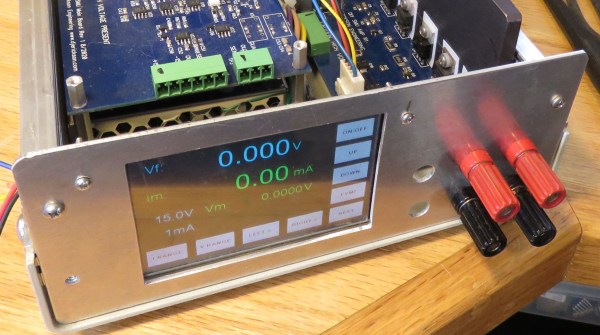
This DIY-SMU from analog electronics guru [Dave Erikson] is a full four-quadrant design, meaning that it can operate with both positive and negative voltages. The design shows excellent performance, comparable to commercial instruments that cost serious money, which is testament to [Dave]’s skill and experience.
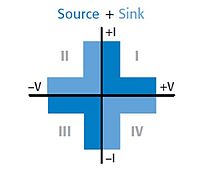
Source: Wikipedia

The quadrants can be understood if you imagine a graph with voltage on the horizontal axis, and current on the vertical. Both axes can swing to both polarities, with quadrants I & III indicating power delivered into a load and quadrants II & IV power absorbed from a source.

The very detailed project logs show every gory detail, every problem found and the work to solve it. Its a long read, which for those interested in such devices, will be time well spent in this scribe’s humble opinion.

The DIY-SMU is mostly analog in nature, with the control portion courtesy of a Teensy 3.2, with a Nextion TFT display with touch for the user interface. The firmware even supports SCPI over USB to allow remote control and data gathering, so its ready to drop right into your test and measurement stack. For more reading goodness, checkout JSMU, a related project, taking inspiration from the DIY-SMU. Details can be found on this project GitHub repo.

Many power supply projects have graced these pages over the years, like this 2015 Hackaday Prize Entry but this is one of the few four-quadrant designs to be found, so hats off!

Continue reading “DIY Source Measurement Unit Shows All The Details”
ThunderScope datapath

Why Buy A New Scope When You Can ‘Just’ Build One?

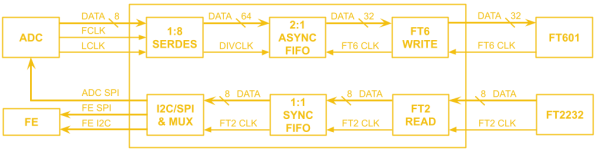
Hackaday Prize 2021 Finalist ThunderScope is doing exactly that. [Aleska] is building a modular open source PC-connected oscilloscope aiming at four channels and a cool 100 MHz bandwidth with a low budget. The detailed project logs, showing how he is learning about ‘scope technology on-the-fly is a fascinating look into the mind of an engineer as he navigates the ups and downs of a reasonably complicated build.

We like how [Aleska] has realised early on, that keeping the project private and only releasing it when “I’m done” actually impedes progress, when you could open source from the beginning, log progress and get great feedback right from the start. All those obvious mistakes and poor design choices get caught and fixed before committing to hardware. Just think of all the time saved. Now this is an attitude to cultivate!

Continue reading “Why Buy A New Scope When You Can ‘Just’ Build One?”

Raspberry Pi Real-Time HAT

New Part Day: Raspberry Pi HAT For IEEE1588 Precision Time Protocol

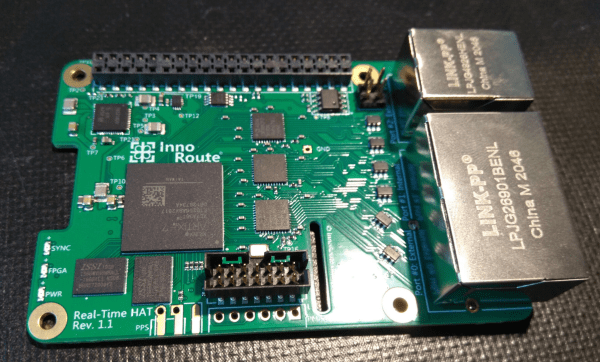
The new Real-Time HAT by InnoRoute adds IEEE1588 PTP support in hardware to a Raspberry Pi 4 nestled beneath. Based around a Xilinx Artix-7 FPGA and a handful of gigabit Ethernet PHY devices, the HAT acts as network-passthrough, adding accurate time-stamps to egress (outgoing) packets and stripping time-stamps from the ingress (incoming) side.

This hardware time-stamping involves re-writing Ethernet packets on-the-fly using specialised network hardware which the Raspberry Pi does not have. Yes, there are software-only 1588 stacks, but they can only get down to 10s of microsecond resolutions, unlike a hardware approach which can get down to 10s of nanoseconds.

1588 is used heavily for applications such as telecoms infrastructure, factory equipment control and anything requiring synchronisation of data-consuming or data-producing devices. CERN makes very heavy use of 1588 for its enormous arrays of sensors and control equipment, for all the LHC experiments. This is the WhiteRabbit System, presumably named after the time-obsessed white rabbit of Alice In Wonderland fame. So, if you have a large installation and a need for precisely controlling when stuff happens across it, this may be just the thing you’re looking for.

IEEE1588 PTP Synchronisation

The PTP client and master device ping a few messages back and forth between themselves, with the network time-stamper recording the precise moment a packet crosses the interface. These time-stamps are recorded with the local clock. This is important. From these measurements, the time-of-flight of the packet and offset of the local clock from the remote clock may be calculated and corrected for. In this way each client node (the hat) in the network will have the same idea of current time, and hence all network packets flowing through the whole network can be synchronised.

The beauty of the system is that the network switches, wiring and all that common infrastructure don’t need to speak 1588 nor have any other special features, they just need to pass along the packets, ideally with a consistent delay.

The Real-Time HAT configures its FPGA via SPI, straight from Raspberry Pi OS, with multiple applications possible, just by a change on the command line. It is possible to upload custom bitstreams, allowing the HAT to be used as a general purpose FPGA dev board should you wish to do so. It even stacks with the official PoE HAT, which makes it even more useful for hanging sensors on the end of a single wire.

Of course, if your needs are somewhat simpler and smaller in scale than a Swiss city, you could just hack a GPS clock source into a Raspberry Pi with a little soldering and call it a day.