Shapeshifting Material For Weather Adaptive Structures

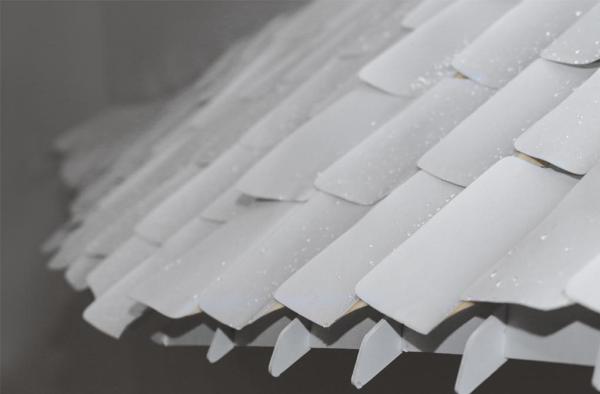
Where [Isaac Newton] had his apple (maybe), [Chao Chen] found inspiration in a pine cone for a design project that lead to a water-sensitive building material. He noticed the way some pine cones are sensitive to water, closing up tight when it rains, but opening up with dry conditions. Some dissection of a pine cone revealed [Mother Nature’s] solution – different layers that swell preferentially when exposed to moisture, similar to how a bimetallic strip flexes when heated. [Chao Chen’s] solution appears to use balsa wood and a polystyrene sheet laminated to a fabric backing to achieve the same movement – the wood swells when wet and pulls the laminate flat, but curls up when dry.

As [Chao] points out, the material is only a prototype, but it looks like a winner down the road. The possibilities for an adaptive material like this are endless. [Chao] imagines a picnic pavilion with a roof that snaps shut when it rains, and has built a working model. What about window shutters that let air and light in but close up automatically in that sudden summer storm? Self-deploying armor for your next epic Super Soaker battle? Maybe there are more serious applications that would help solve some of the big problems with water management that the world faces.

Make sure you check out the video after the break, with a more decorative application that starts out looking like an [M.C. Escher] print but ends up completely different.

Continue reading “Shapeshifting Material For Weather Adaptive Structures”
Coin-Op Weather

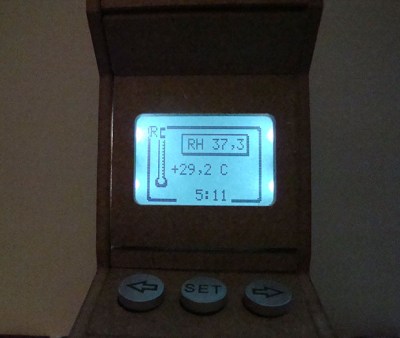
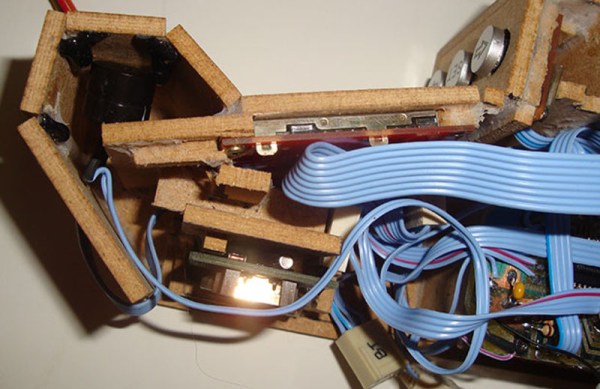
When you have access to your own CNC machine, you tend to make stuff first and ask questions later. That sounds like how [Rui Cabral] came up with a weather station stuffed into a miniature arcade game cabinet.

arcade28Standing only about 16 cm tall, the cabinet is quite detailed and resembles the familiar arcade form factor that has consumed countless quarters. It even appears to be made of particle board like the big boys. The screen cutout is filled by a 84×48 monochrome Nokia display, and the rest of the cabinet’s interior is stuffed with a CNC-milled PCB, temperature and humidity sensors, an RTC, and a Bluetooth module for uploading data to a phone. [Rui] even manages to work in an homage to the grand-daddy of all arcade games with a Pong splash screen.

Another good-looking display for this project might have been this ePaper badge made into a weather station. And we’ve featured even tinier arcade cabinets too, though perhaps not as functional.

[Rui] takes us on a video tour of his build after the break.

Continue reading “Coin-Op Weather”

World’s Greatest Bubble Machine Born Of Space Program

[GordonKirkwood] needs soap bubbles. Big soap bubbles. Why does he need soap bubbles? Because – soap bubbles!

Actually, [Gordon] is a photographer, and he wants to capture candid moments and fleeting expressions. What better way to inspire wonder and amazement than to be able to produce a giant soap bubble on demand? And what better way to do it than with an intricate, computer controlled giant bubble machine?

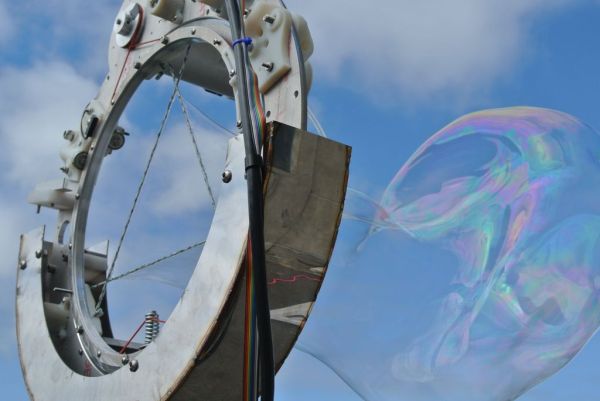
[Gordon’s] inspiration for the bubble producing mechanism comes from the end effector of the Canadarm robotic Space Shuttle arm, which used a cable-grapple design to snare and secure payloads. [Gordon] uses a similar principle to interweave bubble juice-soaked strings and pull them apart in a plane to form a soap film. A puff of wind or a quick shot from a fan inflates and launches the bubble, which the mechanism can pinch off for precise control of size.

The amount of work [Gordon] put into the machine is impressive. His Instructables post is incredibly detailed and goes into not only his build but also his design process and prototyping, the science of soap bubble instruments, and even a nod to the work of other pioneering bubble enthusiasts. And he thoughtfully includes a recipe for professional-grade bubble juice, with a secret ingredient that may surprise you.

You say your bubble-producing needs run more toward quantity than quality? Try using the juice in this homemade bubble robot.

Continue reading “World’s Greatest Bubble Machine Born Of Space Program”

High Voltage, Wood And Resin Result In Fractal Art

Wood burning, which goes by pyrography when it’s feeling fancy, has been an art form for centuries. [PapaJ06] puts a new twist on it by using a microwave oven transformer to generate fractal patterns in wood. We’ve seen these Lichtenberg figures before, but generally as electric discharges in acrylic sheets or crystal balls using multi-mega-electron volt accelerators. [PapaJ06]’s technique is considerably simpler and well within the reach of most would-be fractal artists, relying as it does on a transformer salvaged from a $20 Craigslist microwave.

But the extra twist that really brings the wow factor to the fractal patterns burned into the wood is the addition of some phosphorescent resin to fill the valleys carved by the electric discharge. [PapaJ06] carefully prepares the wood, fills the burns with glow powder mixed with epoxy resin, and finishes with a little sanding, linseed oil and polyurethane. The contrast between the charred and intact wood, and the way the resin fills the voids really brings out the fractal nature of the Lichtenberg figures.

[PapaJ06] doesn’t really show us too much about his process, but luckily [TheBackyardScientist] recently posted a video of his process for riding the lightning. Check it out after the break.

Continue reading “High Voltage, Wood And Resin Result In Fractal Art”

Why Build Furniture When You Can Grow It?

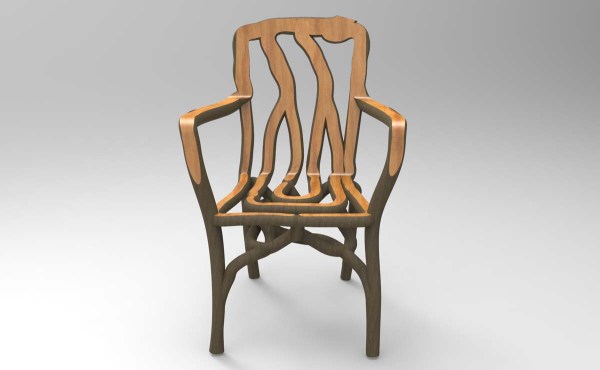
[Gavin Munro] is turning the standard paradigm of furniture making on its head. Instead of harvesting trees and slicing them up into boards – or worse, turning them into sawdust to be used for particle board – [Gavin] is literally growing furniture.

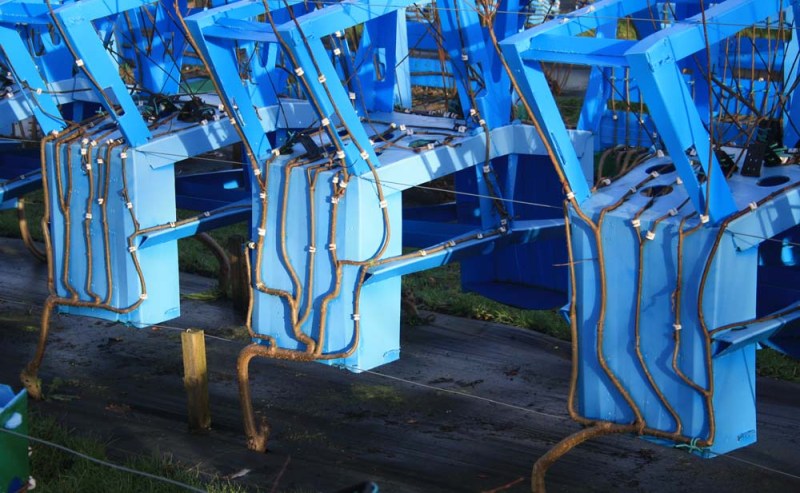
Supple young willow saplings are pruned and trained using wire and plastic form work. The trees are encouraged to grow in the right directions to form legs, arms, seat and back, and eventually the individual pieces are grafted Fg_3_chairs_growingtogether to continue growing into one solid piece. When the chair is mature, the leaves are removed, the chair is cut free from the ground, and with a little seasoning and finishing, you’ve got a unique and functional chair. And what’s more, since it’s a solid piece of wood, there are no joints to loosen over time.


You’ve got to admire the dedication that goes into these chairs. The current crop is about nine years old and still a few years from harvest. There’s a lot to be learned from the organization of a project like this – planning a production line where the first finished pieces are a decade or more from the showroom is no mean feat. Looks like [Gavin] has thought that through as well, by starting a line of lamps that will be turning a profit sooner. The video after the break demonstrates not only [Gavin’s] chairs and lamps, but also features his first harvest of tables.

Continue reading “Why Build Furniture When You Can Grow It?”

Miniature Cannon Packs A Punch, Shows Off Manual Machining Skills

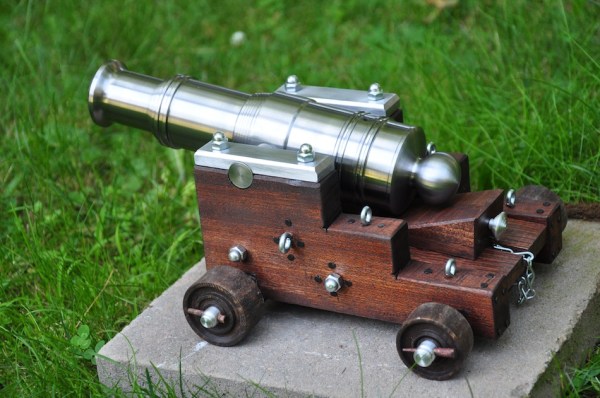
CNC machine tools are getting ever more affordable for the amateur machinist, and they’re an enabling technology for many projects. But you’ve got to respect the old school approach to turning hunks of metal into finished parts with no computer control. [Ticktock34] shows off his skills on a WWII vintage manual lathe with a photo album of his .75 caliber miniature black powder cannon build. What starts as a 3″ diameter actuator from a front end loader ends up as a beautiful replica of a full-sized cannon, along with a half-filled barrel of nicely blued scrap metal. Particularly impressive is the nicely proportioned ball end, cut by hand with no more instrumentation than a set of calipers. [Ticktock34] also shares a few tips for getting the trunnions exactly squared and aligned.

Good looking, and functional – stay tuned after the break for a video with the impressive blast from a test firing – with only a quarter charge of powder, mind you.

Want something a little safer for the kiddies and less likely to result in a visit from the police? Perhaps this PVC pirate cannon is more your speed.

Continue reading “Miniature Cannon Packs A Punch, Shows Off Manual Machining Skills”