Lighting The Great Indoors With A Solar Security Light

Look at any list of things to do to make your house less attractive to the criminal element and you’ll likely find “add motion sensing lights” among the pro tips. But what if you don’t want to light up the night? What if you want to use a motion sensor to provide a little light for navigating inside a dark garage? And what if the fixture you’ve chosen is a solar fixture that won’t quite cooperate? If you’re like [r1ckatkinson], you do a teardown and hack the fixture to do your bidding.

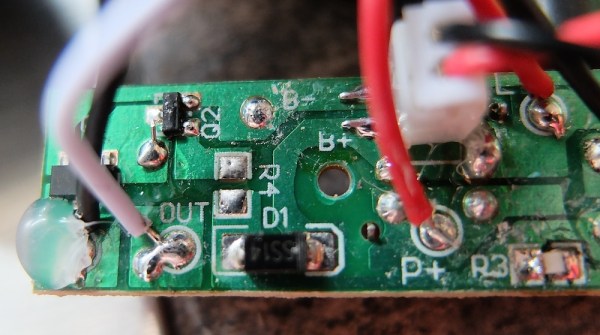
[r1ckatkinson]’s fixture was an inexpensive Maplin solar unit with PIR motion sensing, with the solar panel able to be mounted remotely. This was perfect for the application, since the panel could go outside to power the unit, with the lamp and PIR sensor inside. Unfortunately, the solar cell is also the photosensor that tells the unit not to turn on during the day. Armed with scratch pad and pencil, [r1ckatkinson] traced the circuit and located the offending part – a pull-down resistor. A simple resistor-ectomy later and he’s got a solar-powered light working just the way he likes it.

A simple hack, but effective. Seeing off-the-shelf gear modified is always a treat. Of course there’s something to be said for the more home-brew approach to security lighting, too.

Send In The Drones: Putting Wheels And Wings On The Internet Of Things

Imagine you’re a farmer trying to grow a crop under drought conditions. Up-to-the-minute data on soil moisture can help you to decide where and when to irrigate, which directly affects your crop yield and your bottom line. More sensors would mean more data and a better spatial picture of conditions, but the cost of wired soil sensors would be crippling. Wireless sensors that tap into GSM or some sort of mesh network would be better, but each sensor would still need power, and maintenance costs would quickly mount. But what if you could deploy a vast number of cheap RFID-linked sensors in your fields? And what if an autonomous vehicle could be tasked with the job of polling the sensors and reporting the data? That’s one scenario imagined in a recent scholarly paper about a mobile Internet of Things (PDF link).

both

In the paper, authors [Jennifer Wang], [Erik Schluntz], [Brian Otis], and [Travis Deyle] put a commercially available quadcopter and RC car to the hack. Both platforms were fitted with telemetry radios, GPS, and an off-the-shelf RFID tag reader and antenna. For their sensor array, they selected passive UHF RFID tags coupled to a number of different sensors, including a resistance sensor used to measure soil moisture. A ground-control system was developed that allowed both the quad and the car to maneuver to waypoints under GPS guidance to poll sensors and report back.

Beyond agriculture, the possibilities for an IoT based on cheap sensors and autonomous vehicles to poll them are limitless. The authors rightly point out the challenges of building out a commercial system based on these principles, but by starting with COTS components and striving to keep installed costs to a minimum, we think they’ve done a great proof of concept here.

Unusual Nixie Tubes Lead To Unique Clock

There’s no doubting the appeal of Nixie tubes. The play of the orange plasma around the cathodes through the mesh anode and onto the glass envelope can be enchanting, and the stacking of the symbols in the tube gives a depth to the display that is unlike any other technology. So when [Ian] found a set of six tubes on eBay at a fire sale price, he couldn’t resist picking them up and incorporating them into a unique but difficult to read Nixie clock.

It turns out the set of tubes [Ian] ordered were more likely destined for a test instrument than a clock, displaying symbols such a “Hz”, “V” and “Ω”. Initially disappointed with his seemingly useless purchase, [Ian] put his buyer’s remorse aside and built his clock anyway. Laser-cut acrylic, blue LEDs under the tube for a glow effect, a battery-backed RTC talking to an ATmega328, and the appropriate high-voltage section lead to a good-looking and functional clock, even if [Ian] himself needs a cross-reference chart to read the time. You’ll be able to figure out at the whole character set after watching the video after the break; spoiler alert: sensibly enough, Ω maps to 0.

We’ve seen lots of Nixie projects before, but few as unique as [Ian]’s clock.

Continue reading “Unusual Nixie Tubes Lead To Unique Clock”

Safe Cracking With Signal Analysis

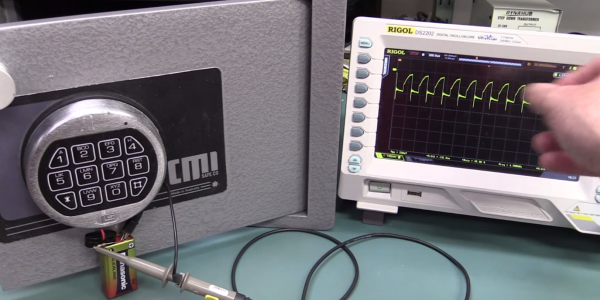
[Dave Jones] over at EEVblog got his hands on a small safe with an electronic lock and decided to try his hand at safe cracking. But rather than breaking out the thermal drill or shaped charge, he hooked up his Rigol scope and attempted a safe cracking via signal analysis (YouTube link).

We have to say that safes Down Under seem much stouter than most of the inexpensive lock boxes we’ve seen in the US, at least in terms of the quality (and quantity) of the steel in the body of the safe. Even though [Dave] was looking for a way in through the electronics, he still needed to deal with all that steel to get himself out of a face-palm moment that resulted in a lockout. Once that was out of the way, he proceeded to capture usable signals from the internal microcontroller using the only two available contacts – the 9 volt battery connections. While he did get signals, he couldn’t find any signatures that would help determine the six digits in the PIN, and as he points out, even if he did, brute-forcing through the one million permutations to find the right code would take too long, given the wrong-code lockout feature of the lock.

Even though he failed to hack into this particular safe, there’s still plenty to be learned from his methods. And who’s to say that other similar locks aren’t a little more chatty about their internals? Maybe you could even manage to EMP your way past the lock.

Wired Hive Counts Bees, Keeps Them Cozy

The world has a bee problem. Honey bees are a major pollinator for all sorts of tasty crops, but an estimated one-third of all colonies in the US have vanished since 2006. These mass disappearances are collectively known as Colony Collapse Disorder, and everything from pesticides to global warming to a new bee virus has been blamed for bees going MIA. Regardless of the cause, keeping the bees that do remain alive and pollinating is important work, and an intelligent bee hive could go a long way toward that goal.

Normally, bee hives are a black – err, white –  box, where the bees go about their business without revealing much about it. While bees are amazing animals with an incredibly rich social structure that allows them to, for instance, team together to ventilate a too-warm hive with their wings, or gang up on invading predators, they have their limits, and knowing what’s going on in the hive helps the beekeeper to maintain an optimal environment. [Miguel’s] system, which appears to still be in the prototyping phase, aims to provide the beekeeper with data on temperature and humidity within each hive. GPS tagging allows the beekeeper to track where a hive is, which is important since hives are moved around as various crops begin to flower. The system can even keep track of the comings and goings of bees using photoelectric sensors; while [Miguel] doesn’t go into detail, we imagine that aspect working something like this bee counter we featured a few years back. And being from Portugal, [Miguel] has incorporated cork into the design of the hive, a sustainable material available locally and offering great thermal properties.

Sounds like [Miguel] is onto something here. The bees need all the help they can get, and anything that improves their husbandry will go a long way toward keeping the world fed. We’ll be watching to see where [Miguel] takes this system.

Natural Materials For Nature’s Call

When it comes to picking out high-end fixtures and appointments for your bathroom remodel, there are tons of choices out there these days. Sure, that double-slipper tub or  $2500 stainless steel toilet can make a statement, and even the local Big Box Home Store has some pretty unique stuff. But for a one of a kind sink, follow [The Samurai Carpenter]’s lead and carve a sink out of a boulder.

Capture2Starting with a stone he found off the porch of his house, [Samurai Carpenter] was able to rough out the shape of the basin with a diamond-bladed cutoff saw. A few plunge cuts within a hand-sketched outline gave him the room needed to hog out most of the material with a cold chisel and hammer. A diamond wheel on an angle grinder, along with a chisel bit on an impact drill, got him down to the final smooth finish. After the break there’s a video showing the final installation, including drilling out the drain hole and mounting the sink to the vanity, which is a beautiful rough-cut slab of what appears to be locally sourced wood. The whole installation looks fantastic and appears to function well; our only quibble is there’s no overflow in the basin, but it’s hard to see how he could have provided one without significantly complicating the project and potentially ruining the aesthetic.

Although they may not fit in with the natural vibe of his remodel, either this or this tricked out mirror could complete a high-end  bathroom remodel.

Continue reading “Natural Materials For Nature’s Call”

CD Execution Chamber Sends Old Discs Off With A Bang

Welded steel safety cage? Check! Polycarbonate blast shield? Check! Vacuum cleaner motor wired to an inviting red button? Double check! Stack of CDs to dispose of as destructively as possible? [Firas Sirriyeh] has got you covered with his CD Terminator 1.0.

While [Firas’s] build log is a little short on descriptive text, there’s really no need for it. His pictures tell the tale. The combination media shredder and interactive performance art piece is a stoutly constructed affair, which you’d want anything capable of flinging razor-sharp plastic and Mylar shrapnel to be. [Firas] has displayed his CD execution chamber at the Jerusalem Mini Maker Fair 2015 (in Hebrew; English link) and the Musara Mix Festival where the must-see video after the break was shot (mildly NSFW language). Some CDs give up the ghost very quickly, but one held out for a remarkable long time before finally exploding; you can see it flexing and warping in a way that almost appears to be slow-motion.

For those who’d rather not fuss with all that bothersome safety, there’s always this automatic CD launcher to play with.

Continue reading “CD Execution Chamber Sends Old Discs Off With A Bang”