Traditional Analogue And An FPGA Make This Junkbox HF Receiver A Bit Special

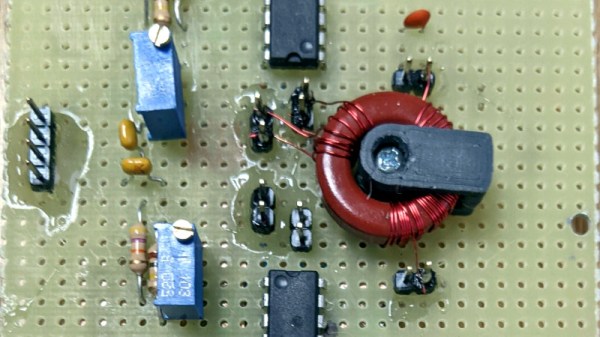
We will have all at some point seen a fascinating project online, only to find not enough information to really appreciate and understand it. Such a project came [Bill Meara]’s way over at the SolderSmoke podcast, and he was fortunately able to glean more from its creator. What [Tom] had made from junkbox parts was a fairly traditional analogue receiver for the 20m amateur band which would be quite an achievement in itself, but what makes it special is its use of an FPGA to augment the analogue tuning.

A traditional analogue radio has a local oscillator which is mixed with the signal from the antenna, and an intermediate frequency of the difference between oscillator and desired signal is filtered from the result and amplified. The oscillator on older receivers would have used a free running tuned circuit, while a newer device might use a phase-locked loop to derive a stable frequency from a crystal.

What [Tom]’s receiver does is take a free-running traditional receiver and use the FPGA as a helper. It has a frequency meter that drives the display, but it also uses the measured figure to adjust the oscillator and keep it on frequency. It has two modes; while tuning it’s a traditional analogue receiver, but when left alone the FPGA stops it drifting. We like it, it’s definitely a special project.

We’ve featured a lot of radio receivers over the years, and this certainly isn’t the only one that’s a bit unconventional.

A 3D-Printed Block And Tackle For Those Annoying Lifts

Perhaps the humble block and tackle — multiple parallel pulleys to reduce the effort of lifting — is not such a common sight as it once was in this age of hydraulic loaders, but it remains a useful mechanism for whenever there is a lifting task. To that end [semi] has produced a 3D-printed block and tackle system, which as can be seen in the video below the break, makes lifting moderately heavy loads a breeze.

It’s a simple enough mechanism, with the 3D printer supplying pulleys, chocks, and attachment points, and steel bolts holding everything together. It’s demonstrated with a maximum weight of 20 kilograms (44 pounds), and though perhaps some hesitation might be in order before trusting it with 200 Kg of engine, we’re guessing it would be capable of much more that what we’re shown. Should you wish to give it a try, the files can be found on Thingiverse.

The block and tackle should hold a special place in the hearts of engineers everywhere, as the first product manufactured using mass-production techniques. It shouldn’t be a surprise that this early-19th century factory came from the work of Marc Brunel, father of Isambard Kingdom Brunel who we’ve made the subject of a previous Hackaday piece.

Continue reading “A 3D-Printed Block And Tackle For Those Annoying Lifts”

Take Note: An E-Paper Tablet From Pine64

Over the years we’ve seen a variety of interesting pieces of hardware emerging from the folks at Pine64, so it’s always worth a second look when they announce a new product. This time it’s the PineNote, a tablet that packs the same Rockchip RK3566 as used in the company’s Quartz64 single board computers behind a 10.1″ 1404 x 1872 16-tone greyscale e-paper screen.

Fitted with 4 GB of LPDDR4 RAM and 128 GB eMMC flash storage, it will feature the same Linux support as previous Pine64 products, with the slight snag of the display driver not yet being complete for 5.xx kernels. They are thus at pains to point out that this is not a ready-to-go consumer device and that early adopters will be expected to write code rather than notes on it.

That last sentence sums up Pine64’s offering perfectly, they produce interesting hardware with open-source support, but sometimes the path from hardware release to stable and usable product can be a rocky one. If you’re interested in hardcore hacking of an e-paper tablet, then you may want to be an early adopter. Otherwise, hang back for a while and buy one once some of the bugs have been ironed out. Meanwhile you can see the whole update in the video below; it has a few other things including a nifty keyboard for the PinePhone.

We’ve mentioned Pine64 a few times over the years, it’s worth noting that their products also lie outside the realm of Linux boxen.

Continue reading “Take Note: An E-Paper Tablet From Pine64”

The Zeloof Z2 Intergrated Circuit Has 100 Transistors

Back in 2018 we reported on the first silicon integrated circuit to be produced in a homemade chip fab. It was the work of [Sam Zeloof], and his Z1 chip was a modest six-transistor amplifier. Not one to rest on his laurels, he’s back with another chip, this time the Z2 is a hundred-transistor array. The Z2 occupies about a quarter of the area of the previous chip and uses a 10µm polysilicon gate process as opposed to the Z1’s metal gates. It won’t solve the global chip shortage, but this is a major step forward for anyone interested in building their own semiconductors.

The transistors themselves are FETs, and [Sam] is pleased with their consistency and characteristics. He’s not measured his yield on all samples, but of the twelve chips made he says he has one fully functional chip and a few others with at least 80% functionality. The surprise is that his process is less complex than one might expect, which he attributes to careful selection of a wafer pre-treated with the appropriate oxide layer.

You can see more about the Z2 in the video below the break. Meanwhile, should you wish to learn more about the Z1 you can see [Sam’s] Hackaday Superconference talk on the subject. We’re looking forward to the Z3 when it eventually arrives, with bated breath!

Continue reading “The Zeloof Z2 Intergrated Circuit Has 100 Transistors”

Review: Mini AMG8833 Thermal Camera

In our ceaseless quest to bring you the best from the cheaper end of the global electronics markets, there are sometimes gadgets that we keep an eye on for a while because when they appear they’re just a little bit too pricey to consider cheap.

Today’s subject is just such a device, it’s a minimalist infra-red camera using the 8 pixel by 8 pixel Panasonic AMG8833 thermal sensor. This part has been around for a while, but even though any camera using it has orders of magnitude less performance than more accomplished models it has remained a little too expensive for a casual purchase. Indeed, these mini cameras were somewhere above £50 ($70) when they first came to our attention, but have now dropped to the point at which they can be found for somewhere over £30 ($42). Thirty quid is cheap enough for a punt on a thermal camera, so off went the order to China and the expected grey parcel duly arrived.

The interface on this camera is about as simple as it gets.

It’s a little unit, 40 mm x 35 mm x 18 mm, constructed of two laser-cut pieces of black plastic held together by brass stand-offs that hold a PCB between them, and on the front is a cut-out for the sensor while on the rear is one for the 35mm OLED display.At the side on the PCB is a micro USB socket which serves only as a power supply. It’s fair to say that this is a tiny unit.

Applying power from a USB battery bank, the screen comes up with a square colour thermal picture and a colour to temperature calibration stripe to its left. The colours adapt to the range of temperatures visible to the sensor, and there is a crosshair in the centre of the picture for which the temperature in Celsius is displayed below the picture. It’s a very straightforward and intuitive interface that requires no instruction, which is handy because the device has none. Continue reading “Review: Mini AMG8833 Thermal Camera”

Should You Be Able To Repair It? We Think So.

You own it, you should be able to fix it. So much equipment on sale today has either been designed to be impossible to maintain, unnecessarily too complex to maintain, maintainable only with specialist tooling only available to authorised service agents, or with no repair parts availability. It’s a hot-button issue in an age when sustainability is a global concern, so legislators and regulators worldwide now finally have it in their sights after years of inaction and it’s become a buzzword. But what exactly is the right to repair, and what do we want it to be?

Is It Designed For Repair?

A Nestle Dolce Gusto machine
For some reason, pod coffee makers are especially resistant to repair. Andy1982, CC BY 3.0

The first question to consider is this: does it matter whether or not you have the right to repair something, if it’s designed specifically with lack of repairability in mind? Consider a typical domestic pod coffeemaker such as a Tassimo or similar: despite being physically quite a simple device, it is designed to be especially complex to dismantle and reassemble. You just can’t get into it when something goes wrong.

Should it be the preserve of regulators to require design for easy repair? We think so. There are other forces working on the designers of home appliances; design-for-manufacture considerations and exterior appearance concerns directly affect the firm’s bottom line, while the end users’ repair experience is often at the bottom of the list, even though the benefit at a national level is obvious. That’s what laws are for.
Continue reading “Should You Be Able To Repair It? We Think So.”

So You Can Solder Small SMD Devices. The Question Is, Just How Small?

A highlight of last year’s Hackaday Remoticon was a soldering competition that had teams from around the world came together online and did the well-known MakersBox SMD Challenge kit in which a series of LED circuits of decreasing size must be soldered. The Hackaday crew acquitted themselves well, and though an 01005 resistor and LED certainly pushes a writer’s soldering skills to the limit it’s very satisfying to see it working. Lest that kit become too easy, [Arthur Benemann] has come up with something even more fiendish; his uSMD is a 555 LED flasher that uses a BGA 555 and a selection of 008004 small components.

The trick with an 01005 is to heat not the tinned and fluxed solder joint, but the trace leading up to it. If components of that size can be mastered then perhaps an 008004 isn’t that much smaller so maybe the same technique might work for them too. In his tip email to us he wrote “Soldering 008004 isn’t much worse than a 0201, you just need magnification“, and while we think he might be trolling us slightly we can see there’s no reason why it shouldn’t be do-able. Sadly he doesn’t seem to have made it available for us to buy and try so if you want to prove yourself with a soldering iron you’ll have to source the PCBs and parts yourself. Still, we suspect that if you are the type of person who can solder an 008004 then that will hardly be an onerous task for you.

Meanwhile this isn’t the first soldering challenge kit we’ve brought you, and of course if you’d like to hone your skills you can find the MakersBox one on Tindie.