Could Reticulum Power A Post-Internet Network?

These days, it is easy to think you always have access to the Internet. But some wonder if — in spite of its ARPANET, nuclear-war-planning heritage — you can actually count on it to be there when things go pear-shaped. [The Tech Prepper], as you might imagine, is quite concerned with that last question, and is flogging Reticulum over high-frequency radio as a post-internet network in a video embedded below.

Reticulum is a cryptographic network stack, fully decentralized and amazing from a cyberpunk/hacker/survivalist perspective. Unfortunately for [The Tech Prepper], until the you-know-what hits the ventilation unit and the FCC and its counterparts in other countries are too busy to be concerned with such trifles, encrypted signals are banned on ham radio bands just about everywhere. That’s why his demo is using a dummy load on the Mercury HF modem instead of an antenna: the feds don’t care if the signal doesn’t leave the building. The video shows how to replicate the setup using his EmComm Tools suite on Ubuntu.

Perhaps more interesting is his vision of a Post-Internet network, be it in a disaster scenario, as he envisions, or simply because we get sick of what the internet has become. The idea of easily hooking an open-source radio modem to a PC running modem73, open-source SDR software, has a certain appeal. Reticulum isn’t your only option there: modem73 will let you run a BBS in the clear — that is, unencrypted and legal to transmit — and let’s face it, wasn’t life online more fun in BBS days?

This isn’t the first time we’ve seen the Reticulum network stack, but last time it was operating at considerably shorter ranges over LoRA. 

Continue reading “Could Reticulum Power A Post-Internet Network?”

Mylar Space Blankets As RF Reflectors

Metalized Mylar “space blankets” are sold as a survivalist’s accessory, primarily due to their propensity for reflecting heat. They’re pretty cheap, and [HamJazz] has performed some experiments on their RF properties. Do they reflect radio waves as well as they reflect heat? As it turns out, yes they do.

Any antenna system that’s more than a simple radiator relies on using conductive components as reflectors. These can either be antenna elements, or the surrounding ground acting as an approximation to a conductor. Radio amateurs will often use wires laid on the ground or buried within it to improve its RF conductivity, and it’s in this function that he’s using the Mylar sheet. Connection to the metalized layer is made with a magnet and some aluminium tape, and the sheet is strung up from a line at an angle. It’s a solution for higher frequencies only due to the restricted size of the thing, but it’s certainly interesting enough to merit further experimentation.

As you can see in the video below, his results are derived in a rough and ready manner with a field strength meter. But they certainly show a much stronger field on one side resulting from the Mylar, and also in an antenna that tunes well. We would be interested to conduct a received signal strength test over a much greater distance rather than a high-level field strength test so close to the antenna, but it’s interesting to have a use for a space blanket that’s more than just keeping the sun away from your tent at a hacker camp. Perhaps it could even form a parabolic antenna.

Continue reading “Mylar Space Blankets As RF Reflectors”

A Ten Band SDR Transceiver For Homebrewers

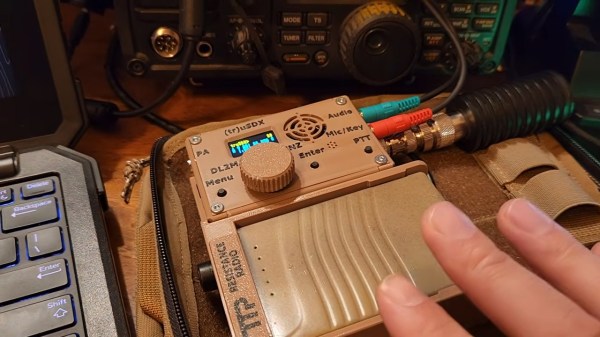
Making a multi-band amateur radio transceiver has always been a somewhat challenging project, and making one that also supported different modes would for many years have been of almost impossible complexity best reserved for expensive commercial projects. [Bob W7PUA] has tackled both in the form of a portable 10-band multi-mode unit, and we can honestly say he’s done a very good job indeed.

As you might expect in 2025 it’s a software defined radio (SDR), but to show how powerful the silicon available today is, it’s all implemented on a microcontroller. There’s a Teensy 4 with an audio codec board that does all the signal processing heavy lifting, and an RF board that takes care of the I/Q mixing and the analogue stuff.

Band switching is handled using a technique from the past; interchangeable plug-in coil and filter units, that do an effective job. The result is a modestly-powered but extremely portable rig that doesn’t look to have broken the bank, and since the write-up goes into detail on the software side we hope it might inform other SDR projects too. We might have gone for old-school embossed Dymo labels on that brushed aluminium case just for retro appeal, but we can’t fault it.

It’s not the first time we’ve looked at a small multi-band SDR here, but we think this one ups the game somewhat.

Thanks [Pete] for the tip!

A New Chinese Radio Breaks Cover, Is It Worth It?

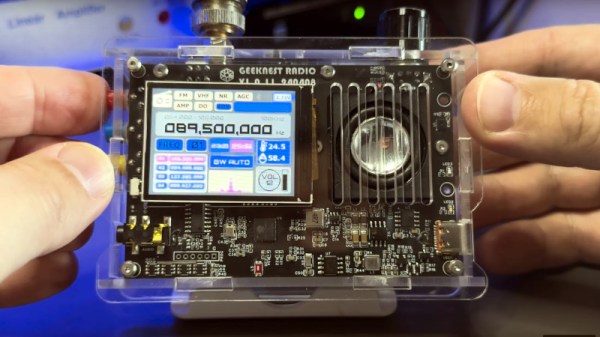
Scanning the firehose of new electronic kits and modules coming from the usual Chinese suppliers can be a rewarding experience, as sometimes among the endless breakout boards comes an item that looks interesting enough to try. As an example there’s a receiver kit being given a quick review by [Tech Minds], offering AM and HF multi-mode, FM broadcast, and air band alongside what appear to be digital streaming features.

Looking at it, though all the RF part is hidden under screening cans we’re guessing it might contain one of the Silicon Labs all-in-one receiver chips, but the whole appears to deliver a useful receiver with a comprehensive interface. The review isn’t quite technical enough so we can’t glean a lot more, but it looks as though it could be useful. We’d be tempted to snag one for review, but since with very few exceptions we pay for the stuff we review, it’s a mite expensive at $50+ for yet another radio.

There’s an ongoing question with all these cheap kits and modules though, first of all where did the design come from and are we freeloading on someone else’s hard work, but then whether or not what you’re getting is a knock-off using defective semiconductors or with bean-counting parts removal degrading performance. We’re guessing more will come out about this radio in due course, and we can all make our own judgement. Meanwhile this one can be found on AliExpress or Banggood, so take a look and see if you’re tempted.

Continue reading “A New Chinese Radio Breaks Cover, Is It Worth It?”

Going Ham Mobile On A Bicycle

It’s said that “Golf is a good walk spoiled,” so is attaching an amateur radio to a bike a formula for spoiling a nice ride?

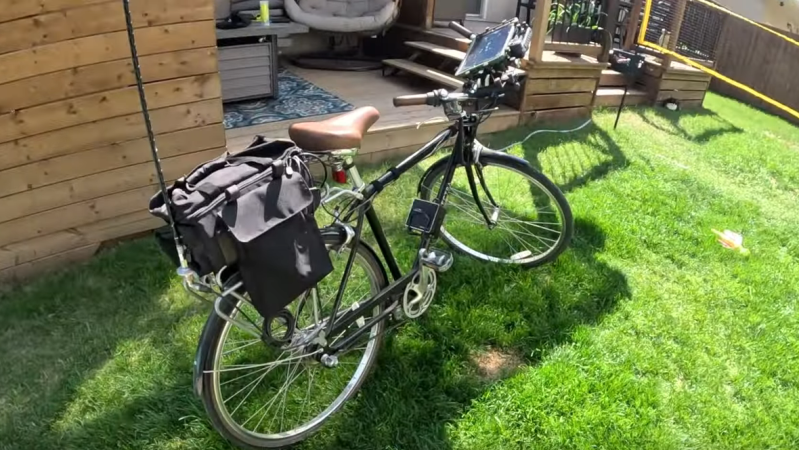
Not according to [Wesley Pidhaychuk (VA5MUD)], a Canadian ham who tricked out his bike with a transceiver and all the accessories needed to work the HF bands while peddling along. The radio is a Yaesu FT-891, a workhorse mobile rig covering everything from the 160-meter band to 6 meters. [Wes] used some specialized brackets to mount the radio’s remote control head to the handlebars, along with an iPad for logging and a phone holder for streaming. The radio plus a LiFePO4 battery live in a bag on the parcel rack in back. The antenna is a Ham Stick mounted to a mirror bracket attached to the parcel rack; we’d have thought the relatively small bike frame would make a poor counterpoise for the antenna, but it seems to work fine — well enough for [Wes] to work some pretty long contacts while pedaling around Saskatoon, including hams in California and Iowa.

The prize contact, though, was with [WA7FLY], another mobile operator whose ride is even more unique: a 737 flying over Yuma, Arizona. We always knew commercial jets have HF rigs, but it never occurred to us that a pilot who’s also a ham might while away the autopilot hours working the bands from 30,000 feet. It makes sense, though; after all, if truckers do it, why not pilots?

Continue reading “Going Ham Mobile On A Bicycle”

Automatic Position Reporting Over HF Radio

While most of us carry cell phones that have GPS and other location services, they require a significant amount of infrastructure to be useful. Drive from Washington to Alaska like [Lonney] did a while back, where that infrastructure is essentially nonexistent, and you’ll need to come up with some other solutions to let friends and family know where you are.

A tool called the Automatic Packet Reporting System (APRS) is fairly robust in the very high frequency (VHF) part of the amateur radio spectrum, but this solution still relies on a not-insignificant amount of infrastructure for the limited distances involved with VHF. [Lonney] adapted a few other tools to get APRS up and running in the HF range, letting his friends keep tabs on him even from the most remote locations.

Continue reading “Automatic Position Reporting Over HF Radio”

Open HT Surgery Gives Cheap Transceiver All-Band Capabilities

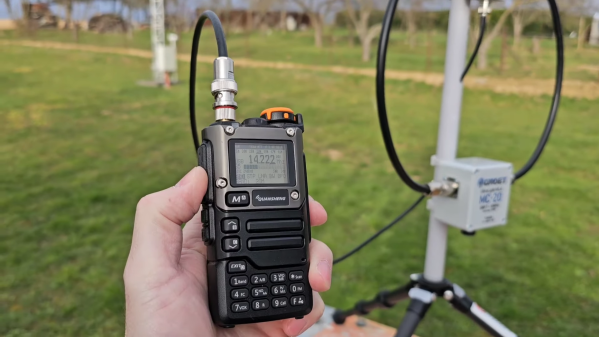
Watch out, Baofeng; there’s a new kid on the cheap handy talkie market, and judging by this hardware and firmware upgrade to the Quansheng UV-K5, the radio’s hackability is going to keep amateur radio operators busy for quite a while.

Like the ubiquitous Baofeng line of cheap transceivers, the Quansheng UV-K5 is designed to be a dual-band portable for hams to use on the 2-meter VHF and 70-centimeter UHF bands. While certainly a useful capability, these bands are usually quite range-limited, and generally require fixed repeaters to cover a decent geographic area. For long-range comms you want to be on the high-frequency (HF) bands, and you want modulations other than the FM-only offered by most of the cheap HT radios.

Luckily, there’s a fix for both problems, as [Paul (OM0ET)] outlines in the video below. It’s a two-step process that starts with installing a hardware kit to replace the radio’s stock receiver chip with the much more capable Si4732. The kit includes the chip mounted on a small PCB, a new RF choke, and a bunch of nearly invisible capacitors. The mods are straightforward but would certainly benefit from the help of a microscope, and perhaps a little hot air rework. Once the hardware is installed and the new firmware flashed, you have an HT that can receive signals down to the 20-meter band, with AM and SSB modulations, and a completely redesigned display with all kinds of goodies.

It’s important to note that this is a receive-only modification — you won’t be transmitting on the HF bands with this thing. However, it appears that the firmware allows you to switch back and forth between HF receive and VHF/UHF transceive, so the radio’s stock functionality is still there if you need it. But at $30 for the radio and $12 for the kit, who cares? Having a portable HF receiver could be pretty handy in some situations. This looks like yet another fun hack for this radio; we’ve seen a few recently, including a firmware-only band expansion and even a Trojan that adds a waterfall display and a game of Pong. Continue reading “Open HT Surgery Gives Cheap Transceiver All-Band Capabilities”