The Hackers And The Hurricane

When natural disasters strike, particularly if they are in some of the less remote parts of the world, we see them unfolding in real-time on our television screens. They become a 24-hour rolling news exercise in disaster titillation, each fresh horror ghoulishly picked over by breathless reporters live-telecasting from windswept streets, and endlessly rehashed by a succession of in-studio expert guests.

Then once the required image of a dusty child being pulled from the rubble or a tearful mother describing her daughter being swept away is in the can, a politician somewhere is found in bed with a model or a tinpot dictator rattles his sabre, and the world moves on. The BAFTA or the Emmy is a certainty for this one, did you see the anguish!

Meanwhile on the ground, the situation remains the same. There is no power, no sanitation, no communications, no food, and help seems very far away. In the wake of the recent hurricane season across the Caribbean, there are millions of people whose worlds have been wrecked, and several international governments have faced significant criticism for their lethargic response.

In our world of hardware hackers and makers, we are on the whole practical people. We exist to make, and do, rather than to endlessly talk. Seeing the plight of the victims of Irma, Jose, or Maria leaves us wanting to do practical things to help, because that’s what we do. But of course, we can do nothing, because we’re thousands of miles away and probably lack whatever skills or training are in demand on the islands.

It’s heartening then to hear of just a few moments when our wider community has managed to be in the right place at the right time to offer some help. We’ve had a couple in our tips line lately we’d like to share.

[Csp3r] writes about the Derbycon conference held in Louisville, at which [Carlos Perez] and [Jose Quinones Borreros], information security specialists from Puerto Rico, were in attendance. They mentioned a need for emergency radios, and the community at the conference came together to raise money for much more than just a few radios. $15,000 was raised in all, spent on radios, solar chargers, generators, flashlights, USB battery packs, and tools. This amounted to a significant bulk, so Hackers For Charity helped secure some space on an aid flight to the island.

Then [Bruce Perens, K6BP] writes about a request from the American Red Cross to the ARRL for 50 radio amateurs to help with their relief efforts in Puerto Rico. They will perform the role you might expect of enabling essential communications, as well as to quote the ARRL: “help record, enter, and submit disaster-survivor information into the ARC Safe and Well system”. This is a request unprecedented in its scale, and reflects the level of damage across the island.

For most of us, the best we can do when helping out with these events will be to drop coins into an OXFAM or Red Cross collecting tin and leave it to the experts. But as we’ve noted above, for just a few of us the opportunity to do something a bit more useful presents itself. If you find yourself in that position, make it count!

We’ve looked at the role of amateur radio in public service before, and we’ve even featured it in one or two projects. This emergency box for example has all you’d need to provide this type of service.

Cyclone Catarina image from the ISS, [Public domain].

Part Soldering Iron, Part Hand-Held Oscilloscope

If you are in the market for a temperature controlled soldering iron, an attractive choice of the moment is the TS-100 iron available by mail-order from China. This is an all-in-one iron with a digital temperature controller built into its handle, featuring a tiny OLED display. It’s lightweight, reasonable quality, and all its design and software are available and billed as open source (Though when we reviewed it we couldn’t find an open source licence accompanying the code.) This combination has resulted in it becoming a popular choice, and quite a few software hacks have appeared for it.

The latest one to come our way is probably best described as coming from the interface between genius and insanity without meaning to disparage the  impressive achievement of its author. [Befinitiv] has implemented a working oscilloscope on a TS-100, that uses the soldering iron tip as a probe and the OLED as a display. It requires a small modification to the hardware to bring the iron contact into an ADC pin on the microcontroller, and there is currently no input protection on it so the iron could easily be fried, but it works.

It is strongly suggested in the write-up that this isn’t a production-ready piece of work and that you shouldn’t put it on your iron. At least, not without that input protection and maybe a resistive divider. But for all that it’s still an impressive piece of work, a working soldering iron that becomes a ‘scope on a menu selection. Take a look at the ‘scope-iron in action, we’ve posted a video below the break.

Continue reading “Part Soldering Iron, Part Hand-Held Oscilloscope”

Retrotechtacular: An Oceanographic Data Station Buoy For The 1960s

When we watch a TV weather report such as the ones that plaster our screens during hurricane season, it is easy to forget the scale of the achievement they represent in terms of data collection and interpretation. Huge amounts of data from a diverse array of sources feed weather models running on some of our most powerful computers, and though they don’t always forecast with complete accuracy we have become used to their getting it right often enough to be trustworthy.

It is also easy to forget that such advanced technology and the vast array of data behind it are relatively recent developments. In the middle of the twentieth century the bulk of meteorological data came from hand-recorded human observations, and meteorologists were dispatched to far-flung corners of the globe to record them. There were still significant areas of meteorological science that were closed books, and through the 1957 International Geophysical Year there was a concerted worldwide effort to close that gap.

We take for granted that many environmental readings are now taken automatically, and indeed most of us could produce an automated suite of meteorological instruments relatively easily using a microcontroller and a few sensors. In the International Geophysical Year era though this technology was still very much in its infancy, and the film below the break details the development through the early 1960s of one of the first automated remote ocean sensor buoys.

Perhaps our last sentence conjures up a vision of something small enough to hold, from all those National Geographic images of intrepid oilskin-clad scientists launching them from the decks of research vessels. But the technology of the early 1960s required something a little more substantial, so the buoy in question is a (using the units of the day) 100 ton circular platform more in the scale of a medium-sized boat. Above deck it was dominated by an HF (shortwave) discone antenna and its atmospheric instrument package. Below deck (aside from its electronic payload) it had a propane-powered internal combustion engine and generator to periodically charge its batteries. In use it would be anchored to the sea floor, and it was designed to operate even in the roughest of maritime conditions.

The film introduces the project, then looks at the design of a hull suitable for the extreme conditions like a hurricane. We see the first prototype being installed off the Florida coast in late 1964, and follow its progress through Hurricane Betsy in 1965. The mobile monitoring station in a converted passenger bus is shown in the heart of the foul weather, receiving constant telemetry from the buoy through 40 foot waves and 110 mph gusts of wind.

We are then shown the 1967 second prototype intended to be moored in the Pacific, this time equipped with a computerised data logging system. A DEC PDP-8 receives the data mounted in the bus, and are told that this buoy can store 24 hours at a stretch for transmission in one go. Top marks to the film production team for use of the word “data” in the plural.

Finally we’re told how a future network of the buoys for presumably the late 1960s and early 1970s could be served by a chain of receiving stations for near-complete coverage of the major oceans. At the height of the Cold War this aspect of the project would have been extremely important, as up-to-the-minute meteorological readings would have had considerable military value.

The film makes an engaging look at a technology few of us will ever come directly into contact with but the benefits of which we will all feel every time we see a TV weather forecast.

Continue reading “Retrotechtacular: An Oceanographic Data Station Buoy For The 1960s”

An Arduino Weather Station With An E-Ink Display

For our Northern Hemisphere readers the chill winds of winter are fast approaching, so it seems appropriate to feature a weather station project. Enjoy your summer, Southern readers!

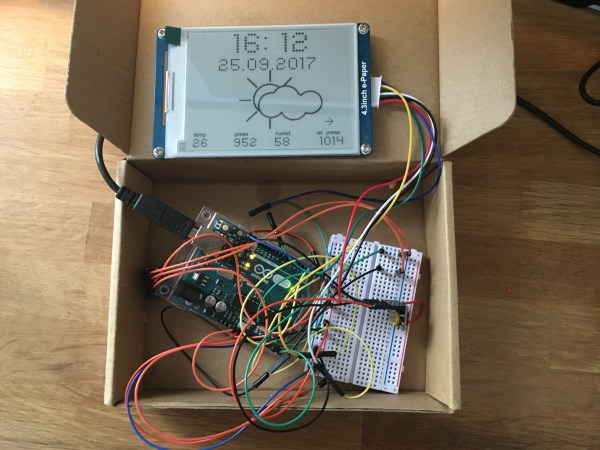
[Fandonov] has created a weather station project with an Arduino Uno at its heart and a Waveshare e-ink display as its face to the world, and as its write-up (PDF) describes, it provides an insight into both some of the quirks of these displays, and into weather forecasting algorithms.

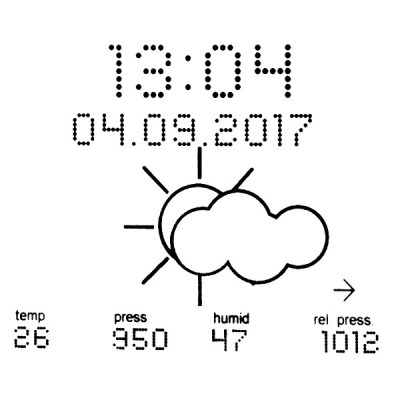
The hardware follows a straightforward formula, aside from Arduino and display it boasts an Adafruit sensor board and a hardware clock. Software-wise though there are some tricks to give the display a scalable font that other tinkerers might find useful, drawing characters as a matrix of filled circle primitives.

The write-up gives an introduction to forecasting based only on local readings rather than on the huge volumes of data over a wide area used by professional meteorologists. In play here is the Zambretti algorithm, which takes the readings and information about whether they are rising or falling, and returns a forecast from a look-up table.

As we’ll all be aware, even professional weather forecasting is fraught with inaccuracies, but this is nonetheless an interesting project that is very much worth a second look. Meanwhile we’ve covered huge numbers of weather stations in the past, a couple of interesting ones are this one using a classic TI99/4A home computer, and more relevant here, this one using an e-paper badge.

Thanks [Phil] for the tip!

A Robot That Can Still Keep Its Balance After A Night In The Pub

One of the star attractions at the recent bring-a-hack prior to our London unconference was [Dan]’s two-wheeled self-balancing robot. As the assorted masses of the Hackaday readership consumed much fine ale and oohed and ahhed over each others work, there it stood on a pub table, defying all attempts to topple it.

In a way a successful self-balancer can look surprisingly unexciting because it achieves the seemingly unimpressive task of just standing there and not doing much except trundling about, but to take such a superficial view belies the significant feat of engineering that gives the self-balancer its party trick. And it’s no mean achievement to create one from fairly basic hardware, so how has he done it?

The 3D-printed frame holds a pair of stepper motors to do the hard work, while a piece of stripboard acts as carrier for boards containing the MPU6050 accelerometer and DRV8825 stepper motor drivers. Meanwhile the brains of the whole show started as an Espruino Pico but has since been moved to an ESP32.

There is a linked GitHub repository with all the code, and if our description of seeing it in a London pub isn’t good enough for you then you can see it in action in the video below.

Continue reading “A Robot That Can Still Keep Its Balance After A Night In The Pub”

Where Can You Fly? Worldwide Drone Laws Mapped

If you are a flier of a multirotor, or drone, you should be painfully aware of the regulations surrounding them wherever you live, as well as the misinformation and sometime bizarre levels of hysteria from uninformed people over their use.

Should you travel with your drone, you will also probably be resigned to being interrogated by airport staff high on The War On Terror security theatre, and you’ll probably not find it surprising that they have little idea of the laws and regulations over which they have pulled you aside. It’s a confusing situation, and it’s one that [Anil Polat] has addressed by collating information about drone laws worldwide, and presenting his results on a Google map.

To do this must have been a huge undertaking, particularly since he got in touch with the appropriate authorities to access the information from the horse’s mouth. Looking at the map, we can almost view the green, yellow, and red pins showing different levels of restriction on flight as a fascinating indication of differing levels of security paranoia worldwide. If your territory has an orange or red pin, our commiseration.

This is a useful resource for anyone with an interest in multirotor flying, and he has also made it available as an app. However, it is always safest to check with the authorities concerned before flying in another territory, in case any laws have changed.

Here at Hackaday we’ve held an interest in the interface between multirotor fliers, governments, and the general public for a while now. In 2015 we took a look at FAA regulations for example, and last year we examined the inaccuracies in British air incident reports.

Via Adafruit.

Return To The Asus Tinker Board: Have Six Months Changed Anything?

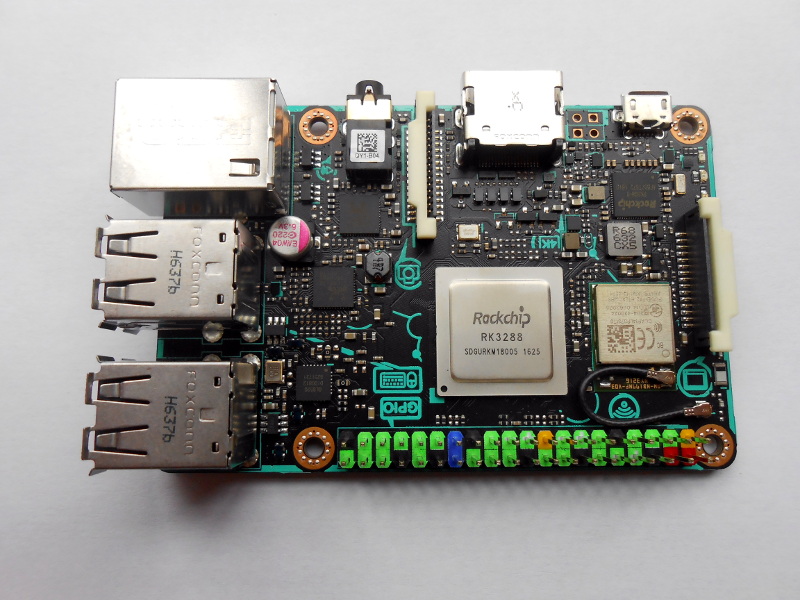
The Asus Tinker Board, in all its glory

Back in February this year, we ordered a new single board computer, and reviewed it. The board in question was the Asus Tinker Board, a Raspberry Pi 3 competitor from the electronics giant in a very well-executed clone of the Raspberry Pi form factor.

Our review found its hardware to be one of the best of that crop of boards we had yet seen, but found serious fault with the poor state of its software support at the time. There was no website, the distro had to be downloaded from an obscure Asus download site, and there was no user community or support channel to speak of. We were then contacted by some of the folks from Asus who explained that the board had not yet been officially launched, and that the unit we’d secured had escaped the fold a little early. Continue reading “Return To The Asus Tinker Board: Have Six Months Changed Anything?”