A Bold Experiment In A Decentralised Low Voltage Local DC Power Grid

January, for many of us in the Northern Hemisphere, can be a depressing month. It’s cold or wet depending where you live, the days are still a bit short, and the summer still seems an awfully long way away. You console yourself by booking a ticket to a hacker camp, but the seven months or so you’ll have to wait seems interminable.

If you want an interesting project to look forward to, take a look at [Benadski]’s idea for a decentralised low voltage local DC power grid for the upcoming SHA 2017 hacker camp in the Netherlands. The idea is to create a network that is both safe and open for hacking, allowing those with an interest in personal power generation to both have an available low-voltage power source and share their surplus power with other attendees.

The voltage is quoted as being 42V DC +/- 15%, which keeps it safely under the 50V limit set by the European Low Voltage Directive. Individuals can request a single 4A connection to the system, and villages can have a pair of 16A connections, which should supply enough for most needs. Users will need to provide their own inverters to connect their 5V or 12V appliances, fortunately a market served by numerous modules from your favourite Far Eastern sales portal.

This project will never be the solution to all power distribution needs, but to be fair that is probably not the intention. It does however provide a platform for experimentation, collaboration, and data gathering for those interested in the field, and since it is intended to make an appearance at future hacker camps there should be the opportunity for all that built up expertise to make it better over time.

We’ve touched on this subject before here at Hackaday, with our look at the availability of standard low voltage DC domestic connectors.

Wind turbine image: Glogger (CC BY-SA 3.0) via Wikimedia Commons.

New Caps And RAM Save Another Poly-1

1980s American teenagers, if they were lucky enough to attend a school with a computer lab, would have sat down in front of Apple IIs or maybe Commodore VIC20s. Similarly, their British cousins had BBC Micros. Solid and educational machines with all sorts of wholesome software, which of course the kids absolutely preferred to run in preference to playing computer games.

New Zealanders, at least a few of them, had the Poly-1. A footnote in the 8-bit microcomputer story, this was a home-grown computer with a built-in monitor clad in a futuristic one-piece plastic shell. Non-Kiwis never had the chance to encounter its 6809 processor and 64k of RAM, the global computer business being too great a challenge for a small New Zealand technology company, especially one whose government support had evaporated.

Decades after the end of Poly-1 production, some survive in the hands of enthusiasts. [Terry Stewart] has two of them, and has posted details of how he brought life back to one that was dead on arrival. It’s a story first of a failed electrolytic capacitor and tricky-to-dismantle PSU design, then of an almost-working computer whose random crashes were eventually traced to a faulty RAM chip. It seems swapping out that quantity of DIL RAM chips is rather tedious, and of course it had to be the final chip in the final bank that exhibited the problem.

Meanwhile it’s interesting to see the design of this unusual machine. A linear power supply contrasts with the switcher you’d have found in an Apple II at the time, and the motherboard is a huge affair. it’s easy to see why this was a relatively expensive machine.

We brought you [Terry]’s first Poly-1 last year, but so far he’s the only owner whose machine we’ve seen. More mainstream 8-bit machines are a common sight here, so for something else a bit esoteric read our coverage of home computers behind the Iron Curtain, and its companion piece on peripherals behind the Iron Curtain.

[via Hacker News]

Understanding The Quartz Crystal Resonator

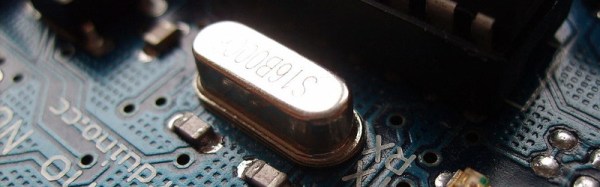
Accurate timing is one of the most basic requirements for so much of the technology we take for granted, yet how many of us pause to consider the component that enables us to have it? The quartz crystal is our go-to standard when we need an affordable, known, and stable clock frequency for our microprocessors and other digital circuits. Perhaps it’s time we took a closer look at it.

The first electronic oscillators at radio frequencies relied on the electrical properties of tuned circuits featuring inductors and capacitors to keep them on-frequency. Tuned circuits are cheap and easy to produce, however their frequency stability is extremely affected by external factors such as temperature and vibration. Thus an RF oscillator using a tuned circuit can drift by many kHz over the period of its operation, and its timing can not be relied upon. Long before accurate timing was needed for computers, the radio transmitters of the 1920s and 1930s needed to stay on frequency, and considerable effort had to be maintained to keep a tuned-circuit transmitter on-target. The quartz crystal was waiting to swoop in and save us this effort.

Continue reading “Understanding The Quartz Crystal Resonator” →

Review: Hammer-Installed Solderless Raspberry Pi Pin Headers

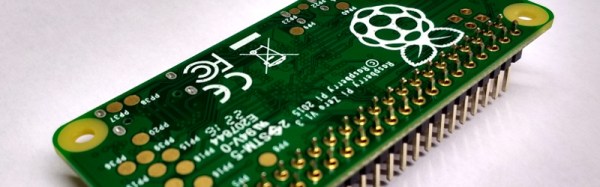
A few days ago we reported on a new product for owners of the Raspberry Pi Zero, a set of solderless header pins that had a novel installation method involving a hammer. We were skeptical that they would provide a good contact, and preferred to stick with the tried-and-trusted soldered pins. It seems a lot of you agreed, and the comments section of the post became a little boisterous. Pimoroni, the originator of the product, came in for a lot of flak, with which to give them their due they engaged with good humor.

It’s obvious this was a controversial product, and maybe the Hackaday verdict had been a little summary based on the hammer aspect of the story. So to get further into what all the fuss had been about I ordered a Pi Zero and the solderless pin kit to try for ourselves.

Continue reading “Review: Hammer-Installed Solderless Raspberry Pi Pin Headers” →

The ARRL Raises A Stink About Illegal FPV Transmitters

We have all been beneficiaries of the boom in availability of cheap imported electronics over the last decade. It is difficult to convey to someone under a certain age the step change in availability of parts and modules that has come about as a result of both the growth of Chinese manufacturing and Internet sales that allow us direct access to sellers we would once only have found through a lengthy flight and an intractable language barrier.

So being able to buy an ESP8266 module or an OLED display for relative pennies is good news, but there is a downside to this free-for-all. Not all the products on offer are manufactured to legal standards wherever in the world we as customers might be, and not all of them are safe to use. We’ve all seen teardowns of lethal iPhone charger knock-offs, but this week the ARRL has highlighted an illegal import that could take being dangerous to a whole new level as well as bring an already beleaguered section of our community to a new low.

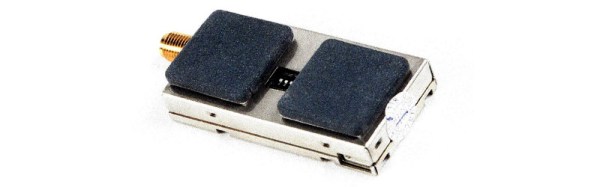
The products the radio amateurs are concerned about are video transmitters that work in the 1.2GHz band. These are sold for use with FPV cameras on multirotors, popularly referred to as drones, and are also being described as amateur radio products though their amateur radio application is minimal. The ARRL go into detail in their official complaint (PDF) about how these devices’ channels sit squarely over the frequencies used by GLONASS positioning systems, and most seriously, the frequencies used by the aircraft transponders on which the safety of our air traffic control system relies.

The multirotor community is the unfortunate recipient of a lot of bad press, most of which is arguably undeserved and the result of ignorant mass media reporting. We’ve written on this subject in the past, and reported on some of the proposals from governments which do not sound good for the enthusiast. It is thus a huge concern that products like those the ARRL is highlighting could result in interference with air traffic, this is exactly not the association that multirotor fliers need in a hostile environment.

The ARRL complaint highlights a particular model with a 5W output, which is easily high enough to cause significant interference. It is however just one of many similar products, which a very straightforward search on the likes of AliExpress or eBay will find on sale for prices well under $100. So if you are concerned with multirotors we’d urge you to ensure that the FPV transmitters you or your friends use are within the legal frequencies and power levels. We’re sure none of you would want an incident involving a manned aircraft on your conscience, nor would you relish the prospect of the encounter with law enforcement that would inevitably follow.

In the past we’ve taken a look at some of the fuss surrounding reported drone incidents, and brought you news of an Australian sausage lover in hot water for drone-based filming. It’s a hostile world out there, fly safe!

A Simple Route To A Plug Top Pi

There are a host of tiny plug-top computers available for the experimenter who requires an all-in-one mains-powered computing platform without the annoyance of a full-sized PC or similar. But among the various models there has always been something missing, a plug-top Raspberry Pi. To address that gap in the market, [N-O-D-E] has created a fusion of Pi and plug using the official Raspberry Pi PSU accessory and a Raspberry Pi Zero, with a UUGear Zero4U USB hub sandwiched between the two.

It’s a pretty straightforward and simple build, the back of the PSU is formed into a flat surface with a bit of Sugru, then the power cable is stripped back to its wires which are then connected to the power pins on the USB hub. The hub is then attached to the Sugru — he doesn’t say how, but we suspect double-sided tape — and the Pi is mounted on top of the hub. Pogo pins make the required connections to the pads on the underside of the computer, so it can be removed and replaced at will.

The result is a useful addition to your Pi arsenal, one that could be used for a host of little stand-alone devices. It could use a cover, however we suspect a 3D printer owner could create themselves one with relative ease. The full description is shown in the video below the break.

Continue reading “A Simple Route To A Plug Top Pi” →

Blob-less Raspberry Pi Linux Is A Step Closer

The Raspberry Pi single board computer has been an astounding success since its launch nearly five years ago, to the extent that as of last autumn it had sold ten million units with no sign of sales abating. It has delivered an extremely affordable and pretty powerful computer into the hands of hobbyists, youngsters, hackers, engineers and thousands of other groups, and its open-source Raspbian operating system has brought a useful Linux environment to places we might once have thought impossible.

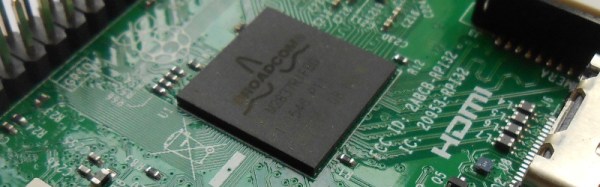
The previous paragraph, we have to admit, is almost true. The Pi has sold a lot, it’s really useful and lots of people use it, but is Raspbian open-source? Not strictly. Because the Broadcom silicon that powers the Pi has a significant amount of proprietary tech that the chipmaker has been unwilling to let us peer too closely at, each and every Raspberry Pi operating system has shipped with a precompiled binary blob containing the proprietary Broadcom code, and of course that’s the bit that isn’t open source. It hasn’t been a problem for most Pi users as it’s understood to be part of the trade-off that enabled the board’s creators to bring it to us at an affordable price back in 2012, but for open-source purists it’s been something of a thorn in the side of the little board from Cambridge.

This is not to say that all is lost on the blob-free Pi front. Aided by a partial pulling back of the curtain of secrecy by Broadcom in 2014, work has quietly been progressing, and we now have the announcement from [Kristina Brooks] that a minimal Linux kernel can boot from her latest open firmware efforts. You won’t be booting a blob-free Raspbian any time soon as there are bugs to fix and USB, DMA, and video hardware has still to receive full support, but it’s a significant step. We won’t pretend to be Broadcom firmware gurus as we’re simply reporting the work, but if it’s your specialty you can find the code in its GitHub repository. Meanwhile, we look forward to future progress on this very interesting project.

We reported on the partial Broadcom release back in 2014. At the time, the Raspberry Pi people offered a prize to the first person running a native Quake III game on their hardware, sadly though they note the competition is closed they haven’t linked to the winning entry.