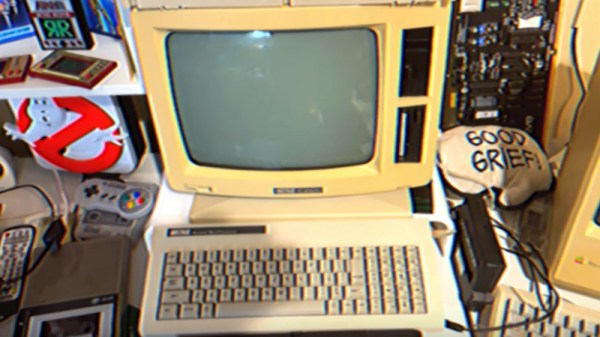
If Clive Sinclair’s genius in consumer electronics was in using ingenious hacks to make cheaper parts do greater things, then his Amstrad competitor Alan Sugar’s was in selling decade-old technology to consumers as new and exciting. His PCW series of computers are a great example, 1970s CP/M machines smartly marketed for late 1980s home offices. They were a popular choice at the time, and [Retro Recipes] has one. In a video filmed in period standard definition he’s taking us through a repair to its Gotek drive, and then a RAM upgrade.
The repair and upgrade are fairly straightforward, the former being a failed OLED screen on the drive and the latter being the installation of a bank of DIP memory chips. The interest lies in how they cost-minimised a CP/M machine as a consumer product. The board relies heavily on custom chips as you might expect, and there’s a brief glimpse of one of those unusual 3″ floppy drives. The power supply is part of the monitor board as was often the case with Amstrad machines, and the whole thing is about as simple as it can be. The full video can be found below the break.
We’re guessing that particularly in the UK there will be plenty of PCWs still languishing in dusty attics, but surprisingly given their popularity at the time we see less of them that might be expected. There has been a significantly upgraded model on these pages though.