Macintosh System 7 Ported To X86 With LLM Help

You can use large language models for all sorts of things these days, from writing terrible college papers to bungling legal cases. Or, you can employ them to more interesting ends, such as porting Macintosh System 7 to the x86 architecture, like [Kelsi Davis] did.

When Apple created the Macintosh lineup in the 1980s, it based the computer around Motorola’s 68K CPU architecture. These 16-bit/32-bit CPUs were plenty capable for the time, but the platform ultimately didn’t have the same expansive future as Intel’s illustrious x86 architecture that underpinned rival IBM-compatible machines.

[Kelsi Davis] decided to port the Macintosh System 7 OS to run on native x86 hardware, which would be challenging enough with full access to the source code. However, she instead performed this task by analyzing and reverse engineering the System 7 binaries with the aid of Ghidra and a large language model. Soon enough, she had the classic System 7 desktop running on QEMU with a fully-functional Finder and the GUI working as expected. [Kelsi] credits the LLM with helping her achieve this feat in just three days, versus what she would expect to be a multi-year effort if working unassisted.

Files are on GitHub for the curious. We love a good port around these parts; we particularly enjoyed these efforts to recreate Portal on the N64. If you’re doing your own advanced tinkering with Macintosh software from yesteryear, don’t hesitate to let us know.
Smart Home Gets A Custom Keypad Controller

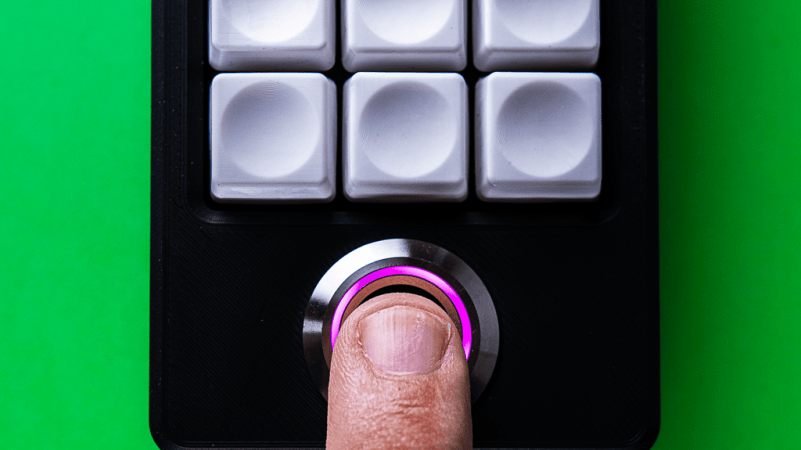
Voice assistants and smartphones are often the go-to interfaces for modern smart home systems. However, if you fancy more direct physical controls, you can go that route as well. To that end, [Salim Benbouziyane] whipped up a nifty keypad to work with his Home Assistant setup.

The build is based on an ESP32 microcontroller, which has wireless hardware onboard to communicate with the rest of [Salim’s] Home Assistant setup. Using the ESPHome firmware framework as a base, the microcontroller is connected to a four-by-three button keypad array, built using nice clicky key switches. There’s also an indicator light on top as a system status indicator. A fingerprint scanner provides an easy way for users to authenticate when disarming the alarm.

Security and speed were the push for [Salim] to whip up this system. He found it difficult to disarm his alarm in a hurry when fumbling with his phone, and the direct keypad entry method was far more desirable.

Sometimes, the easiest route to the smart home of your dreams is to just build the exact solutions you need. Video after the break.

Continue reading “Smart Home Gets A Custom Keypad Controller”

Bluetooth Earrings Pump Out The Tunes

When you think of a Bluetooth speaker, you’re probably picturing a roughly lunchbox-sized device that pumps out some decent volume for annoying fellow beachgoers, hikers, or public transport users. [Matt Frequencies] has developed something in an altogether different form factor—tiny Bluetooth speakers you can dangle from your earlobes! They’re called Earrays, and they’re awesome.

The build started with [Matt] harvesting circuit boards from a pair of off-the-shelf Bluetooth earbuds. These are tiny, and perfect for picking up a digital audio stream from a smartphone or other device, but they don’t have the grunt to drive powerful speakers. Thus, [Matt] hooked them up to a small Adafruit PAM8302A amplifier board, enabling them to drive some larger speaker drivers that you can actually hear from a distance. These were then installed in little 3D printed housings that are like a tiny version of the speaker arrays you might see hanging from the rigging at a major dance festival. Throw on a little earring hook, and you’ve got a pair of wearable Bluetooth speakers that are both functional, fashionable, and very audible!

[Matt] has continued to develop the project, even designing a matching pendant and a charging base to make them practical to use beyond a proof-of concept. Despite the weight of the included electronics, they’re perfectly wearable, as demonstrated by [DJ Kaizo Trap] modelling the hardware in the images seen here.

We’ve seen plenty of great LED earrings over the years, but very few jewelry projects in the audio space thus far. Perhaps that will change in future—if you pursue such goals, let us know!

An LED Sphere For Your Desk

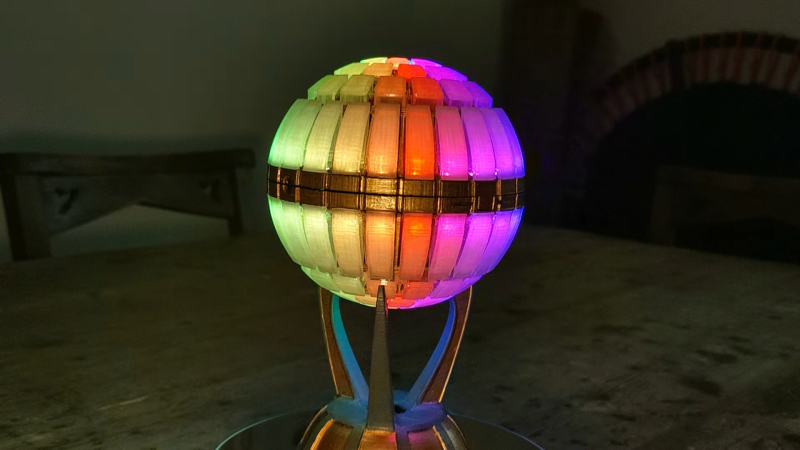
The Las Vegas Sphere is great and all, but few of us can afford the expense to travel to out there to see it on the regular. If you’re looking for similar vibes you can access at home, you might enjoy the desk toy that [AGBarber] has designed.

The scale is small — the sphere measures just 98 mm (3.6 inches) in diameter — but that just means it’s accessible enough to be fun. The build is based around various sizes of WS2812B addressable LED rings, and contains 120 individual RGB LEDs in total. They’re wrapped up in a 3D printed housing which does a great job of diffusing the light. Transparent filament was used to print parts that light up with a richly-saturated glow with few visible hotspots. Commanding the LEDs is an ESP8266 microcontroller in the form of a Wemos D1 Mini, which provides plenty of grunt to run animations as well as great wireless connectivity options. [AGBarber] relied on their own Pixel Spork library to handle all the cool lighting effects. Files are on GitHub for the curious.

Maybe you don’t like spheres, and icosahedrons are more your speed. Well, we’ve featured those too—with 2,400 LEDs, no less.

Continue reading “An LED Sphere For Your Desk”

Detecting Surveillance Cameras With The ESP32

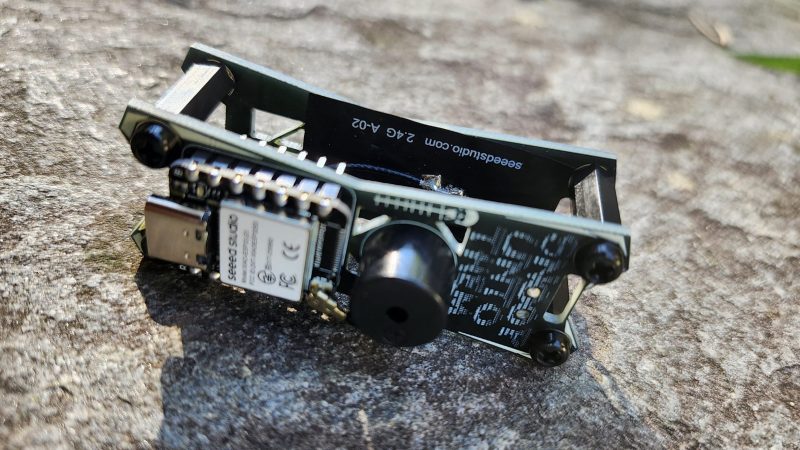
These days, surveillance cameras are all around us, and they’re smarter than ever. In particular, many of them are running advanced algorithms to recognize faces and scan license plates, compiling ever-greater databases on the movements and lives of individuals. Flock You is a project that aims to, at the very least, catalogue this part of the surveillance state, by detecting these cameras out in the wild.

The system is most specifically set up to detect surveillance cameras from Flock Safety, though it’s worth noting a wide range of companies produce plate-reading cameras and associated surveillance systems these days. The device uses an ESP32 microcontroller to detect these devices, relying on the in-built wireless hardware to do the job. The project can be built on a Oui-Spy device from Colonel Panic, or just by using a standard Xiao ESP32 S3 if so desired. By looking at Wi-Fi probe requests and beacon frames, as well as Bluetooth advertisements, it’s possible for the device to pick up telltale transmissions from a range of these cameras, with various pattern-matching techniques and MAC addresses used to filter results in this regard. When the device finds a camera, it sounds a buzzer notifying the user of this fact.

Meanwhile, if you’re interested in just how prevalent plate-reading cameras really are, you might also find deflock.me interesting. It’s a map of ALPR camera locations all over the world,  and you can submit your own findings if so desired. The techniques used by in the Flock You project are based on learnings from the DeFlock project. Meanwhile, if you want to join the surveillance state on your own terms, you can always build your own license plate reader instead!

[Thanks to Eric for the tip!]

How Water Vapor Makes Smartphones Faster

Once upon a time, home computers were low-powered enough that they barely needed any cooling at all. An Amiga 500 didn’t even have a heatsink on the CPU, while the early Macintosh got by with a single teeny little fan.

Modern smartphones are far more powerful than these ancient machines, packed with multi-core processors running at speeds of many gigahertz. Even still, they’ve generally been able to get by without any active cooling devices. However, as manufacturers continue to push the envelope of performance, they’ve had to scramble for ways to suck heat out of these handheld computers. Vapor chamber cooling has risen as a solution to this problem, using simple physics to keep your handset humming along at maximum speed for longer.

Continue reading “How Water Vapor Makes Smartphones Faster”