Apple Watch Gets Custom Transparent Case

The Apple Watch was the tech company’s attempt to bring wrist computers into the mainstream. It’s naturally available in a variety of fits and finishes, but if you want something properly original, you’ve got to go custom. [Useless Mod] does just that with a clear case for the popular smartwatch.

The mod starts with a patient, careful disassembly of the watch – necessary given the delicate components inside. It’s achieved in the end with only having to drill out 1 screw and an unfortunately snapping of the crown wheel axle. However, [Useless Mod] presses on, and silicone casts the original Apple enclosure. The video goes over all the finer points, from degassing to using strips of acrylic plastic to act as runners. Once done, the silicone mold is used to produce a replica case in transparent epoxy, and the watch is reassembled.

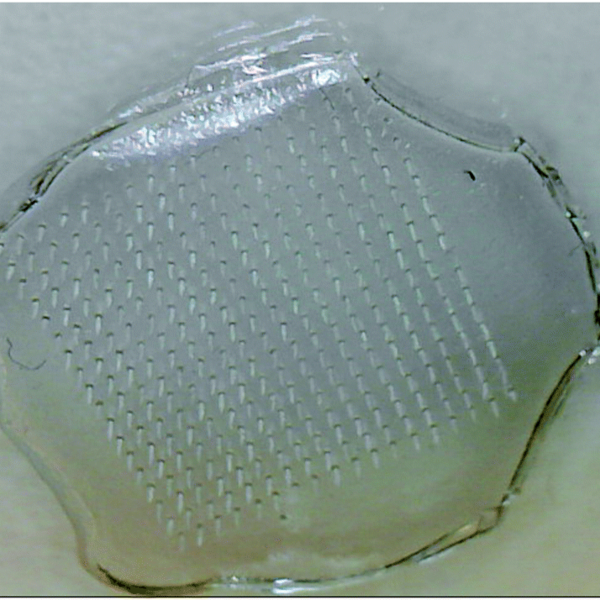
The final result is impressive, with the case optically clear and showing off the watch’s internals. The look is improved by removing some of the original insulation tape to better reveal the PCBs inside. Unfortunately, the design of the watch, which is largely covered by a screen and heartbeat sensor, means it’s not the greatest choice for a clear case mod, but it works nonetheless. We’ve seen similar work before from [Useless Mod] too – like this transparent drone case for the Mavic Mini. Video after the break.

Continue reading “Apple Watch Gets Custom Transparent Case”

Sony’s Electric Car Now Road Testing In Austria

The Consumer Electronics Show was not typically a place for concept cars, and Sony aren’t known as a major automaker. However, times change, and the electric transport revolution has changed much. At the famous trade show, Sony shocked many by revealing its Vision-S concept — a running, driving, prototype electric car.

Far from a simple mockup to show off in-car entertainment or new fancy cameras, Sony’s entry into the automotive world is surprisingly complete. Recently, the Japanese tech giant has been spotted testing the vehicle on the road in Austria, raising questions about the future of the project. Let’s dive in to what Sony has shown off, and what it means for the potential of the Vision-S.

Continue reading “Sony’s Electric Car Now Road Testing In Austria”

Custom Bite Sensor Replaces Keyboard Expression Pedal

Sometimes, standard hardware won’t do when it comes to the differently abled. [Ben Krasnow] found himself recently working on a project for a musician who doesn’t have the use of his legs, and thus needed to create a new interface to replace a standard expression pedal.

[Ben] is a big fan of the build first method of working, and demonstrates why it works well. In this case, the first attempt involved a pneumatic design, where the user would bite down on an air bladder that actuated a remotely-located potentiometer via a tube and bellows. However, while this design worked, the tactile feedback was poor. This led to experimentation with mechanical designs, with an initial attempt involving a 3D printed mechanism and a rotary pot. This was better, but still had problems with damage from teeth and poor feel .The final design is essentially an analog button, built with fabric-impregnated silicone for wear resistance and using a linear pot for smooth feedback.

The final design is impressively tidy, and [Ben] notes that while it looks simple, it was only arrived at by trying plenty of worse solutions first. We’ve seen other work done in the gaming world too; recently, modular controllers have come into vogue to serve a wide variety of needs. Video after the break.

Continue reading “Custom Bite Sensor Replaces Keyboard Expression Pedal”

How To Run Alternative Batteries On The DJI Mavic Mini

Rechargeable batteries are ubiquitous these days, freeing us from the expense and hassle of using disposable cells. However, this has come with the caveat that many manufacturers demand their equipment only be used with their own official batteries. [aeropic] wasn’t a fan of this, so built a circuit to allow his DJI Mavic Mini to fly with any batteries he pleased.

The Mavic Mini uses I2C to communicate with official packs, making the hack relatively straightforward. [aeropic] built a board nicknamed B0B, which tells the drone what it wants to hear and lets it boot up with unofficial batteries installed. The circuit uses a PIC12F1840 to speak to the drone, including reporting voltage on the cells installed. Notably, it only monitors the whole pack, before dividing the voltage to represent the value of individual cells, but it shouldn’t be a major problem in typical use. Combined with a few 3D printed components to hold everything together, it allows you to build your own cheap pack for the Mavic Mini with little more than a PCB and a few 18650 cells.

It’s always good to see hackers getting out and doing the bread and butter work to get around restrictive factory DRM measures, whether its on music, printer cartridges, or drone batteries. We’ve even seen the scourge appear on litter boxes, too. Video after the break.

Continue reading “How To Run Alternative Batteries On The DJI Mavic Mini”

Hide And Seek AI Shows Emergent Tool Use

Machine learning has come a long way in the last decade, as it turned out throwing huge wads of computing power at piles of linear algebra actually turned out to make creating artificial intelligence relatively easy. OpenAI have been working in the field for a while now, and recently observed some exciting behaviour in a hide-and-seek game they built.

The game itself is simple; two teams of AI bots play a game of hide-and-seek, with the red bots being rewarded for spotting the blue ones, and the blue ones being rewarded for avoiding their gaze. Initially, nothing of note happens, but as the bots randomly run around, they slowly learn. Over millions of trials, the seekers first learn to find the hiders, while the hiders respond by building barriers to hide behind. The seekers then learn to use ramps to loft over them, while the blue bots learn to bend the game’s physics and throw them out of the playfield. It ends with the seekers learning to skate around on blocks and the hiders building tight little barriers. It’s a continual arms race of techniques between the two sides, organically developed as the bots play against each other over time.

It’s a great study, and particularly interesting to note how much longer it takes behaviours to develop when the team switches from a basic fixed scenario to an changable world with more variables. We’ve seen other interesting gaming efforts with machine learning, too – like teaching an AI to play Trackmania. Video after the break.

Continue reading “Hide And Seek AI Shows Emergent Tool Use”

Physically Huge SD Card Technically Has Some Benefits

SD cards were developed and released just before the turn of the millenium. Since then, we’ve seen smaller formats, miniSD and microSD, become popular for portable devices. However, sometimes bigger is better. [Useless Mod] dared to dream that dream, and put together a (physically) gigantic SD card.

In card is a full 10x scale reproduction of a SanDisk Extreme Pro SD card,  complete with packaging, too. Built out of layers of laser cut MDF, it’s spray painted and given a high-quality label to complete the effect. The write protect slider instead serves in this case as a latch to open the assembly. Inside, there’s a simple regular SD card slot, wired up to the bigger card’s giant contacts made with copper tape. These interface with an huge 10x scale SD card slot, which acts as an adapter, allowing the giant SD to be used with regular hardware like cameras.

The giant SD might seem silly, but it has plenty of useful features. There’s flashing LEDs behind the label that make it easy to find if you drop it, along with an Apple Watch hidden inside that means it can be located using the Find My iPhone service. We’d have loved if it featured a RAID array full of 10 or more SD cards, as well, just to justify its enormous size. That said, [Useless Mod] points out that it’s big enough to keep a DSLR dry in a rainstorm when fitted to the hotshoe, so there’s that.

It’s a fun build, not a serious one, but one that we enjoyed on its merits. We suspect that, regardless of the card inside, you’ll have little luck recording at 4K with such long wire lengths in play. If you’ve ever had more normal compatability problems with the format, consider that it could be size causing your issues. Video after the break.

Continue reading “Physically Huge SD Card Technically Has Some Benefits”

A Big Set Of Logic Gates For Teaching The Basics

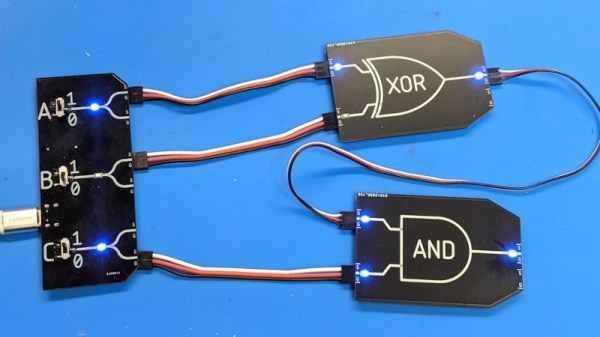
Teaching students about logic gates is often done in two parts, once on the whiteboard for the theory, and again on the breadboard for the practice. [shurik179] wasn’t a fan of the abstraction between easy-to-understand symbols on the whiteboard, and small IC packages full of many gates in reality. Instead, he built a set of real-world logic gates that can be wired together as a teaching tool.

Each “gate’ consists of a PCB roughly the size of a business card that features LEDs to indicate the state of its inputs and outputs, and a silkscreen indicating the name and symbol of the gate in question. There’s also a master PCB, which features three seed values, A, B, and C, to feed into the system. Students can set these values to 1 or 0, and feed them into the gates, which are wired together with 3-conductor servo cables, and observe the input on the built-in LEDs.

It’s a great way to demonstrate logic gates in the classroom. The design also allows the PCBs to be flipped over to show the actual electronic components responsible for implementing the logic, serving as a great bridge towards better understanding of real electronic design. Of course, it’s not the only way to learn – even Fallout 4 has a fully fledged logic toolkit these days!