Physically Huge SD Card Technically Has Some Benefits

SD cards were developed and released just before the turn of the millenium. Since then, we’ve seen smaller formats, miniSD and microSD, become popular for portable devices. However, sometimes bigger is better. [Useless Mod] dared to dream that dream, and put together a (physically) gigantic SD card.

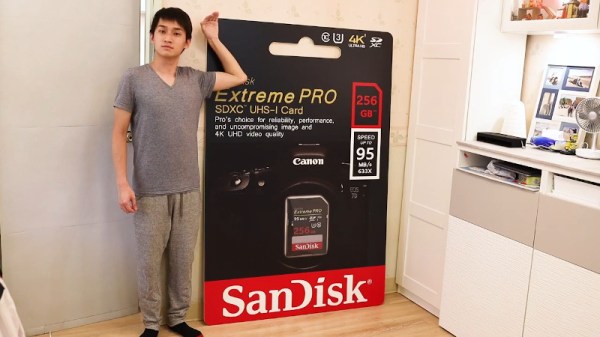
In card is a full 10x scale reproduction of a SanDisk Extreme Pro SD card,  complete with packaging, too. Built out of layers of laser cut MDF, it’s spray painted and given a high-quality label to complete the effect. The write protect slider instead serves in this case as a latch to open the assembly. Inside, there’s a simple regular SD card slot, wired up to the bigger card’s giant contacts made with copper tape. These interface with an huge 10x scale SD card slot, which acts as an adapter, allowing the giant SD to be used with regular hardware like cameras.

The giant SD might seem silly, but it has plenty of useful features. There’s flashing LEDs behind the label that make it easy to find if you drop it, along with an Apple Watch hidden inside that means it can be located using the Find My iPhone service. We’d have loved if it featured a RAID array full of 10 or more SD cards, as well, just to justify its enormous size. That said, [Useless Mod] points out that it’s big enough to keep a DSLR dry in a rainstorm when fitted to the hotshoe, so there’s that.

It’s a fun build, not a serious one, but one that we enjoyed on its merits. We suspect that, regardless of the card inside, you’ll have little luck recording at 4K with such long wire lengths in play. If you’ve ever had more normal compatability problems with the format, consider that it could be size causing your issues. Video after the break.

Continue reading “Physically Huge SD Card Technically Has Some Benefits”
A Big Set Of Logic Gates For Teaching The Basics

Teaching students about logic gates is often done in two parts, once on the whiteboard for the theory, and again on the breadboard for the practice. [shurik179] wasn’t a fan of the abstraction between easy-to-understand symbols on the whiteboard, and small IC packages full of many gates in reality. Instead, he built a set of real-world logic gates that can be wired together as a teaching tool.

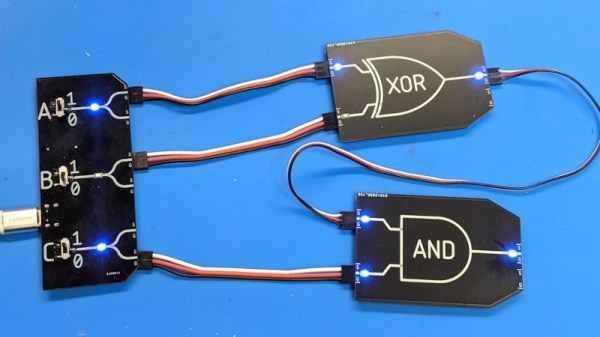
Each “gate’ consists of a PCB roughly the size of a business card that features LEDs to indicate the state of its inputs and outputs, and a silkscreen indicating the name and symbol of the gate in question. There’s also a master PCB, which features three seed values, A, B, and C, to feed into the system. Students can set these values to 1 or 0, and feed them into the gates, which are wired together with 3-conductor servo cables, and observe the input on the built-in LEDs.

It’s a great way to demonstrate logic gates in the classroom. The design also allows the PCBs to be flipped over to show the actual electronic components responsible for implementing the logic, serving as a great bridge towards better understanding of real electronic design. Of course, it’s not the only way to learn – even Fallout 4 has a fully fledged logic toolkit these days!

AMD’s Threadripper Is The Beating, Heating Heart Of “Most Powerful” DIY Laptop

There are plenty of powerful, “desktop-replacement” laptops out on the market if you’ve got the money to spend. Sometimes, though, that just doesn’t scratch that crazy itch in the back of your head for true, unbridled computing power. When you’ve got an insatiable thirst for FLOPS, you’ve got to strike out on your own, as [Jeff] did with this Threadripper laptop.

The aim was to pack an AMD Threadripper processor into a nominally portable laptop format. For this build, the AMD 1950X was chosen for its affordability and huge computing power, as well as a TDP of 180W. This high heat output has stopped the chips ending up in portable builds until now, but [Jeff] didn’t see this as a problem, but a challenge.

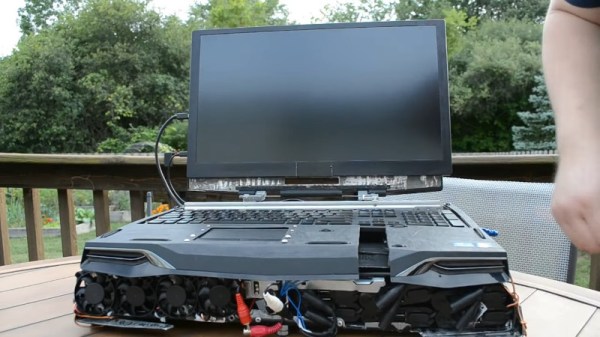
What results is a wild, lashed together build of high-power parts into what could charitably be called a laptop – though we’d recommend against putting it on your lap. With a 4K 18″ screen, keyboard, touchpad, and many Dell Powerbanks kludged together into an HP Media Center case, it fits the usual form factor, albeit with more exposed heatpipes and cables than the typical consumer may be used to.

[Jeff] claims this is the current most powerful laptop in the world, as builds that use the 3950X throttle it back in their applications. We don’t have the data to compare, but we certainly wouldn’t be stacking our own portable rig up against it in a fight. DIY laptops have a long history at Hackaday, going all the way back to 2007. If you’ve got your own wild build, be sure to drop us a line. Video after the break.

Continue reading “AMD’s Threadripper Is The Beating, Heating Heart Of “Most Powerful” DIY Laptop”

Game Boy Replica Built In Brass

Nintendo’s Game Boy is legendary for being the meat in the handheld gaming revolution, as well as being nigh-on indestructible whether in the custody of children or soldiers in the Gulf War. However, [Jiri] decided to see if he could whip up a tribute of his own, in brass instead of plastic.

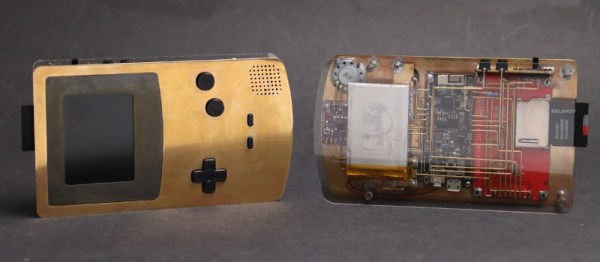
The hardware is based on the Odroid GO emulator firmware for the ESP32, running on a 2.2″ color TFT screen. It’s a great base for a custom build, which avoids gutting any precious classic hardware. It’s then assembled behind front plate milled out of brass, with delicate point-to-point brass wires giving it an artistic circuit sculpture look. The brass did prove difficult to work with at times, acting as a heat sink which prevented easy soldering of the standoffs in place. To get around this, [Jiri] used a hotplate to heat the plate from below, keeping it warm enough so that a hand iron could do the job.

The final result is a fun Game Boy emulator in a stylish case – though one you shouldn’t throw in a back pack lest it short out the exposed conductors. It would make a great gift for any lifelong Nintendo fan. [Jiri] is no strange to circuit sculpture, as we well know – we’ve featured his tools and methods before. Video after the break.

Continue reading “Game Boy Replica Built In Brass”

Making Silicone Molds – Big Ones!

If you’ve got one of something and you want more, duplicating it with a silicone mold can be a great way to go. This is applicable to 3D printing something you need many copies of, and a whole variety of other usecases. [Eric Strebel] prides himself on his abilities in this area, and has put out a guide to producing very large silicone molds in a simple and reliable manner.

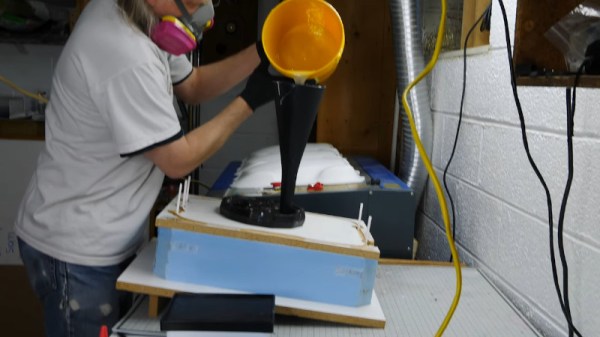
The overarching process is simple, but followed properly, it produces great results. [Eric] starts by building a mold box out of wood, coated in shellac to ensure it doesn’t stick to the silicone. The master part is then stuck to the base, surrounded by a lasercut cardboard strip which acts as a seal and key. Once properly degassed silicone is poured in and cured, the second half can be made. The mold is flipped in the mold box, the seal key removed,  and release agent applied to the silicone surfaces. With another pour and cure, the mold is ready for casting new parts.

While simple, if the correct equipment isn’t used or steps skipped, you’ll end up with a useless mold full of air bubbles or surface irregularities. It’s useful to see just what it takes to get a mold of such scale (13″ x 19″!) completed without flaws. We’ve featured [Eric]’s work before, such as his fine detail improvements on the Apple Pencil. Video after the break.

Continue reading “Making Silicone Molds – Big Ones!”

Mavic Mini Gets Custom Clear Case

Apparently, in the drone scene, sticker wraps are popular for a custom aesthetic. [Useless Mod] wanted to go a little further, however, and decided to build a full crystal enclosure for his Mavic Mini, facing some hurdles along the way. (Video, embedded below.)

The first stage of the build was disassembly, with the compact 249 gram drone requiring a deft touch to avoid damaging the delicate ribbon cables and mechanisms inside. With the drone stripped down to its bare components, a silicone mould was made of each individual piece of the case, with new parts being cast in clear epoxy. It’s not a job for the faint of heart, with many undercuts and complex features to contend with. However, [Useless Mod] managed to produce the parts and get it all back together.

An initial test flight ended poorly, when the drone entered an uncontrollable wobble due to the case not being fully assembled. However, with fresh internals and with everything properly put together, everything worked! It’s not a build we’d suggest for the inexperienced, as the moulds required are complex and the electronics quite fragile. The final result is a good one though, and it even weighs 10 grams less than the original casing!

For those in the US, the world of drones is set to change drastically in short order.

Continue reading “Mavic Mini Gets Custom Clear Case”

Apple II Prints Off The Breaking News

These days, we’re alerted to the rise of Bitcoin and the fall of nations via little buzzes from the smartphones in our pocket. Go back fifty years or so and it was all a bit more romantic, with noisy teletype machines delivering hot tips straight to the newsroom for broadcast to the wider public. [Joshua Coleman] wanted a bit of that old fashioned charm, so set up a news printer at home with his old Apple II.

The Apple II in this case isn’t directly connected to the Internet. Instead, it talks to a modern Macintosh, acting as a serial terminal. The Macintosh then connects to a modern BBS that delivers news headlines over Telnet. The Apple II then routes the headlines as they come in to a beautiful Epson LQ-500 dot matrix printer, replete with vintage tractor feed paper. [Joshua] takes the time to highlight just what hardware is required, as well as how to set up the Apple II to redirect the serial output to the printer so the news automatically prints as it comes in.

It’s a fun and noisy way to stay up to date, and you can be sure that if you hear the printer really start going for it, you might want to switch on the TV for more information on just what’s going wrong at the present minute. Old computers may not have the grunt to really hang with the modern net, but they can make a charming interface for it; this SE/30 does a great job with Spotify, as an example. Video after the break.

Continue reading “Apple II Prints Off The Breaking News”