Radio Shack Rebirth May Have Gone Awry In Alleged Ponzi-Like Scheme

Oh, Radio Shack. What a beautiful place you once were, a commercial haven for those seeking RC cars, resistors, and universal remotes. Then, the downfall, as you veered away from your origins, only to lead to an ultimate collapse. More recently, the brand was supposed to return to new heights online… only to fall afoul of the Securities and Exchange Commission. (via Yahoo Finance, Bloomberg)

The Radio Shack brand was picked up a few years ago by a company known as Retail Ecommerce Ventures (REV). The company’s modus operandi was to take well-known but beleaguered brands and relaunch them as online-only operations. Beyond Radio Shack, REV also owned a number of other notable brand names, like Pier 1, Modell’s Sporting Goods, and Dress Barn.

Unfortunately, the Radio Shack rebirth probably won’t reach the stellar heights of the past. Namely, because REV has been accused of operating a Ponzi-like scheme by the SEC. Despite huge boasts allegedly made to investors, none of REV’s portfolio of brands were actually making profits, and the SEC has charged that the company was paying investor returns with cash raised from other investors — unsustainable, and a major no-no, legally speaking. In any case, the SEC charges apply directly to REV. The RadioShack brand has since been acquired by Unicomer Group, which operates the current online business, and has no ties to REV or its former operators.

We were cautiously optimistic when we heard about the REV buyout back in 2020, but at this point, it’s probably best to come to terms with the fact that Radio Shack won’t be returning to its former glory. The name will linger in our hearts for some time to come, but the business we knew is long gone. Sometimes it’s better to look to the future than to try and recreate the magic of the past, especially if you’re doing inappropriate things with other people’s money in the process.

How Regulations Are Trying To Keep Home Battery Installs Safe

The advent of rooftop solar power generation was a huge step forward for renewable energy. No longer was generating electricity the sole preserve of governments and major commercial providers; now just about any homeowner could start putting juice into the grid for a few thousand dollars. Since then, we’ve seen the rise of the home battery, which both promises to make individual homes more self sufficient, whilst also allowing them to make more money selling energy to the grid where needed.

Home batteries are becoming increasingly popular, but as with any new home utility, there come risks. After all, a large capacity battery can present great danger if not installed or used correctly. In the face of these dangers, authorities in jurisdictions around the world have been working to ensure home batteries are installed with due regard for the safety of the occupants of the average home.

Continue reading “How Regulations Are Trying To Keep Home Battery Installs Safe”

Dodecahedron Speaker Is Biblically Accurate

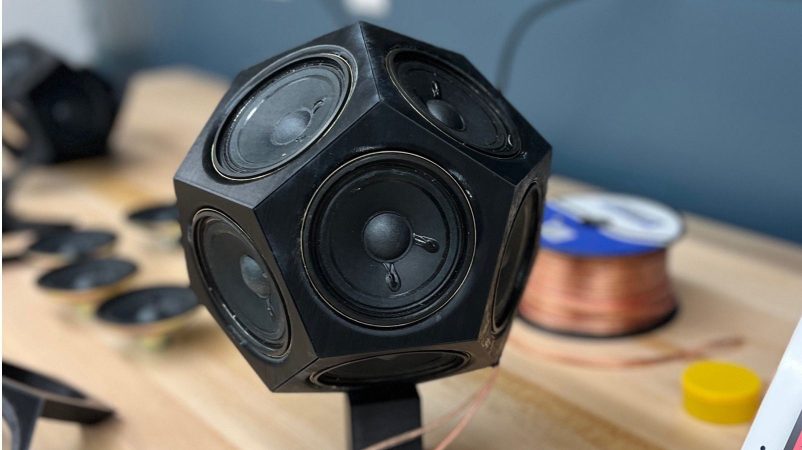
Once upon a time, many radios and TVs only came with a single (mono) speaker. Then someone decided all audio hardware should have as many speakers as we have ears. That was until [Olivia] came along, and whipped up a dodecahedron speaker as an educational piece for workshops. Really, it shows us that twelve speakers should be the minimum standard going forward.

The speaker relies on a 3D-printed frame. The dodecahedron shell is assembled from 12 individual faces, each of which hosts a small individual speaker. Multichannel audio fans shouldn’t get too excited—all twelve speakers are wired to the same input in four groups of three, making this essentially an exceptionally complicated mono device. It might sound silly, but it’s actually a great way to deliver audio in many directions all at once. [Olivia] even went to the effort of running some sweep tests in anechoic and reverberation chambers to see how they performed, which is a fun bit of extra detail in the build log.

[Olivia] notes that these unique speakers are great as a beginner workshop build. They’re easy to modify in various ways to suit different ideas or levels of ability, and they can be made for less than $30 a pop. We’d love to see an advanced version that maybe packed in a lithium battery and a Bluetooth module to make them a standalone audio device. Video after the break.

Continue reading “Dodecahedron Speaker Is Biblically Accurate”

How A Failed Video Format Spawned A New Kind Of Microscope

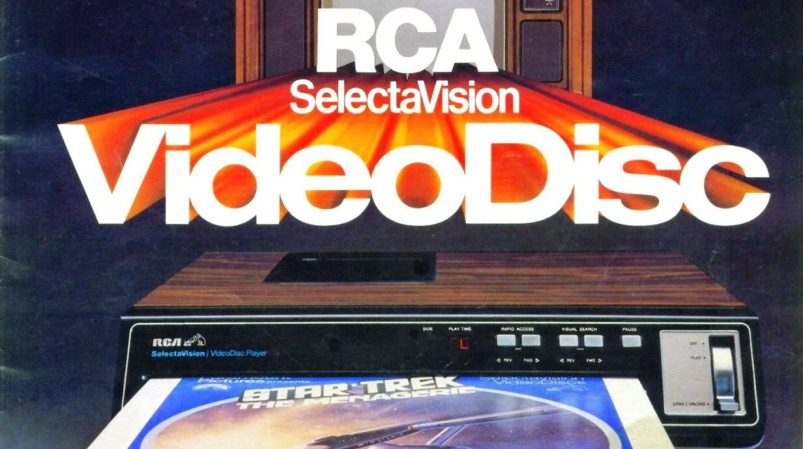
The video cassette tape was really the first successful home video format; discs just couldn’t compete back in the early days. That’s not to say nobody tried, however, with RCA’s VideoDisc a valiant effort that ultimately fell flat on its face. However, the forgotten format did have one benefit, in that it led to the development of an entirely new kind of microscope, as explained by IEEE Spectrum.

The full story is well worth the read; the short version is that it all comes down to capacitance. RCA’s VideoDisc format was unique in that it didn’t use reflective surfaces or magnetic states to represent data. Instead, the data was effectively stored as capacitance changes. As a conductive stylus rode through an undulating groove in a carbon-impregnated PVC disc, the capacitance between the stylus and the disc changed. This capacitance was effectively placed into a resonant circuit, where it would alter the frequency over time, delivering an FM signal that could be decoded into video and audio by the VideoDisc player.

The VideoDisc had a capacitance sensor that could detect such fine changes in capacitance, that it led to the development of the Scanning Capacitance Microscope (SCM). The same techniques used to read and inspect VideoDiscs for quality control could be put to good use in the field of semiconductors. The sensors were able to be used to detect tiny changes in capacitance from dopants in a semiconductor sample, and the SCM soon became an important tool in the industry.

It’s perhaps a more inspiring discovery than when cheeky troublemakers figured out you could use BluRay diodes to pop balloons. Still fun, though. An advertisement for the RCA VideoDisc is your video after the break.

Continue reading “How A Failed Video Format Spawned A New Kind Of Microscope”

Automatic Feeder Keeps Fish Sated

[Noisy Electrons] is a maker who also likes to keep fish. He sometimes needs to travel and keep his fish fed in the meantime, so he created an automated solution to handle that for him.

The build is based around an STM32 microcontroller, paired with a MCP7940N real-time clock to keep time. The microcontroller is hooked up to a few buttons and a small display to serve as an interface, allowing the feeding times and dosage amounts to be configured right on the device. Food is distributed from a 3D printed drum with a hole in it, which is rotated via a stepper motor.  Each time the drum rotates, some food falls through the hole and into the tank. Dosage amount is measured in rotations — the more times the drum rotates, the more food is delivered to the fish.

[Noisy Electron] built three of these devices for three separate tanks. Thus far, it’s been three weeks and all the fish are still alive, so we’ll take that as a vote of confidence in the build. We’ve featured some other great pet feeders over the years, too Continue reading “Automatic Feeder Keeps Fish Sated”

Heart Rate Measurement Via WiFi, The DIY Way

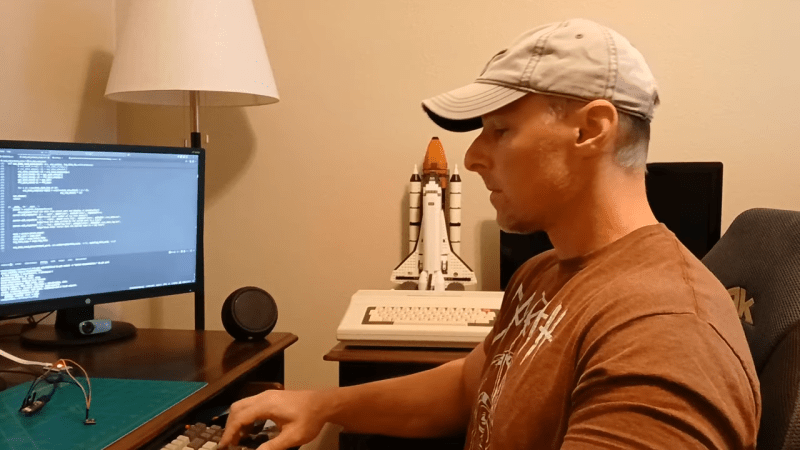
A few weeks back, we reported on a research group that figured out how to measure heartrate using perturbations in WiFi signals. [Nick Bild] was interested in this so-called “Pulse-Fi” technique, but noted the paper explaining it was behind a paywall. Thus, he worked to recreate the technology himself so he could publish the results openly for anyone eager to learn.

[Nick] paid for the research paper, and noted that it was short on a few of the finer details and didn’t come with any code or data from the original research team. He thus was left to figure out the finer details of how to measure heart rate via WiFi in his own way, though he believes his method is quite close to the original work.

The basic concept is simple enough. One ESP32 is set up to transmit a stream of Channel State Information packets to another ESP32, with a person standing in between. As the person’s heart beats, it changes the way the radio waves propagate from the transmitting unit to the receiver. These changes can be read from the packets, and processed to estimate the person’s heart rate. [Nick] explains the various data-massaging steps involved to go from this raw radio data to a usable heart rate readout.

It’s a great effort from [Nick] to recreate this research all on his own in his home lab. Files are on GitHub for the curious. If you’re eager to learn more about these innovative measurement techniques, you might like to read our prior reporting on the tech. Also, it’s worth remembering—don’t use your homebrew prototypes for any serious healthcare purposes. Continue reading “Heart Rate Measurement Via WiFi, The DIY Way”

Building Your Own DVB-S2 Receiver

Generally, a digital TV tuner is something you buy rather than something you make yourself. However, [Johann] has always been quite passionate about the various DVB transmission standards, and decided he wanted to build his own receiver just for the fun of it.

[Johann]’s build is designed to tune in DVB-S2 signals transmitted from satellites, and deliver that video content over a USB connection. When beginning his build, he noted it was difficult to find DVB reception modules for sale as off-the-shelf commercial parts. With little to nothing publicly available, he instead purchased a “Formuler F1 Plug & Play DVB-S2 HDTV Sat Tuner” and gutted it for the Cosy TS2M08-HFF11 network interface module (NIM) inside. He then paired this with a Cypress CY7C68013A USB bridge to get the data out to a PC. [Johann] then whipped up a Linux kernel driver to work with the device.

[Johann] doesn’t have hardcore data on how his receiver performs, but he reports that it “works for me.” He uses it in South Germany to tune in the Astra 19.2E signal.

We don’t talk a lot about DVB these days, since so much video content now comes to us over the Internet. However, we have still featured some nifty DVB hacks in the past. If you’re out there tinkering with your own terrestrial or satellite TV hardware, don’t hesitate to notify the tipsline!