Modular Camera Remote Is Highly Capable

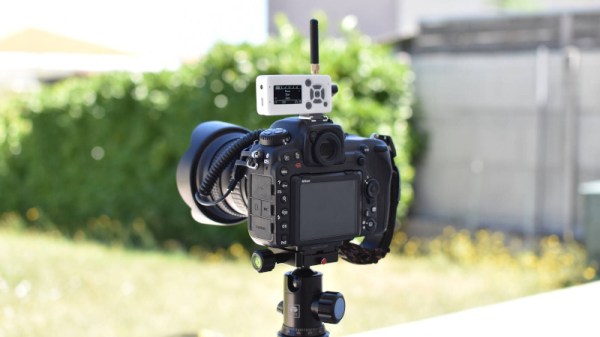
Many cameras these days have optional remotes that allow the shutter release to be triggered wirelessly. Despite this, [Foaly] desired more range, and more options for dealing with several cameras at once. As you’d expect, hacking ensued.

[Foaly] uses Silver modules to photograph rocket launches safely.
The system goes by the name of Silver, and is modular in nature. Each Silver module packs a transmitter and receiver, and can send and receive trigger orders to any other module in range. This allows a module to be used to trigger a camera, or be used as a remote to control other modules. There’s even a PC interface program that controls modules over USB.

Modules are also capable of sharing configuration changes with other modules in the field, making it easy to control a large battery of cameras without having to manually run around changing settings on each one. Oh, and it can run as a basic intervalometer too.

LoRa is used for wireless communications between modules, giving them excellent range. [Foaly] successfully used the remotes at ranges over 500 meters without any dropouts, capturing some great model rocket takeoffs in the process.

Silver is a highly robust project that should do everything the average photographer could ever possibly need, and probably a good deal more. Firmware and board files are available for those eager to make their own.

We’ve seen several very impressive camera augmentations entered into the 2019 Hackaday Prize, from ultra high-speed LED flash modules to highly flexible automatic trigger systems.


This Lightning Detector Is Remarkably Sensitive

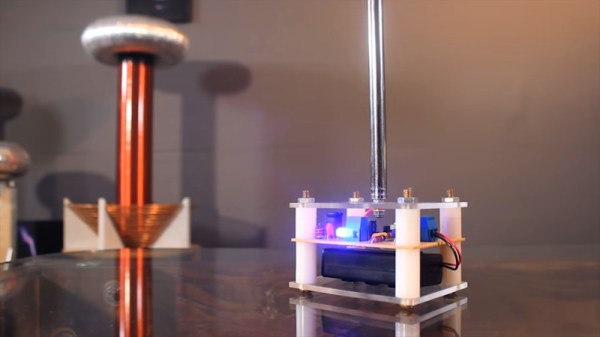
Lightning strikes are quite high energy events, and release plenty of radio frequency energy when they go off in the atmosphere. This makes them easy to detect, and the magnitude of the energy release means it can be done at impressive range. [Jay] decided to build a device of his very own, and was impressed at its detection performance.

The device is a simple but effective design. An antenna is used to capture RF signals, and these are then amplified through a single transistor stage. This is connected to a basic transistor flasher circuit, which is biased to only flash when tipped over the edge by an incoming signal. After building the circuit, [Jay] noticed that the device wasn’t just picking up signals from lightning, but also those from many other smaller discharges. The device was able to detect a shock from wearing socks on a wood floor, as well as discharges from a Van de Graff generator and even just from getting out of a chair!

Lightning detectors have been around for a long time now; we’ve seen others grace these pages before. Video after the break.

Continue reading “This Lightning Detector Is Remarkably Sensitive”

Weather Alert Lamp Keeps An Eye On What’s Brewing

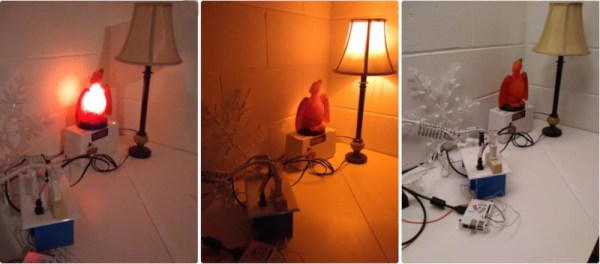
Whether you’re getting ready for work in the morning, or heading out on a camping trip in the woods, it’s nice to know what to expect when the weather rolls over the horizon. To keep abreast of things, [natethecoder] built a lamp system to stay across weather alerts.

A Raspberry Pi 3 acts as the heart of the system, with Node Red responsible for running the show. Querying the web every 5 minutes for updated weather data, it keeps track of weather alerts, as well as incoming snowfall. For a basic weather watch, a yellow lamp is lit, while there’s a red lamp for more serious warnings. A Christmas decoration serves as the indicator for snow. The lamps are all controlled by mains-rated solid state relays, making it easy to swap out the lamps for other devices if so desired down the track. There’s also a lamp test subroutine that fires on startup to ensure everything is working correctly.

It’s a handy way to get your weather info at a glance, and would prove useful to anyone living in a storm-prone area. For something more portable, consider this umbrella that tells you the weather.

Super Nice LED Lamp Is Super Simple

If you’re looking for a fancy LED lamp, the Internet can provide in spades. There are all manner of flashy-this and glowing-that, often with wild and impressive designs made with high-end tools. However, when it came time to decorate the apartment, [thebigpotatoe] wanted to build something simple that anyone could attempt. From this, the Super Simple RGB WiFi Lamp was created.

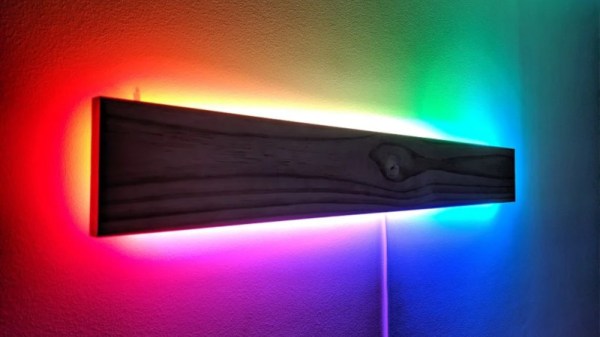
The body of the lamp consists of a plank of wood. It may not sound like much, but thanks to a nifty design, it actually comes out looking remarkably stylish. The plank is fitted with aluminium angle on the back, and a strip of WS2812B LEDs are wrapped around the perimeter of the board. An ESP8266 NodeMCU is fitted to run the show, and powered from a mains supply to allow it to run all day.

The trick here is that the LEDs are mounted on the back of the board, where they are out of direct sight. The light from the LEDs is projected onto the wall the lamp is mounted on, giving a nice smooth effect without requiring any dedicated diffusers. There’s a series of animations coded in, which look great, particularly when the animations wrap around the end of the lamp.

It’s a great addition to the apartment’s feature wall, and goes to show that you don’t need world-beating crafting skills to make a great piece for your home. You can even go all out, and light your whole room this way. Video after the break.

Continue reading “Super Nice LED Lamp Is Super Simple”

X-Printer Fits In A Backpack

3D printers are great for rapid prototyping, but they’re not usually what you’d call… portable. For [Malte Schrader], that simply wouldn’t do – thus, the X-printer was born!

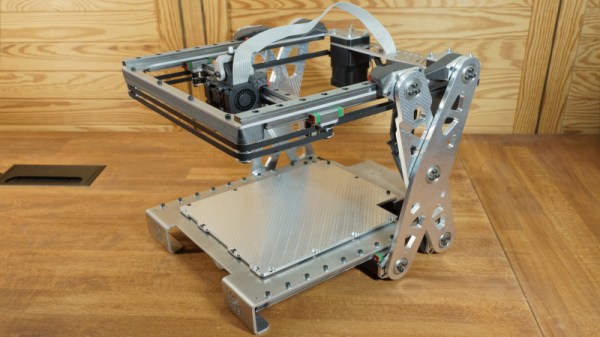
The X-printer is a fused-deposition printer built around a CoreXY design. Its party piece is its folding concertina-style Z-axis, which allows the printer to have a build volume of 160x220x150mm, while measuring just 300x330x105mm when folded. That’s small enough to fit in a backpack!

Getting the folding mechanism to work took some extra effort, with the non-linear Z-axis requiring special attention in the firmware. The printer runs Marlin 1, chosen for its faster compile time over Marlin 2. Other design choices are made with an eye to ruggedness. The aluminium frame isn’t as light as it could be, but adds much needed rigidity and strength. We’d love to see a custom case that you could slide the printer into so it would be protected while stowed.

It’s a build that shows there’s still plenty to be gained from homebrewing your own printer, even in the face of unprecedented options on the market today. We’ve seen other unique takes on the portable printer concept before, too. Video after the break.

Continue reading “X-Printer Fits In A Backpack”

Interactive LED Dome Glows With The Best Of Them

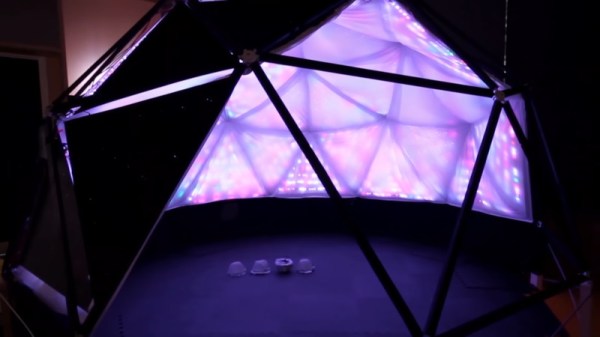
With the price and availability of components these days, it’s easier than ever to throw a whole pile of LEDs at a build and get them flashing away. The hard part is doing it well. [Amy Goodchild] is an artist, and has a knack for producing rather beautiful LED projects. The When in Dome installation is no exception.

The build is based around a large geodesic dome, fitted with LED panels that glow and react to the occupants inside. Using the Microsoft Kinect as a sensor enables the dome to map out what’s happening in 3D space, and use this data to guide its animations. WS2812B LED strips were used, in combination with a Fadecandy controller along with Processing. This is a powerful combination which makes designing attractive LED effects easier, without forcing users to go to the effort of writing their own libraries or optimizing their microcontroller code.

For those more interested in the dome itself, you’ll be happy to know that [Amy] doesn’t skimp on the details there either. The build actually started as a commercially available kit, though there’s still plenty of manual cutting, screwing, and painting required. She does an excellent job documenting the dome build through a series of videos, and walks the reader through some of the design decisions she made (and would remake, if given the chance).

People love geodesic domes at the best of times; adding an interactive LED installation just takes things to the next level. We’ve seen them used as greenhouses too, and they make a great hackerspace project as well. Video after the break.

Continue reading “Interactive LED Dome Glows With The Best Of Them”

Copper Coil Lamp Built With 3D Printed Tools

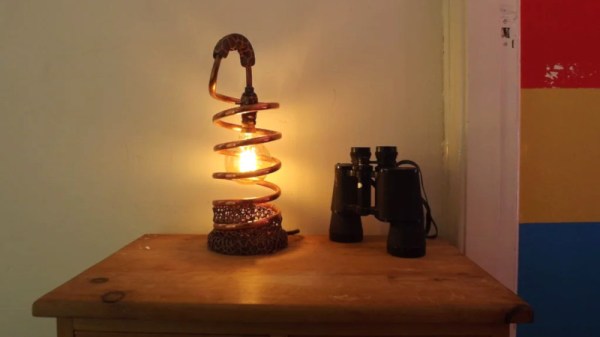
3D printing is a great way to create complex geometric forms. However, it can be very slow, and parts may lack strength compared to other alternatives. There are other ways to take advantage of this technology however, as shown in the build of this tidy voronoi lamp. 

The lamp is so-called for its voronoi-patterned base, named after the mathematical concept. 3D printing is used to create the base, which would be very difficult to create with traditional subtractive machining methods. A copper coil is then used to give the lamp some height, as well as act as protection for the filament bulb. Here, 3D printing helps out in a different way, being used to create a jig to allow the copper to be quickly wound into an accurate coil shape. The coil also serves to act as a conduit for the mains wiring, giving the lamp a neat finished appearance.

The project goes to show that even if 3D printing is appropriate to produce your final parts, it may be of help to create useful jigs or tools to get the job done. We’ve even seen similar applications before in the microcontroller space!