Supercon 2024: Using An Oscilloscope To Peek Below The Noise Floor

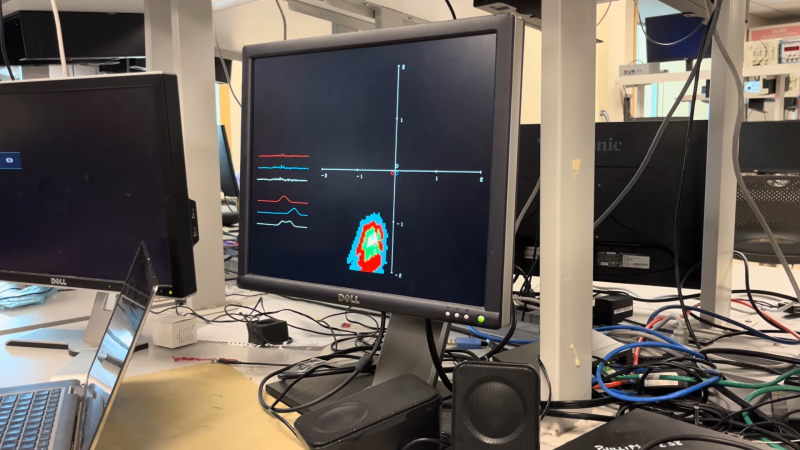
When you’re hunting for a signal with your oscilloscope, the stronger it is, the better. If it’s weak, you might struggle to tease it out from other interference, or even from the noise floor itself. You might wish that you were looking for something more obvious rather than the electromagnetic equivalent of a needle in a haystack.

Finding hidden signals below the noise floor may be a challenge, but it needn’t be an insurmountable one. James Rowley and Mark Omo came to the 2024 Hackaday Superconference to tell us how to achieve this with the magic of lock-in amplifiers.

Continue reading “Supercon 2024: Using An Oscilloscope To Peek Below The Noise Floor”

The Commodore 64 Gets An HDMI Upgrade

The Commodore 64 may remain the best selling computer of all time, but it has one major flaw. It doesn’t have HDMI! That makes it a total pain to use with modern displays. Thankfully, [Side Projects Lab] has whipped up an HDMI output board to solve this concerning oversight from the original designers.

The project was inspired by work by [Copper Dragon], who whipped up a nifty RGB output board. This device worked by reading the inputs to the C64’s VIC II graphics chip, which it then used to recreate a pixel-perfect video frames to then produce a quality analog video output. [Side Projects Lab] figured the same interception technique would be useful for producing a quality HDMI output.

The result was the HD-64. It sits inside the C64 in place of the original RF modulator. It uses an interleaver socket to capture digital signals going to the VIC II. It then feeds these signals to an emulated VIC II running inside an FPGA, which creates the pixel-perfect screen representation and synthesizes the proper digital HDMI output. Meanwhile, the analog audio output from the SID chip is captured from the RF modulator’s original header, and sent out via the HDMI output as well. The default output is super-sharp, but the device can be configured to allow scanlines and anti-aliasing if that’s more to your tastes.

If you want to hook your C64 up to a modern screen, this is going to be one of the tidiest and sharpest ways to do it. We’ve seen similar hacks for other platforms before, too. Video after the break.

Continue reading “The Commodore 64 Gets An HDMI Upgrade”

Nerf Blaster Becomes Remote Control Turret

For most of us, turrets that aim and shoot at things are the sole domain of video games. However, they’re remarkably easy to build with modern technology, as [meub] demonstrates. Meet the SwarmTurret.

The build is based around an existing foam blaster, namely the Nerf Swarmfire. This blaster was chosen for being easy to integrate into the build, thanks to its motorized direct-plunger firing mechanism and electronic trigger. It also has the benefit of being far less noisy and quicker to fire than most flywheel blasters.

For this build, the Nerf blaster was slimmed down and fitted to a turret base built with hobby servos and 3D printed components. The blaster is also fitted with a webcam for remote viewing. A Raspberry Pi is running the show, serving up a video feed and allowing aiming commands to be sent via a Websockets-based interface. Thus, you can login via a web browser on your phone or laptop, and fire away at targets to your heart’s content.

We’ve featured some great turrets before, like this Portal-themed unit.

Continue reading “Nerf Blaster Becomes Remote Control Turret”

LED Matrix Built For M.2 Interface

The M.2 slot is usually used for solid-state storage devices. However, [bitluni] had another fun idea for how to use the interface. He built an M.2 compatible LED matrix that adds a little light to your motherboard.

[bitluni] built a web tool for sending images to the matrix.
[bitluni] noted that the M.2 interface is remarkably flexible, able to offer everything from SATA connections to USB, PCI Express, and more. For this project, he elected to rely on PCI Express communication, using a WCH CH382 chip to translate from that interface to regular old serial communication.

He then hooked up the serial interface to a CH32V208 microcontroller, which was tasked with driving a 12×20 monochrome LED matrix. Even better, he was even able to set the microcontroller up to make it programmable upon first plugging it into a machine, thanks to its bootloader supporting serial programming out of the box. Some teething issues required rework and modification, but soon enough, [bitluni] had the LEDs blinking with the best of them. He then built a web-based drawing tool that could send artwork over serial direct to the matrix.

While most of us are using our M.2 slots for more traditional devices, it’s neat to see this build leverage them for another use. We could imagine displays like this becoming a neat little add-on to a blingy computer build for those with a slot or two to spare. Meanwhile, if you want to learn more about M.2, we’ve dived into the topic before.

Continue reading “LED Matrix Built For M.2 Interface”

EMF Forming Was A Neat Aerospace Breakthrough

Typically, when we think about forming metal parts, we think about beating them with hammers, or squeezing them with big hydraulic presses. But what if magnets could do the squeezing? As it turns out—Grumman Aerospace discovered they can, several decades ago! Even better, they summed up this technique in a great educational video which we’ve placed below the break.

The video concerns the development of the Grumman EMF Torque Tube. The parts are essentially tubes with gear-like fittings mounted in either end, which are fixed with electromagnetic forming techniques instead of riveting or crimping. Right away, we’re told the key benefits—torque tubes built this way are “stronger, lighter, and more fatigue resistant” than those built with conventional techniques. Grumman used these torque tubes in such famous aircraft as the F-14 Tomcat, highlighting their performance and reliability.

Continue reading “EMF Forming Was A Neat Aerospace Breakthrough”

Tearing Down And Hacking The T2S+ Thermal Camera

[Dmytro] was able to lay his hands on a InfiRay T2S+ camera. It’s a capable thermal imaging unit that comes at a cheaper price than many of its rivals. [Dmytro] decided to pull it apart to see what makes it tick, and he discovered a few interesting things along the way.

Like so much modern hardware, pulling the case apart does require some spudging and levering. Once inside, though, it comes apart in a relatively straightforward manner. Once inside, [Dmytro] notes some similarities between this camera and the Flir Lepton, another affordable thermal camera on the market. He also finds a clone of the Cypress FX2LP chip, which is used for talking USB. There’s also an Gowin FPGA inside, with [Dmytro] suspecting the gateware onboard could be modified. If so, the camera may be a candidate for running open source firmware in future.

What bothered [Dmytro] about this camera, though, was the software. When used with an Android phone, the camera demands the use of a proprietary app with with questionable permissions. It can be used on a regular computer, where it appears as a standard webcam. However, in this mode, the camera fails to self-calibrate, and the images quickly become useless. [Dmytro] worked to hack around this, by figuring out a way to trigger calibrations and run the proper image corrections manually when using the camera without the smartphone app. He also explores techniques to improve the resolution of the thermal measurements made by the camera.

We’ve seen some other neat thermal camera hacks over the years. Video after the break.

Continue reading “Tearing Down And Hacking The T2S+ Thermal Camera”

POV On The Flipper Zero

The Flipper Zero can do all kinds of neat stuff, like helping you cut keys or decode various radio transmissions. However, until now, it hasn’t been particularly adept at persistence of vision tasks. The LightMessenger was designed for that very purpose, and [Derek] recently wrote up a deep-dive into the interesting gadget.

The device doing its job.

The LightMessenger is a hardware add-on module developed by LAB401 in collaboration with [TIX LE GEEK] for the Flipper Zero. In persistence-of-vision mode, you can plug it in via the GPIO header and display messages in the air by shaking it around. Even better, you can do so in color, with a height resolution of 16 pixels—meaning you can display some nice text or basic graphics. You can key in different text or select and edit bitmaps using the utility on the Flipper screen itself. There’s even a simple flashlight mode, because why not?

In the second part of [Derek]’s write-up, he also goes into detail on the development and manufacturing process for the device.

Files are on GitHub for the curious. We’ve gone over the basics of POV projects before, too.

Continue reading “POV On The Flipper Zero”