How Pollution Controls For Cargo Ships Made Global Warming Worse

In 2020 international shipping saw itself faced with new fuel regulations for cargo ships pertaining to low sulfur fuels (IMO2020). This reduced the emission of sulfur dioxide aerosols from these ships across the globe by about 80% practically overnight and resulting in perhaps the biggest unintentional geoengineering event since last century.

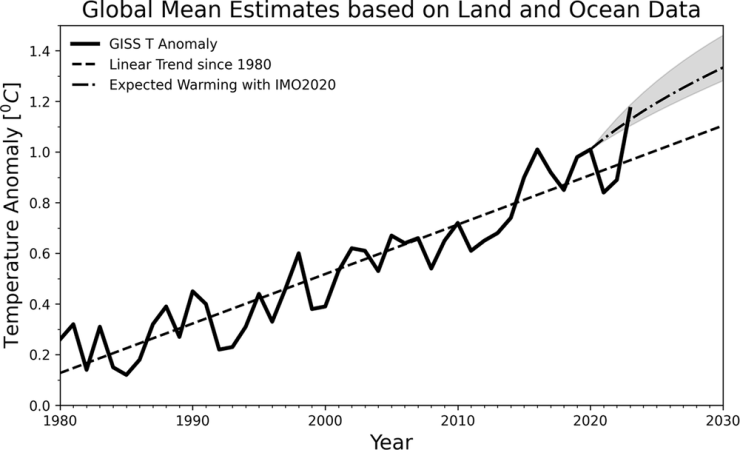
As detailed in a recent paper by [Tianle Yuan] et al. as published in Nature, by removing these aerosols from the Earth’s atmosphere, it also removed their cooling effect. Effectively this change seems to have both demonstrated the effect of solar engineering, as well as sped up the greenhouse effect through radiative forcing of around 0.2 Watt/m2 of the global ocean.

The inadvertent effect of the pollution by these cargo ships appears to have been what is called marine cloud brightening (MCB), with the increased reflectivity of said clouds diminishing rapidly as these pollution controls came into effect. This was studied by the researchers using a combination of satellite observations and a chemical transport model, with the North Atlantic, the Caribbeans and South China Sea as the busiest shipping channels primarily affected.

Although the lesson one could draw from this is that we should put more ships on the oceans burning high-sulfur fuels, perhaps the better lesson is that MCB is a viable method to counteract global warming, assuming we can find a method to achieve it that doesn’t also increase acid rain and similar negative effects from pollution.

Featured image: Time series of global temperature anomaly since 1980. (Credit: Tianle Yuan et al., Nature Communications Earth Environment, 2024)
The Glacial IPv6 Transition: Raising Questions On Necessity And NAT-Based Solutions

A joke in networking circles is that the switch from IPv4 to IPv6 is always a few years away. Although IPv6 was introduced in the early 90s as a result of the feared imminent IPv4 address drought courtesy of the blossoming Internet. Many decades later, [Geoff Huston] in an article on the APNIC blog looks back on these years to try to understand why IPv4 is still a crucial foundation of the modern Internet while IPv6 has barely escaped the need to (futilely) try to tunnel via an IPv4-centric Internet. According to a straight extrapolation by [Geoff], it would take approximately two more decades for IPv6 to truly take over from its predecessor.

Although these days a significant part of the Internet is reachable via IPv6 and IPv6 support comes standard in any modern mainstream operating system, for some reason the ‘IPv4 address pool exhaustion’ apocalypse hasn’t happened (yet). Perhaps ironically, this might as [Geoff] postulates be a consequence of a lack of planning and pushing of IPv6 in the 1990s, with the rise of mobile devices and their use of non-packet-based 3G throwing a massive spanner in the works. These days we are using a contrived combination of TLS Server Name Indication (SNI), DNS and Network Address Translation (NAT) to provide layers upon layers of routing on top of IPv4 within a content-centric Internet (as with e.g. content distribution networks, or CDNs).

While the average person’s Internet connection is likely to have both an IPv4 and IPv6 address assigned to it, there’s a good chance that only the latter is a true Internet IP, while the former is just the address behind the ISP’s CG-NAT (carrier-grade NAT), breaking a significant part of (peer to peer) software and services that relied on being able to traverse an IPv4 Internet via perhaps a firewall forwarding rule. This has now in a way left both the IPv4 and IPv6 sides of the Internet broken in their own special way compared to how they were envisioned to function.

Much of this seems to be due to the changes since the 1990s in how the Internet got used, with IP-based addressing of less importance, while giants like Cloudflare, AWS, etc. have now largely become ‘the Internet’. If this is the path that we’ll stay on, then IPv6 truly may never take over from IPv4, as we will transition to something entirely else. Whether this will be something akin to the pre-WWW ‘internet’ of CompuServe and kin, or something else will be an exciting revelation over the coming years and decades.

Header: Robert.Harker [CC BY-SA 3.0].

Chinese Humanoid Robot Establishes New Running Speed Courtesy Of Running Shoes

As natural as walking is to us tail-less bipedal mammals, the fact of the matter is that it took many evolutionary adaptations to make this act of controlled falling forward work (somewhat) reliably. It’s therefore little wonder that replicating bipedal walking (and running) in robotics is taking a while. Recently a Chinese humanoid robot managed to bump up the maximum running speed to 3.6 m/s (12.96 km/h), during a match between two of Robot Era’s STAR1 humanoid robots in the Gobi desert.

For comparison, the footspeed of humans during a marathon is around 20 km/h and significantly higher with a sprint. These humanoid robots did a 34 minute run, with an interesting difference being that one was equipped with running shoes, which helped it reach these faster speeds. Clearly the same reasons which has led humans to start adopting footwear since humankind’s hunter-gatherer days – including increased grip and traction – also apply to humanoid robots.

That said, it looks like the era when humans can no longer outrun humanoid robots is still a long time off.

Continue reading “Chinese Humanoid Robot Establishes New Running Speed Courtesy Of Running Shoes”

Using An OLED Display’s Light For Embedded Sensors

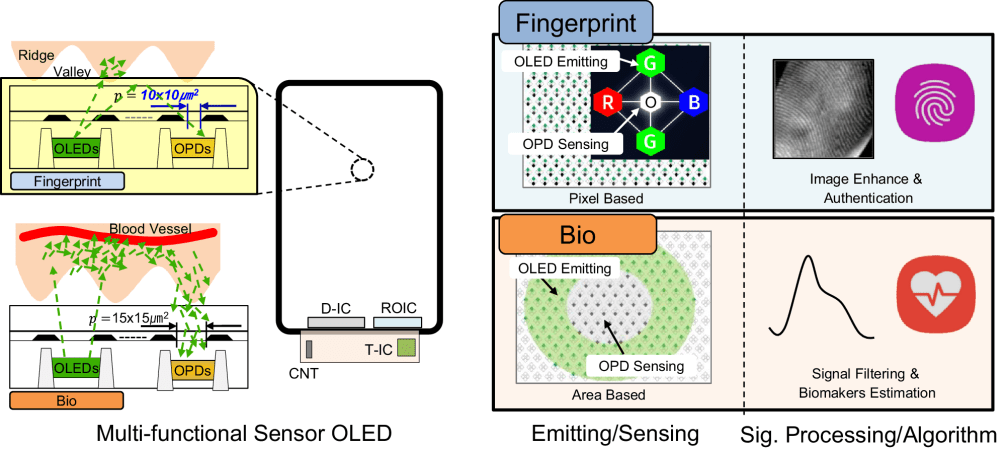
These days displays are increasingly expected to be bidirectional devices, accepting not only touch inputs, but also to integrate fingerprint sensing and even somehow combine a camera with a display without punching a hole through said display. Used primarily on smartphone displays, these attempts have been met with varying degrees of success. But a paper published in the Communications Engineering journal describes a version which combines an OLED with photosensors in the same structure — a design that may provide a way to make such features much more effective.

The article by [Chul Kim] and colleagues of the Samsung Display Research Center in South Korea the construction of these bidirectional OLED displays is described, featuring the standard OLED pixels as well as an organic photodiode (OPD) placed side-by-side. Focusing on the OLED’s green light for its absorption characteristics with the human skin, the researchers were able to use the produced OLED/OPD hybrid display for fingerprint recognition, as well as a range of cardiovascular markers, including heart rate, blood pressure, etc.

The basic principle behind these measurements involves photoplethysmography, which is commonly used in commercially available pulse oximeters. Before these hybrid displays can make their way into commercial devices, there are still a few technical challenges to deal with, in particular electrical and optical leakage. The sample demonstrated appears to work well in this regard, but the proof is always in the transition from the lab to mass-production. We have to admit that it would be rather cool to have a display that can also handle touch, fingerprints and record PPG data without any special layers or sensor chips.

Keeping Tabs On An Undergraduate Projects Lab’s Door Status

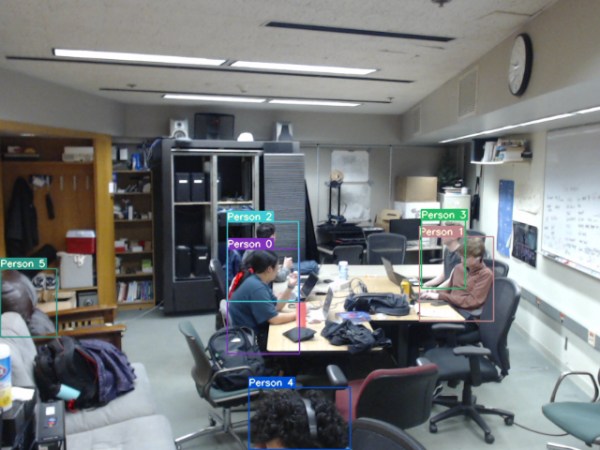
Over at the University of Wisconsin’s Undergraduate Projects Lab (UPL) there’s been a way to check whether this room is open for general use by CS undergraduates and others practically for most of the decades that it has existed. Most recently [Andrew Moses] gave improving on the then latest, machine vision-based iteration a shot. Starting off with a historical retrospective, the 1990s version saw a $15 camera combined with a Mac IIcx running a video grabber, an FTP server and an HP workstation that’d try to fetch the latest FTP image.

As the accuracy of this system means the difference between standing all forlorn in front of a closed UPL door and happily waddling into the room to work on some projects, it’s obvious that any new system had to be as robust as possible. The machine vision based version that got installed previously seemed fancy: it used a Logitech C920 webcam, a YOLOv7 MV model to count humanoids and a tie into Discord to report the results. The problem here was that this would sometimes count items like chairs as people, and there was the slight issue that people in the room didn’t equate an open door, as the room may be used for a meeting.

Thus the solution was changed to keeping track of whether the door was open, using a sensor on the two doors into the room. Sadly, the captive-portal-and-login-based WiFi made the straightforward approach with a reed sensor, a magnet and an ESP32 too much of a liability. Instead the sensor would have to communicate with a device in the room that’d be easier to be updated, ergo a Zigbee-using door sensor, Raspberry Pi with Zigbee dongle and Home Assistant (HA) was used.

One last wrinkle was the need to use a Cloudflare-based tunnel add-on to expose the HA API from the outside, but now at long last the UPL door status can be checked with absolute certainty that it is correct. Probably.

Featured image: The machine vision-based room occupancy system at UoW’s UPL. (Credit: UPL, University of Wisconsin)

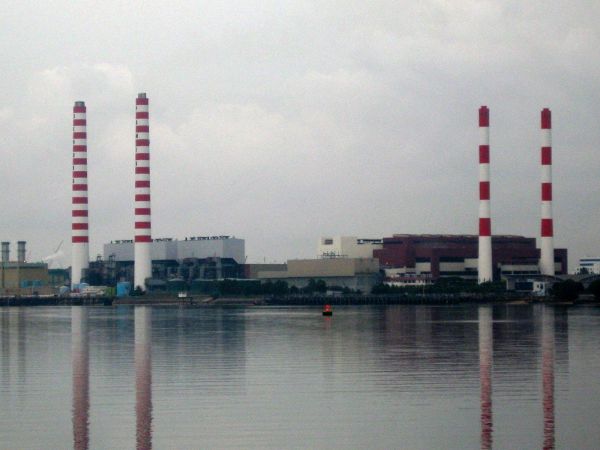
Senoko natural gas and oil-fired power station, Singapore in 2007. (Credit: Terence Ong)

Singapore’s 4300 Km Undersea Transmission Line With Australia Clears Regulatory Hurdle

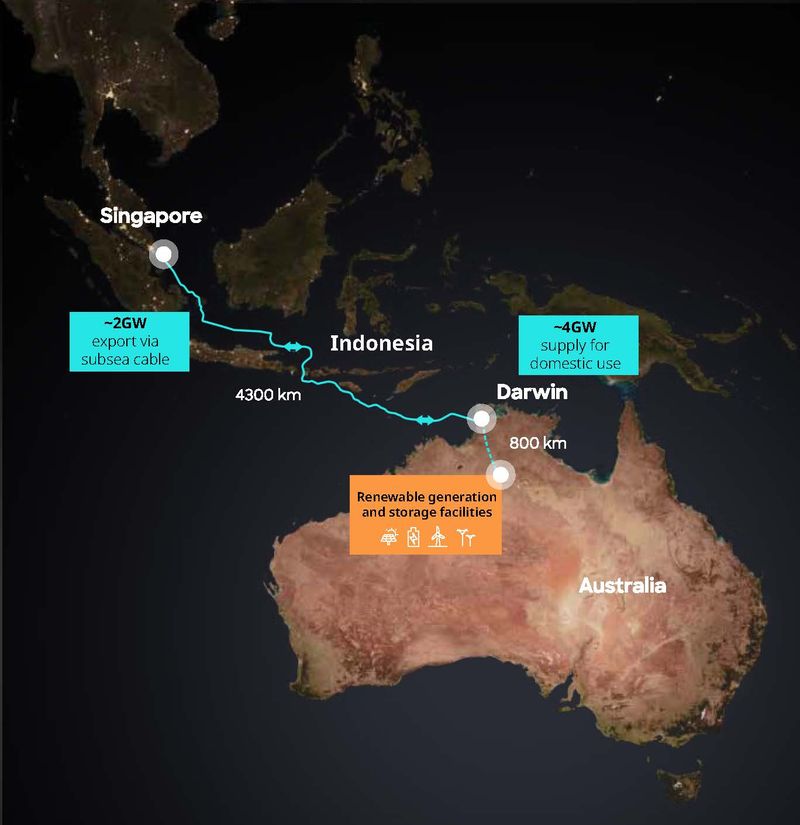
The proposed AAPowerLink transmission line between Darwin (Australia) and Singapore. (Credit: Sun Cable)

Recently Singapore’s Energy Market Authority (EMA)  granted Sun Cable conditional approval for its transmission line with Australia. Singapore has been faced for years now with the dilemma that its population’s energy needs keep increasing year-over-year, while it has very little space to build out its energy-producing infrastructure, least of all renewables with their massive footprints. This has left Singapore virtually completely dependent on natural gas-burning thermal plants. Continue reading “Singapore’s 4300 Km Undersea Transmission Line With Australia Clears Regulatory Hurdle”

Feeling A Pong Of Nostalgia: Does It Hold Up In 2024?

We have probably all been there: that sudden memory of playing a (video) game and the good memories associated with said memory. Yet how advisable is it to try and re-experience those nostalgic moments? That’s what [Matt] of the Techmoan YouTube channel decided to give a whirl when he ordered the Arcade1Up Pong 2 Player Countercade game system. This comes loaded with multiple variants of the Pong game, including Pong Doubles and Pong Sports, in addition to Warlords, Super Breakout and Tempest. This unit as the name suggests allows for head-to-head two-player gaming.

This kind of ‘countercade’ system is of course much smaller than arcade versions, but you would expect it to give the Pong clones which [Matt] played as a youngster a run for their money at least. Ultimately [Matt] – after some multiplayer games with the Ms. – concluded that this particular nostalgia itch was one that didn’t have to be scratched any more. While the small screen of this countercade system and clumsy interface didn’t help much, maybe Pong just isn’t the kind of game that has a place in 2024?

From our own point of view of having played Pong (and many other ‘old’ games) on a variety of old consoles at retro events & museums, it can still be a blast to play even just Pong against a random stranger at these places. Maybe the issue here is that nostalgia is more about the circumstances of the memory and less of the particular game or product in question. Much like playing Mario Kart 64 on that 20″ CRT TV with three buddies versus an online match in a modern Mario Kart. It’s just not the same vibe.

Continue reading “Feeling A Pong Of Nostalgia: Does It Hold Up In 2024?”