Using Integer Addition To Approximate Float Multiplication

Once the domain of esoteric scientific and business computing, floating point calculations are now practically everywhere. From video games to large language models and kin, it would seem that a processor without floating point capabilities is pretty much a brick at this point. Yet the truth is that integer-based approximations can be good enough to hit the required accuracy. For example, approximating floating point multiplication with integer addition, as [Malte Skarupke] recently had a poke at based on an integer addition-only LLM approach suggested by [Hongyin Luo] and [Wei Sun].

As for the way this works, it does pretty much what it says on the tin: adding the two floating point inputs as integer values, followed by adjusting the exponent. This adjustment factor is what gets you close to the answer, but as the article and comments to it illustrate, there are plenty of issues and edge cases you have to concern yourself with. These include under- and overflow, but also specific floating point inputs.

Unlike in scientific calculations where even minor inaccuracies tend to propagate and cause much larger errors down the line, graphics and LLMs do not care that much about float point precision, so the ~7.5% accuracy of the integer approach is good enough. The question is whether it’s truly more efficient as the paper suggests, rather than a fallback as seen with e.g. integer-only audio decoders for platforms without an FPU.

Since one of the nice things about FP-focused vector processors like GPUs and derivatives (tensor, ‘neural’, etc.) is that they can churn through a lot of data quite efficiently, the benefits of shifting this to the ALU of a CPU and expecting (energy) improvements seem quite optimistic.

Improving Magnetoplasmadynamic Ion Thrusters With Superconductors

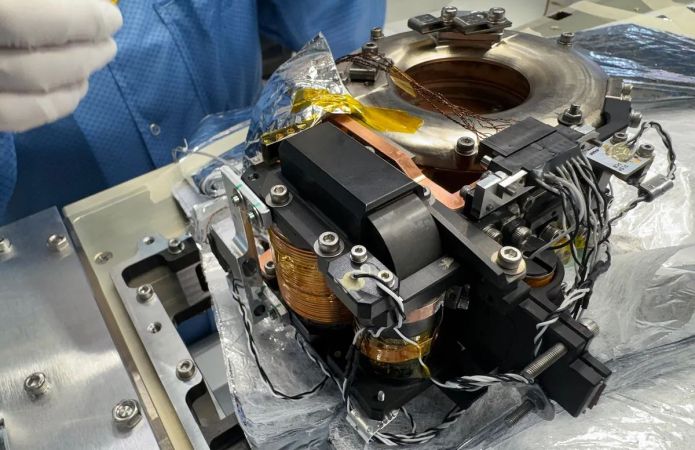
Ion thrusters are an amazing spacecraft propulsion technology, providing very high efficiency with relatively little fuel. Yet getting one to produce more thrust than that required to lift a sheet of A4 paper requires a lot of electricity. This is why they have been only used for applications where sustained thrust and extremely low fuel usage are important, such as the attitude management of satellites and other spacecraft. Now researchers in New Zealand have created a prototype magnetoplasmadynamic (MPD) thruster with a superconducting electromagnet that is claimed to reduce the required input power by 99% while generating a three times as strong a magnetic field.

Although MPD thrusters have been researched since the 1970s – much like their electrostatic cousins, Hall-effect thrusters – the power limitations on the average spacecraft have limited mission profiles. Through the use of a high-temperature superconducting electromagnet with an integrated cryocooler, the MPD thruster should be able to generate a very strong field, while only sipping power. Whether this works and is as reliable as hoped will be tested this year when the prototype thruster is installed on the ISS for experiments.

FreeDOS 1.4 Released

Even in 2025 there are still many applications for a simple Disk Operating System (DOS), whether this includes running legacy software (including MS-DOS games & Windows 3.x), or (embedded) systems running new software where the overhead of a full-fat Linux or BSD installation would be patently ridiculous.

This is where the FreeDOS project provides a modern, fully supported DOS, with the recent 1.4 release adding a whole range of features and updates to existing components like the FreeCOM command shell. This is the first stable release since 1.3 was released in 2022.

FreeDOS saw its first release in 1994 and has become the de facto replacement for MS-DOS — featuring many improvements to make it work well on modern hardware and a package manager to manage installed software much like on Linux & BSD. The new kernel didn’t quite make it into this release, but it and some other items will be available in the monthly test builds.

You can download the new 1.4 release here, with live & installer CD images, a USB installer and even a Floppy Edition available. System requirements include an (Intel) x86 CPU, a BIOS (or legacy UEFI mode), 640 kB of RAM and 20 MB of storage.

Why USB-C Splitters Can Cause Magic Smoke Release

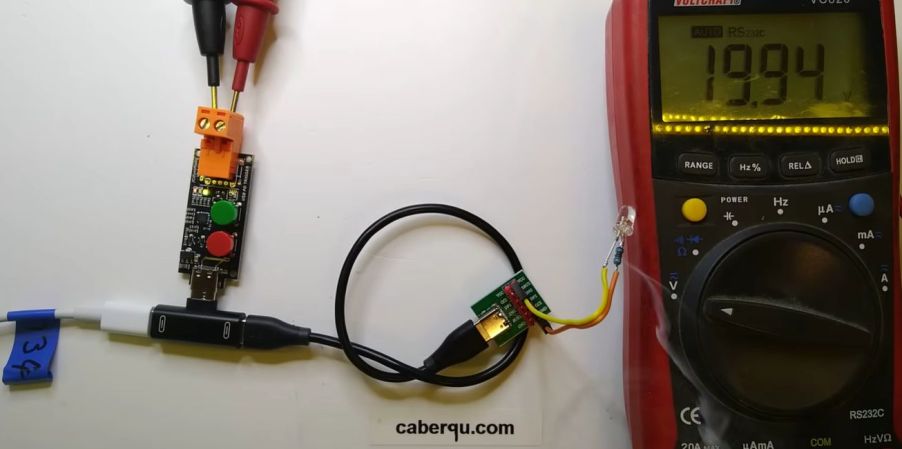
Using USB for powering devices is wonderful, as it frees us from a tangle of incompatible barrel & TRS connectors, not to mention a veritable gaggle of proprietary power connectors. The unfortunate side-effect of this is that the obvious thing to do with power connectors is to introduce splitters, which can backfire horribly, especially since USB-C and USB Power Delivery (USB-PD) were introduced. The [Quiescent Current] channel on YouTube recently went over the ways in which these handy gadgets can literally turn your USB-powered devices into a smoldering pile of ashes.

Much like Qualcomm’s Quick Charge protocols, USB-PD negotiates higher voltages with the power supply, after which this same voltage will be provided to any device that’s tapped into the power supply lines of the USB connector. Since USB-C has now also taken over duties like analog audio jacks, this has increased the demand for splitters, but these introduce many risks. Unless you know how these splitters are wired inside, your spiffy smartphone may happily negotiate 20V that will subsequently fry a USB-powered speaker that was charging off the same splitter.

In the video only a resistor and LED were sacrificed to make the point, but in a real life scenario the damage probably would be significantly more expensive.

Continue reading “Why USB-C Splitters Can Cause Magic Smoke Release” →

Teardown Of A Scam Ultrasonic Cleaner

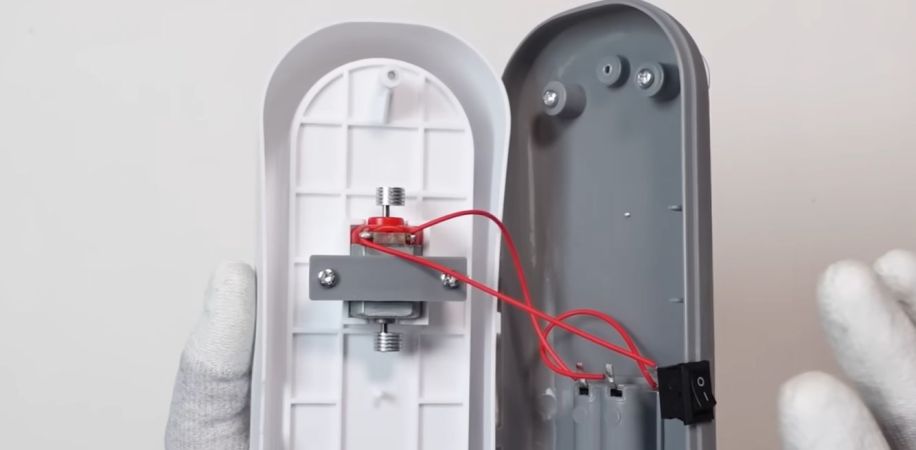
Everyone knows that ultrasonic cleaners are great, but not every device that’s marketed as an ultrasonic cleaner is necessarily such a device. In a recent video on the Cheap & Cheerful YouTube channel the difference is explored, starting with a teardown of a fake one. The first hint comes with the use of the description ‘Multifunction cleaner’ on the packaging, and the second in the form of it being powered by two AAA batteries.

Unsurprisingly, inside you find not the ultrasonic transducer that you’d expect to find in an actual ultrasonic cleaner, but rather a vibration motor. In the demonstration prior to the teardown you can see that although the device makes a similar annoying buzzing noise, it’s very different. Subsequently the video looks at a small ultrasonic cleaner and compares the two.

Among the obvious differences are that the ultrasonic cleaner is made out of metal and AC-powered, and does a much better job at cleaning things like rusty parts. The annoying thing is that although the cleaners with a vibration motor will also clean things, they rely on agitating the water in a far less aggressive way than the ultrasonic cleaner, so marketing them as something which they’re not is very unpleasant.

In the video the argument is also made that you do not want to clean PCBs with an ultrasonic cleaner, but we think that people here may have different views on that aspect.

Continue reading “Teardown Of A Scam Ultrasonic Cleaner” →

Remembering Betty Webb: Bletchley Park & Pentagon Code Breaker

S/Sgt Betty Vine-Stevens, Washington DC, May 1945.

On 31 March of this year we had to bid farewell to Charlotte Elizabeth “Betty” Webb (née Vine-Stevens) at the age of 101. She was one of the cryptanalysts who worked at Bletchley Park during World War 2, as well as being one of the few women who worked at Bletchley Park in this role. At the time existing societal biases held that women were not interested in ‘intellectual work’, but as manpower was short due to wartime mobilization, more and more women found themselves working at places like Bletchley Park in a wide variety of roles, shattering these preconceived notions.

Betty Webb had originally signed up with the Auxiliary Territorial Service (ATS), with her reasoning per a 2012 interview being that she and a couple of like-minded students felt that they ought to be serving their country, ‘rather than just making sausage rolls’. After volunteering for the ATS, she found herself being interviewed at Bletchley Park in 1941. This interview resulted in a years-long career that saw her working on German and Japanese encrypted communications, all of which had to be kept secret from then 18-year old Betty’s parents.

Until secrecy was lifted, all her environment knew was that she was a ‘secretary’ at Bletchley Park. Instead, she was fighting on the frontlines of cryptanalysis, an act which got acknowledged by both the UK and French governments years later.

Continue reading “Remembering Betty Webb: Bletchley Park & Pentagon Code Breaker” →

On Egyptian Pyramids And Why It’s Definitely Aliens

History is rather dull and unexciting to most people, which naturally invites exciting flights of fancy that can range from the innocent to outright conspiracies. Nobody truly believes that the astounding finds and (fully functioning) ancient mechanisms in the Indiana Jones and Uncharted franchises are real, with mostly intact ancient cities waiting for intrepid explorers along with whatever mystical sources of power, wealth or influence formed the civilization’s foundations before its tragic demise. Yet somehow Plato’s fictive Atlantis has taken on a life of its own, along with many other ‘lost’ civilizations, whether real or imagined.

Of course, if these aforementioned movies and video games were realistic, they would center around a big archaeological dig and thrilling finds like pot shards and cuneiform clay tablets, not ways to smite enemies and gain immortality. Nor would it involve solving complex mechanical puzzles to gain access to the big secret chamber, prior to walking out of the readily accessible backdoor. Reality is boring like that, which is why there’s a major temptation to spruce things up. With the Egyptian pyramids as well as similar structures around the world speaking to the human imagination, this has led to centuries of half-baked ideas and outright conspiracies.

Most recently, a questionable 2022 paper hinting at structures underneath the Pyramid of Khafre in Egypt was used for a fresh boost to old ideas involving pyramid power stations, underground cities and other fanciful conspiracies. Although we can all agree that the ancient pyramids in Egypt are true marvels of engineering, are we really on the cusp of discovering that the ancient Egyptians were actually provided with Forerunner technology by extraterrestrials?

Continue reading “On Egyptian Pyramids And Why It’s Definitely Aliens” →