Airloom’s Whacky Wind Clothesline Turbine Idea

What if you don’t put airfoils on a central, spinning axis, but instead have them careen around a circular track? If you’re a company called Airloom, you’d say that it’s a very cheap, very efficient and highly desirable way to install wind-based generators that can do away with those unsightly and massive 100+ meter tall wind turbines, whether on- or offshore. Although grand claims are made, and venture capital firms have poured in some money, hard data is tough to find on their exact design, or the operating details of their one and only claimed kW-level prototype.

Transpower's 'flying clothesline' wind turbine setup.
Transpower’s ‘flying clothesline’ wind turbine setup.

Despite the claims made by Airloom, they’re not the first to have this idea, with Transpower in the 1980s making itself famous with their ‘flying clothesline’ that featured a continuous loop of sails tensioned between two ropes. These ran around a pole on either end with each having a generator for a claimed total of 200 kW. Ultimately Transpower seems to have gone under along with many other wind power pioneers of the era as they couldn’t make their idea economically feasible. Something which is a definite trend in the field.

Some parts about Airloom’s design are definitely concerning, with the available images showing each airfoil running along a central rail on a number of wheels and with their ‘Power Takeoff’ (i.e. generator) not defined in any meaningful manner. Here is where [Robert Murray-Smith] had a bit of fun in a recent video, creating his own dual-chain version that somewhat resembles a mixture between the Transpower and Airloom designs. He also put the design up on Thingiverse for others to 3D print and tinker with, requiring a handful of bearings for smooth running.

For the power takeoff, [Robert] suggests that in his design the cogs around which the chain moves could be attached to a generator (like in the Transpower design), but he could see no indication of how Airloom intends to do this. Feel free to put your own speculations in the comments. And if you’re from Airloom, show us the details!

Continue reading “Airloom’s Whacky Wind Clothesline Turbine Idea”
The Slow March Of Sodium-Ion Batteries To Compete With Lithium-Ion

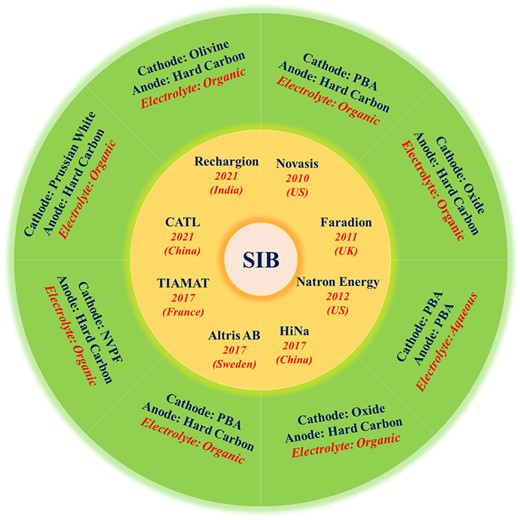
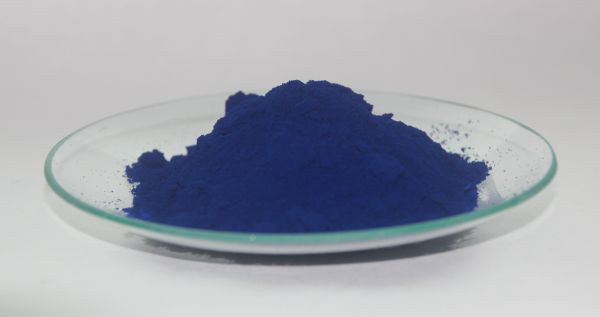
The process of creating new battery chemistries that work better than existing types is a slow and arduous one. Not only does it know more failures than successes, it’s rare that a once successful type gets completely phased out, which is why today we’re using lead-acid, NiMH, alkaline, lithium, zinc-air, lithium-ion and a host of other battery types alongside each other. For one of the up-and-coming types in the form of sodium (Na)-based batteries the same struggles are true as it attempts to hit the right balance between anode, cathode and electrolyte properties. A pragmatic solution here involves Prussian Blue for the cathode and hard carbon for the anode, as is the case with Swedish Northvolt’s newly announced sodium-ion battery (SIB) which is sampling next year.

Commercialization of different SIB battery chemistries by various companies. (Credit: Yadav et al. 2022)
Commercialization of different SIB battery chemistries by various companies. (Credit: Yadav et al., 2022)

The story of SIBs goes back well over a decade, with a recent review article by Poonam Yadav and colleagues in Oxford Open Materials Science providing a good overview of the many types of anodes, cathodes and electrolytes which have been attempted and the results. One of the issues that prevents an SIB from directly using the carbon-based anodes employed with today’s lithium-ion batteries (LIB) is its much larger ionic radius that prevents intercalation without altering the carbon material to accept Na+ ions.

This is essentially where the hard carbon (HC) anode used by a number of SIB-producing companies comes into play, which has a far looser structure that does accept these ions and thus can be used with SIBs. The remaining challenges lie then with the electrolyte – which is where an organic form is the most successful – and the material for the sodium-containing cathode.

Although oxide forms and even sodium vanadium fluorophosphate (NVPF) are also being used, Prussian Blue analogs (PBAs) are attractive for being very low-cost and effective as cathode material once processed. An efficient way to process PB into fully sodiated and reduced Prussian White was demonstrated a few years ago, followed by successive studies backing up this assessment.

Although SIBs are seeing limited commercial use at this point, signs are that if it can be commercialized for the consumer market, it would have similar capacity as current LIBs, albeit with the potential to be cheaper, more durable and easier to recycle.

Easy Hackintosh With Docker-OSX: Soon To Be Impossible?

The Docker-OSX project has to be among one of the easiest ways to get a fully functional Hackintosh off the ground on any Linux or Windows (10+) system, with the Docker image handling the heavy lifting of keeping the copy of MacOS happy and satisfied, even as the legality remains questionable, as we previously reported on in 2021. Officially, Apple’s software license for MacOS states that it can only be installed and use on Apple-branded hardware, which precludes the installation in e.g. a Docker container. This has left Docker-OSX in a gray zone where it’s technically illegal, but as it’s being advertised by its developer [Sick Codes] to be for use by security researchers who participate in Apple’s Bug Bounty program (including iOS, which requires XCode, which requires MacOS, etc.), it seems to slip through the cracks.

An obvious issue which may soon spell the end of MacOS-on-x86_64 and with it this use of Docker-OSX is that MacOS is now straddling Apple Silicon and Intel’s x86_64 architecture, with the latter no longer being sold by Apple’s in any of its systems after the recent introduction of its Apple Silicon-based Mac Pro. Although MacOS Sonoma (14) still supports x86_64, this support could be cut in MacOS 15 or 16, at which point running Docker-OSX with an Apple Silicon-only MacOS image would at the very least require an AArch64-based ARM system, though likely with an ISA extension level that matches the lowest-end Apple Silicon (ARMv8.5-A for M1).

Although this should not make it impossible to run Docker-OSX on future Linux (and perhaps Windows) systems on AArch64-based systems, it would make it more complicated and expensive as using one’s existing x86_64-based PC is no longer an option aside from adding a sluggish Qemu layer in between, which would add a significant performance penalty. If you are using Docker-OSX, what are your experiences and plans here?

Continue reading “Easy Hackintosh With Docker-OSX: Soon To Be Impossible?”

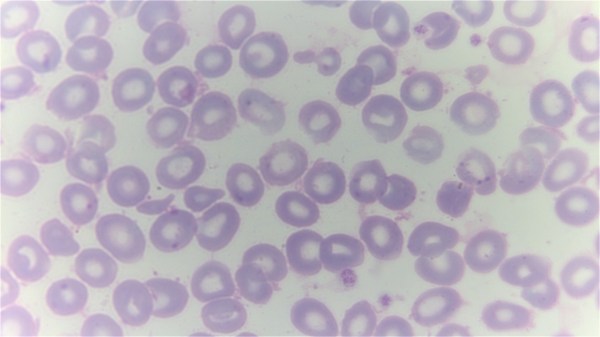
A giemsa stained blood smear from a person with beta thalassemia (Credit: Dr Graham Beards, Wikimedia Commons)

First CRISPR-Based Therapies For Sickle Cell Disease And Beta Thalassemia Approved In The UK

The gene-therapy-based treatment called Casgevy was recently approved in the UK, making it the first time that a treatment based on the CRISPR-Cas9 gene editing tool has been authorized for medical treatments. During the clinical trials, a number of patients were enrolled with either sickle cell disease (SCD) or β thalassemia, both of which are blood disorders that affect the production of healthy red blood cells. Of the 45 who enrolled for the SCD trial, 29 were evaluated in the initial 12-month efficacy assessment, with 28 of those found to be still free of the severe pain crises that characterizes SCD. For the β thalassemia trial, 42 patients were evaluated and 39 were still free of the need for red blood cell transfusions and iron chelation after the 12-month period, with the remaining three showing a marked reduction in the need for these.

Both of these blood disorders are inherited via recessive genes, meaning that in the case of SCD two abnormal copies of the β-globin (HBB) gene are required to trigger the disorder. For β thalassemia a person can be a carrier or have a variety of symptoms based on the nature of the two sets of mutated genes that involve the production of HbA (adult hemoglobin), with the severest form (β thalassemia major) requiring the patient to undergo regular transfusions. Both types of conditions have severe repercussions on overall health and longevity, with few individuals living to the age of 60.

The way that the Casgevy treatment works involves taking stem cells out of the bone marrow of the patient, after which the CRISPR-Cas9 tool is used to target the BCL11A gene and cut it out completely. This particular gene is instrumental in the switch from fetal γ globin (HBG1, HBG2) to adult β globin form. Effectively this modification causes the resulting cells to produce fetal-type hemoglobin (HbF) instead of adult HbA which would have the mutations involved in the blood disorder.

For the final step in the treatment, the modified stem cells have to be inserted back into the patient’s bone marrow, which requires another treatment to make the bone marrow susceptible to hosting the new cells. After this the patient will ideally be cured, as the stem cells produce new, HbF-producing cells that go on to create healthy hemoglobin. Although safety and costs (~US$2M per patient) considerations of such a CRISPR-Cas9 gene therapy may give pause, this has to be put against the prospect of 40-60 years of intensive symptom management.

Currently, the US FDA as well as the EU’s EMA are also looking at possibly approving the treatment, which might open the gates for similar gene-therapies.

Top image: A giemsa stained blood smear from a person with beta thalassemia. Note the lack of coloring. (Credit: Dr Graham Beards, Wikimedia Commons)

Hacking Apple’s Magic Mouse To Fix Its Worst Flaws

The Magic Mouse was first released by Apple in 2009 and was a major departure from previous designs. It was sleek, low-profile, and featured a touch pad on the top for gestures. Although the first generation was powered by two AA batteries and didn’t lead to much commentary, the 2015 redesign caused a lot of scathing memes and worse, mostly due to the rechargeable battery and the Lightning charging port that had been located on its bottom, leading to Dead Magic Mouse syndrome when you wanted to charge it. Since then myriad hackers have tried to fix the Magic Mouse’s issues, with [Ivan Kuleshov]’s recent attempt being perhaps the most straightforward and possibly successful.

Essentially, the Magic Mouse has two major flaws: ergonomics and the worst possible location of the charging port. Although both 3D models and commercial products exist to alleviate the former issue – and some of these even add wireless charging in between mousing sessions – all attempts to relocate the charging port were met by failure, as the Magic Mouse cannot be both charged and used at the same time due to how Apple designed the circuit.

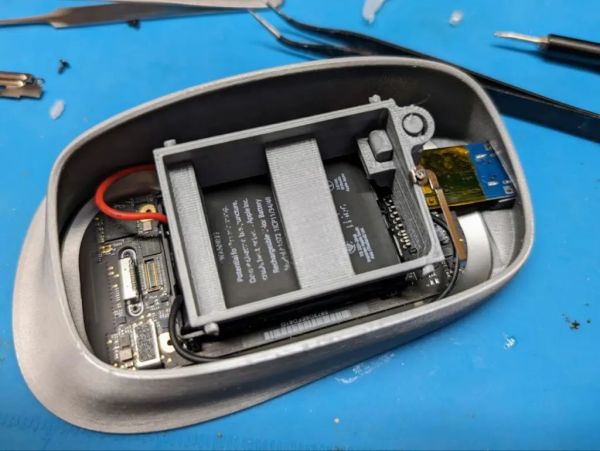
What [Ivan] did differently is that aside from tweaking some existing 3D models for Magic Mouse extensions to his liking, he also fixed the charging issue by avoiding Apple’s circuitry altogether and adding a USB-C port in the process. He also added a TP4056-based charging module, directly soldered to the battery’s terminals, that will top off the battery when plugged in. During experimentation on a live Magic Mouse, this led to the battery charge reported in MacOS increasing correspondingly. More or less, at least.

The 3D printed shell isn’t just a wrapper around the original mouse either, but splits the squat rodent into its upper and lower sections, so that the optical sensor isn’t suspended off the surface, while also keeping the touch-sensitive top section where it should be. According to [Ivan] the project files will be made available on his GitHub account in the near future.

Pineberry Pi HatDrive: Using NVMe SSDs With The Raspberry Pi 5

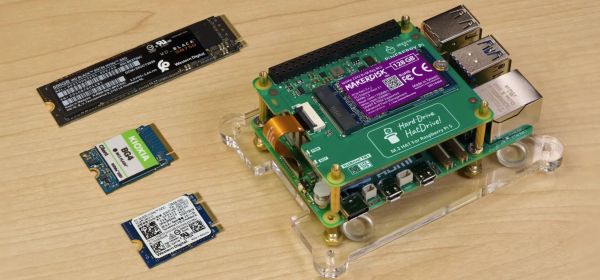
When the Raspberry Pi 5 launched, many were left chomping at the bit after seeing the PCIe FPC connector alongside the promise that an ‘NVMe SSD HAT would be forthcoming’. Although the official Raspberry Pi NVMe HAT is still a long while off, the Polish company Pineberry Pi is ramping up to release its Top & Bottom versions of its very wittily called HatDrive.

They sent a prototype to [Jeff Geerling], who has been putting his grubby mitts all over them before putting together a video showing off the HatDrive Top, which can accept 2230 and 2242 size NVMe drives.

The primary goal of adding an NVMe drive to the RPi is of course to get rid of those slow and fragile SD cards. Although the SD card standard supports near-NVMe-like speeds with UHS-III, the Raspberry Pi 5 bottoms out at UHS-I, around 100 MB/s. Despite this, using an NVMe drive for booting still takes some work, as [Jeff] lays out in a clear article. Most of this involves tweaking the /boot/config.txt file to enable external PCIe support, editing the onboard EEPROM to change the boot order (in lieu of having a PC-like BIOS screen) and getting the OS image flashed onto the NVMe drive you intend to boot from.

Although things seem to work fine during [Jeff]’s testing, some caveats remain, such as the RPi 5 officially supporting only PCIe Gen 2 x1, with Gen 3 possible, but with potential data integrity issues. There’s also the fundamental limit of having only a single lane of PCIe available. If that’s no problem, then Pineberry Pi offers the aforementioned HatDrive Top for traditional HAT-style mounting, and a Bottom version that can accept up to 2280 format NVMe SSDs. Including the provided ribbon cables, you can order the Top and Bottom for €20 and €25.99 respectively, with the first batch to ship in early December.

Continue reading “Pineberry Pi HatDrive: Using NVMe SSDs With The Raspberry Pi 5”

Additive Manufacturing Of Nickel Nanopillars Using Two-Photon Lithography

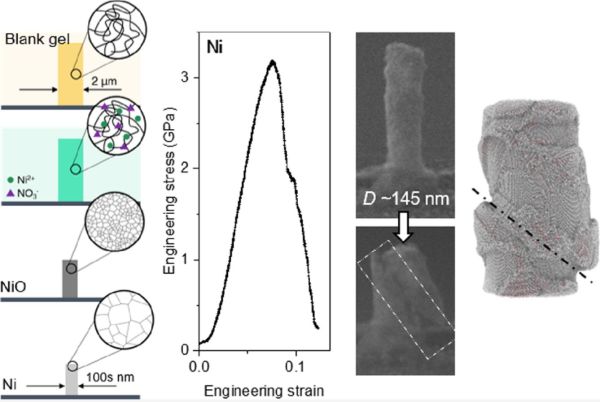
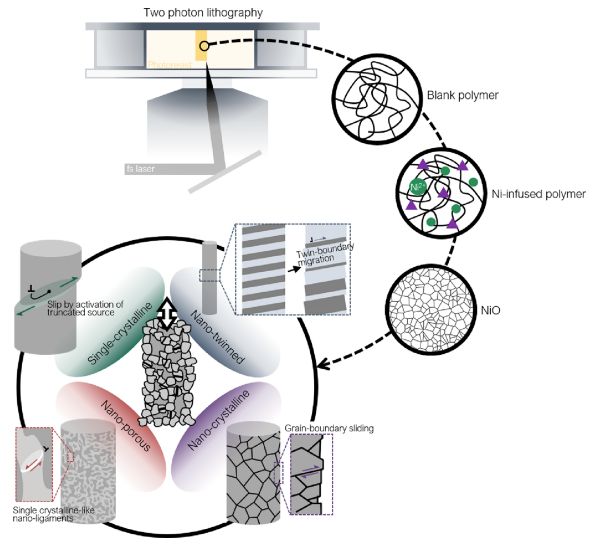
The multistep, two-photon-lithography-based additive manufacturing method forms intermediate products of blank polymer, Ni-infused polymer, and NiO while fabricating Ni
nanopillars. (Credit: Zhang et al., 2023)

Manufacturing nano-sized features is rapidly becoming an essential part of new technologies and process, ranging from catalysts to photonics and nano-scale robotics. Creating these features at scale and in a reproducible manner is a challenge, with previous attempts using methods ranging from dealloying and focused ion beams to templated electrodeposition all coming with their own drawbacks. Here recent research by Whenxin Zhang and colleagues as published in Nano Letters demonstrates a method using additive manufacturing.

Specifically, nanopillars were printed in a hydrogel polymer with a laser-based lithography method called two-photon absorption which allows for a femtosecond laser to very precisely affect a small region within the targeted material with little impact on the surrounding area. This now solid and structured polymer hydrogel was then submerged into a Ni(NO3)2 solution to infuse it with nickel. After drying, the resulting structure had the polymer burned away in a furnace, leaving just the porous Ni nanopillars.

Subsequent testing showed that these nanopillars were more robust than similar structures created using other methods, presumably due to the less ordered internal physical structure of each pillar. Based on these results, it’s likely that the same approach could be used for other types of nano-sized structures.