The Linux Scheduler And How It Handles More Cores

Sometimes you read an article headline and you find yourself re-reading it a few times before diving into the article. This was definitely the case for a recent blog post by [The HFT Guy], where the claim was made that the Linux kernel has for fifteen years now been hardlocked into not scheduling for more than 8 cores. Obviously this caused a lot of double-checking and context discovery on both Hacker News and the Level 1 Techs forum. So what is going on exactly? Did the Linux developers make an egregious error more than a decade ago that has crippled Linux performance to this day? Continue reading “The Linux Scheduler And How It Handles More Cores”

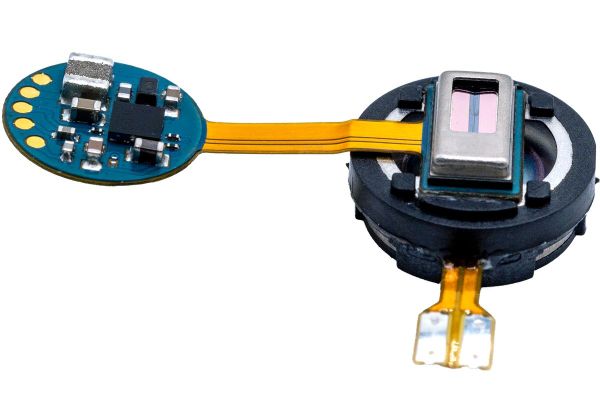
XMems Cowell MEMS-based tweeter on top of dynamic driver. (Credit: xMEMS)

After MEMS Microphones, MEMS Speakers Enter The Market

These days it’s hard to not come across solid-state (micro-electromechanical systems, MEMS) microphones, as they are now displacing electret microphones almost everywhere due to their small size and low cost. Although MEMS speakers are not impossible, creating a miniature speaker that can both displace a lot of air (‘volume’) and accurately reproduce a wide range of frequencies – unlike simple piezo buzzers – is a lot tougher. Here a startup called xMEMS figures that they have at least partially cracked the code with their piezoMEMS speakers, with Creative using the Cowell version in their brand-new Aurvana Ace in-ear monitors. Continue reading “After MEMS Microphones, MEMS Speakers Enter The Market”

Underwater Kites Buoying The Prospect Of More Tidal Power Generation

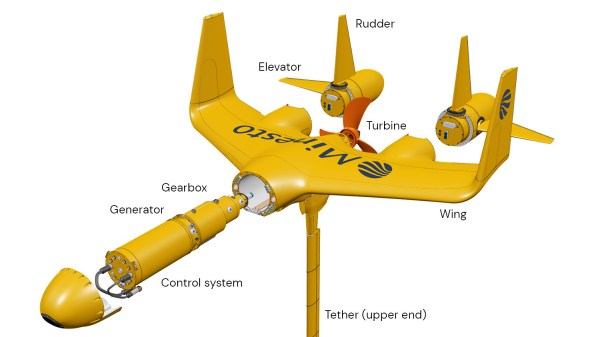
Swedish start-up Minesto has been for years trying to float the idea of having underwater turbines that generate power for use on-shore. These would be anchored to the seafloor by a long tether and move around in figure-of-eight patterns like a kite, which would increase the flow over the turbine’s blades. After a few years of trials, its 1.2 MW Dragon 12 kite will now be installed off the coast of the Faroe Islands.

Previously, Minesto had installed its much smaller DG500 (0.5 MW) kite turbine at Holyhead Deep, in Wales, where a single unit has been tested at a depth of between 65 and 91 meters. So far, only this unit has seen continuous operation. As noted in the linked Tethys report, this one unit was not connected to the grid, and research on its environmental impact is still ongoing as of September 2022. The main concerns are how it might affect cetaceans (whales, dolphins, etc.), including potential collisions with these as well as diving birds who might end up diving in the midst of a swarm of kites moving about at fairly high speeds.

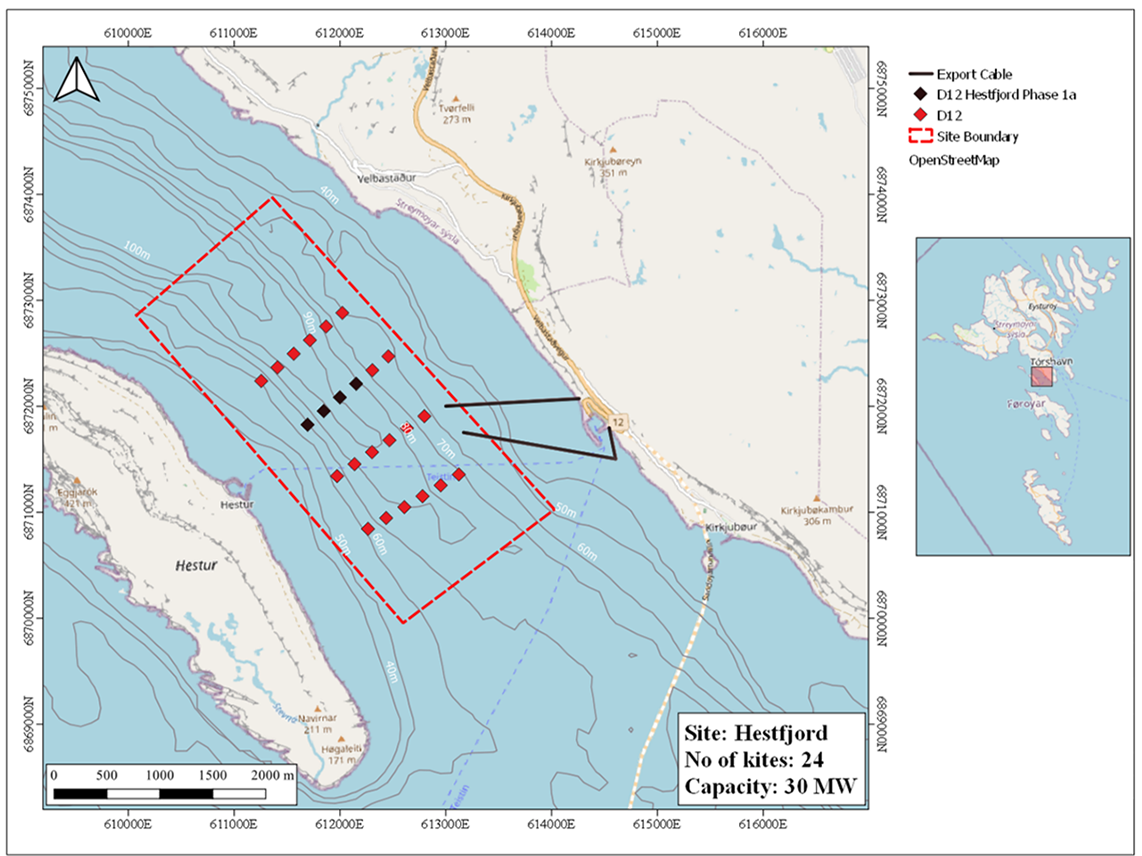
One of the proposed Minesto Dragon 12 kite array installation sites at the Faroe Islands. (Credit: Minesto)

Although by itself putting a turbine into the much stronger and energetic ocean currents – not to mention near-continuous – makes sense, the marine environment is a tough one to survive. The DG500 prototype has seen a few years of use, but this would be the first large-scale deployment of such a system and thus the first significant long-term durability test. The goal at the Faroe Islands is to install 120 MW of capacity, across four kite groups, joining the smaller Dragon 4 (0.4 MW) unit that was grid-connected in May of last year.

Depending on the results, including the economics, this technology could prove to be either much better and cheaper than off-shore wind turbines, or turn out to be saddled with fundamental flaws that has plagued previous attempts to make use of the strong currents and tides that make the world’s oceans and seas into one of Nature’s most impressive sights.

The Quaint History Of The Commodore ChessMate

The Commodore International of the 1970s was a company which dabbled in a bit of everything when it came to consumer electronics, with the Commodore ChessMate being a prime example of the circuitous way that some of its products came to be. Released in 1978, its existence was essentially the result of MOS Technology releasing the KIM-1 single board computer in 1976. In May of that year, [Peter Jennings] traveled all the way from Toronto, Canada to Cleveland, USA to attend the Midwest Regional Computer Conference and acquire a KIM-1 system and box of manuals for a mere $245. On this KIM-1 he’d proceed to develop his own chess game, called MicroChess, implemented fully in 6502 ASM to fit within the 1 kB of RAM.

As one of the first major applications to run on the KIM-1, it quickly became an international hit, which caught the attention of Commodore – which had acquired MOS Technology by then – who ended up contacting [Peter] about a potential chess computer project. This turned out to based on the custom MOS 6504 CPU, while sharing many characteristics with the KIM-1 SBC. Being a MicroChess-only system, the user experience was optimized for more casual users, with the user manual providing clear instructions on how to start a new game and how to enter the position of a newly moved piece, along with no less than eight difficulty settings.

If you’re feeling like making your own ChessMate, or want to dig into the technical details, this excellent article by [Hans Otten] has got you covered.

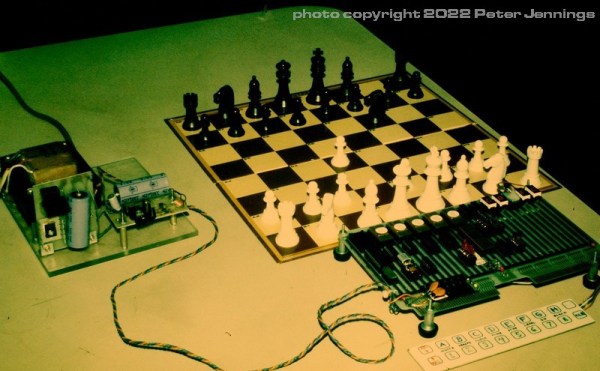
Top image: Commodore ChessMate Prototype in 1978. (Credit: Peter Jennings)

(Thanks to [Stephen Walters] for the tip)

Testing Various Properties Of LEGO-Compatible Axles

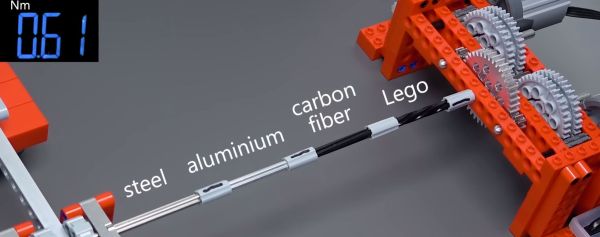
If you ever wondered what’d happen if you were to use LEGO Technic parts, but they were made out of something other than plastic, the [Brick Experiment Channel] has got you covered. Pitting original Lego axles against their (all except steel commercially available) equivalents made out of carbon fiber, aluminium and steel, some of the (destructive) results are very much expected, while some are more surprising.
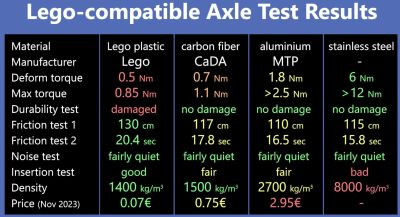
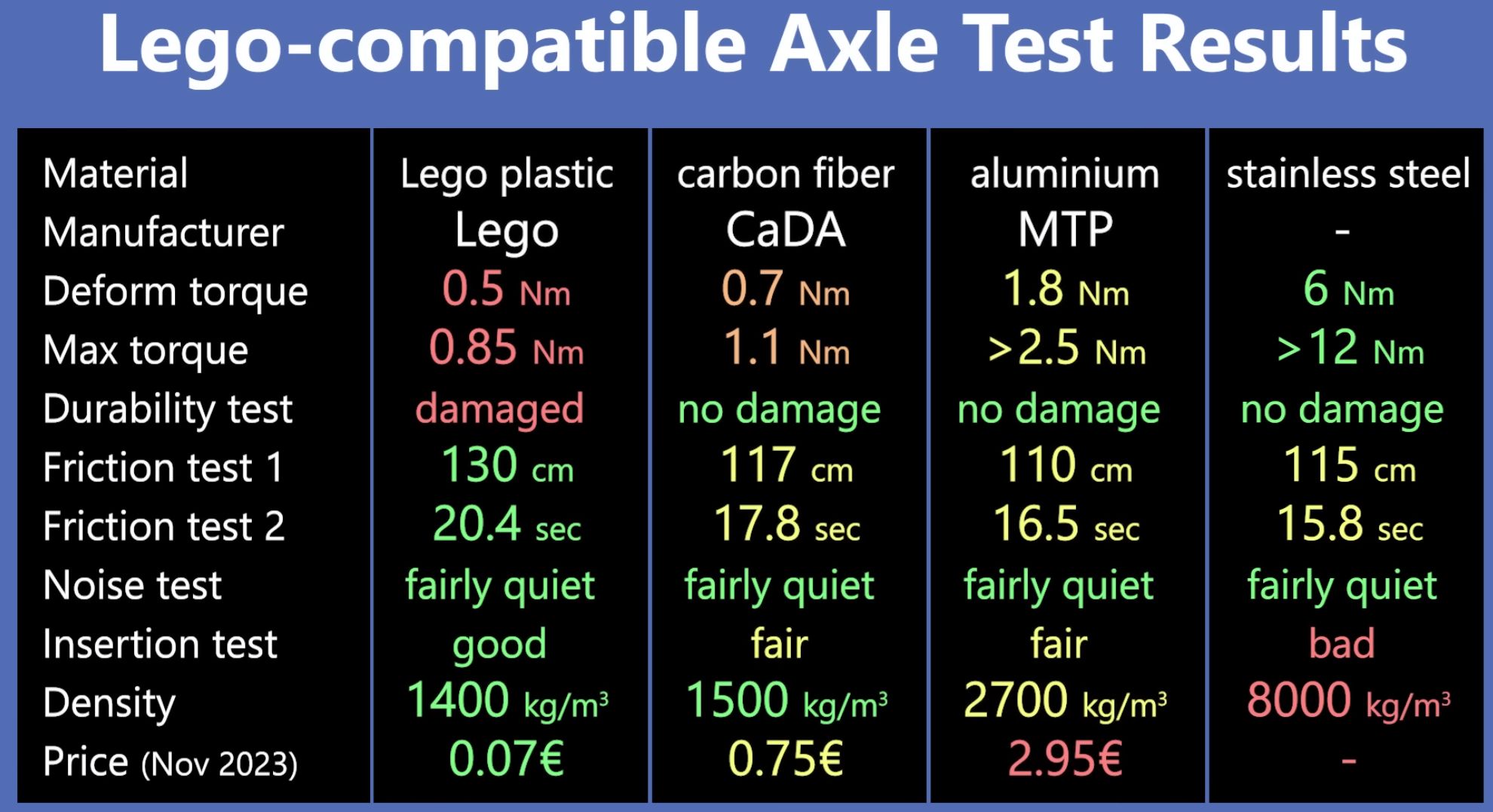
Lego-compatible axle test results. (Credit: Brick Experiment Channel, YouTube)

Starting off with the torque test, each type of axle is connected with others and rotated with increasing torque until something gives out. Unsurprisingly, the plastic Technic part fails first and renders itself into a twist, before the carbon fiber version gives up. Aluminium is softer than steel, so ultimately the latter wins, but not before a range of upgrades to the (LEGO-based) testing rig, as these much stronger axles require also strong gears and the like to up the torque.

When it comes to durability, all except the original LEGO version didn’t mind having plastic rubbing against them for a while. Yet for friction in general, the plastic version did better, with less friction. Whether or not this is due to material wearing away is a bit of a question. Overall, stainless steel gets you a lot of strength, but in a dense (8000 kg/m3) package, aluminium comes somewhat close, with 2700 kg/m3, and carbon fiber (1500 kg/m3) does better than the original part (1400 kg/m3), with only a bit more weight, though at roughly ten times the cost.

On that note, we’re looking forward to the first 100% stainless steel LEGO Technic kit, reminiscent of the era when Meccano came in the form of all-metal components and a bucket of bolts.

Continue reading “Testing Various Properties Of LEGO-Compatible Axles”

Using Nuclear Decay As Random Number Generator Source For An MCU

Although there are many ways to get a random number generator (RNG) set up on a microcontroller, it’s hard to argue with the sheer randomness of the various kinds of radiation zipping all around us from nuclear decay events. For [gbonacini] the purchase of a Geiger counter first in 2022 was the reason to tinker with using these as the source for an RNG, which simply runs a counter until a Geiger counter event occurs that ‘selects’ a number and the counter is reset to zero.

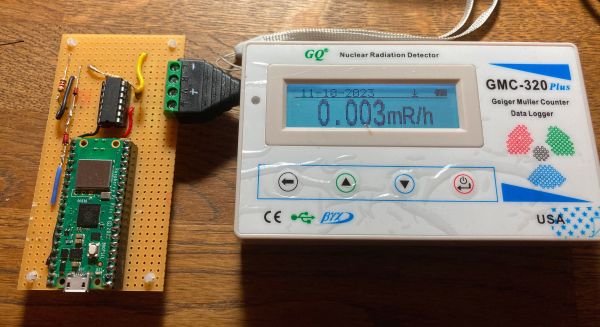
With the next version of this system the hardware and layout has changed somewhat, using a commercial handheld Geiger counter (GMC-320+) and its audio output as a generic input for any MCU. The (pulsed) audio signal is amplified with an opamp (left unspecified) that connects to a GPIO pin of the MCU (RP2040-based Pico W). Here the same algorithm is used to create a continuous queue of randomly picked numbers, which can also be queried via the WiFi interface with a custom protocol, essentially making it a network-connected RNG that could be used by other network-connected appliances.

C++ source is provided for the Pico W example, but it should be easy enough to adapt to other platforms. The GMC-320+ is also among the more affordable Geiger counters out there, even if it’s somewhat bulky to pair with just a single MCU, making a more basic Geiger counter module better for a permanent installation. Either way you should get pretty good RNG this way without splurging on exotic hardware.

Thanks to [navigator] for the tip.

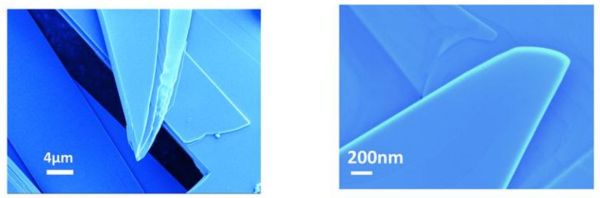
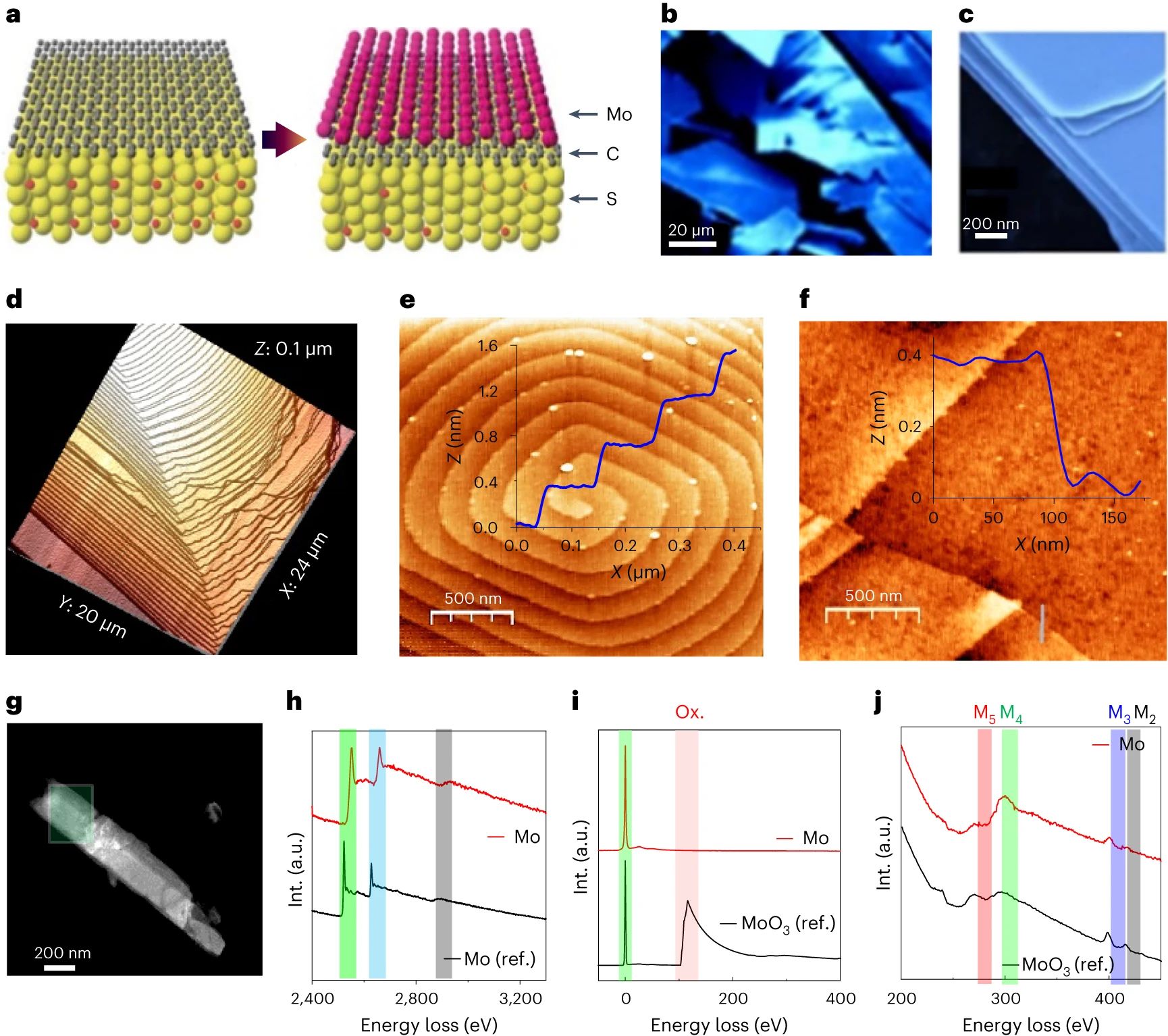
Molybdenene whiskers. (Credit: Sahu et al., 2023)

Introducing Molybdenene As Graphene’s New Dirac Matter Companion

Amidst all the (well-deserved) hype around graphene, it’s important to remember that its properties are not unique to carbon. More atoms can be coaxed into stable 2-dimensional configuration, with molybdenene previously theoretically possible. This is now demonstrated by Tumesh Kumar Sahu and colleagues in a recent Nature Nanotechnology article, through the manufacturing of a 2D molybdenum-based material which they showed to be indeed molybdenene. Essentially, this is a 2D lattice of molybdenum atoms, a configuration in which it qualifies as Dirac matter, just like graphene. For those of us unfamiliar with Dirac materials, this gentle introduction by Jérôme Cayssol in Comptes Rendus Physique might be of use.

Manufacturing process of molybdenene. (Credit: Sahu et al., 2023)

In order to create molybdenene, the researchers started with molybdenum disulfide (MoS2), which using a microwave-assisted field underwent electrochemical transformation into whiskers that when examined turned out to consist out of monolayers of Mo. The sulfur atoms were separated using a graphene sheet. As is typical, molybdenene sheets were exfoliated using Scotch tape, in a process reminiscent of the early days of graphene research.

Much like graphene and other Dirac materials, molybdenene has many potential uses as a catalyst, as cantilever in scanning electron microscope (SEM) tips, and more. If the past decades of research into graphene has demonstrated anything, it is that what once seemed more of a novelty, suddenly turned out to have endless potential in fields nobody had considered previously. One of these being as coatings for hard disk platters, for example, which has become feasible due to increasingly more efficient ways to produce graphene in large quantities.