Historical Satellite Tracker Saved From Scrap Heap

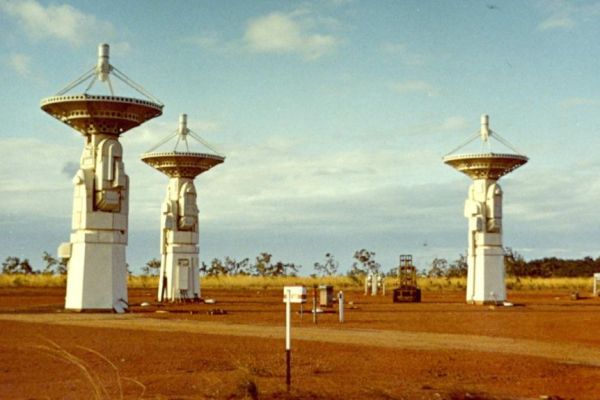
In a bit of rare Australian space news, the  Arnhemland Historical Society has managed to save one of the satellite trackers used during the 1960s and 1970s from the scrap heap. As the Space Race intensified during the 1950s and 1960s, every nation wanted a piece of this new technology. A number of European nations banded together in the form of ELDO, the European Launcher Development Organisation.

Australia was a partner in this program, with launches of the Europa-1 and Europa-2 rockets taking place from Woomera, South Australia. Initially the UK’s cancelled Blue Streak IRBM program provided the first stage for Europa-1, but this was later replaced with the French Diamant. France also provided the Coralie second stage in addition to the German-developed Astris third stage.
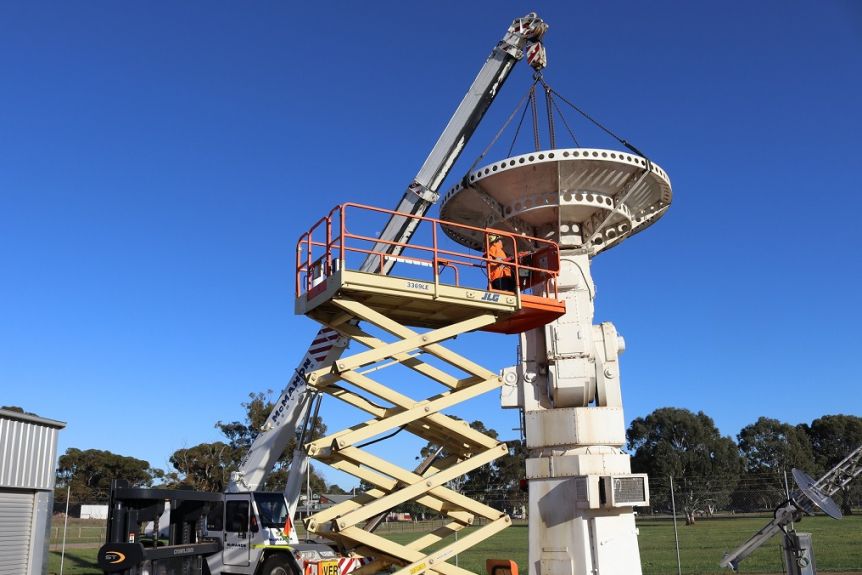
The satellite tracker being dismantled at the South Australian defence base before it was trucked north. (Photo: Arnhemland Historical Society)

The first launch of the Europa-1 took place in 1966, with the rocket performing well, but inaccurate readings from a radar station leading to the rocket to be wrongly instructed to self-destruct. Of nine launches, four were successful, with the satellite trackers at Arnhemland providing tracking support. Ultimately, the many technical setbacks led to the demise of ELDO, and it was merged by the 1970s into what is now the European Space Agency, with its main launch site in Kourou, French Guiana.

Despite the lack of success, these early days at Woomera were instrumental in getting Europe’s feet wet in the development of the Ariane rockets. Woomera’s rocketing days may also not be over yet, with NASA having announced  in 2019 plans to use Woomera for launches.

Maybe one day Arnhemland will have its own space port, with the old satellite track on display to remind of those early days.

[Top photo: The ELDO satellite trackers were state-of-the-art when they stood in Gove in the 1960s. (Supplied: Arnhemland Historical Society)]

(Thanks, David)

GitHub’s Move Away From Passwords: A Sign Of Things To Come?

Later this month, people who use GitHub may find themselves suddenly getting an error message while trying to authenticate against the GitHub API or perform actions on a GitHub repository with a username and password. The reason for this is the removal of this authentication option by GitHub, with a few ‘brown-out’ periods involving the rejection of passwords to give people warning of this fact.

This change was originally announced by GitHub in November of 2019, had a deprecation timeline assigned in February of 2020 and another blog update in July repeating the information. As noted there, only GitHub Enterprise Server remains unaffected for now. For everyone else, as of November 13th, 2020, in order to use GitHub services, the use of an OAuth token, personal token or SSH key is required.

While this is likely to affect a fair number of people who are using GitHub’s REST API and repositories, perhaps the more interesting question here is whether this is merely the beginning of a larger transformation away from username and password logins in services.

Continue reading “GitHub’s Move Away From Passwords: A Sign Of Things To Come?”

Evaluating Raspberry Pi As A Programmable Logic Controller

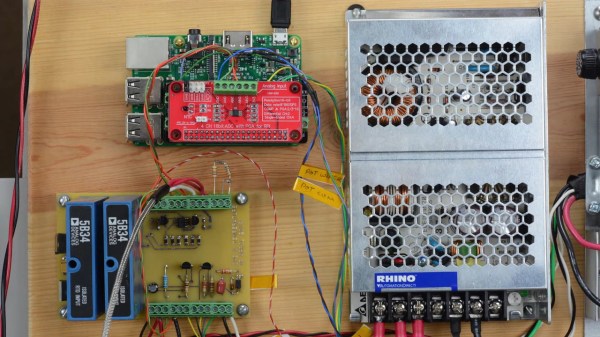
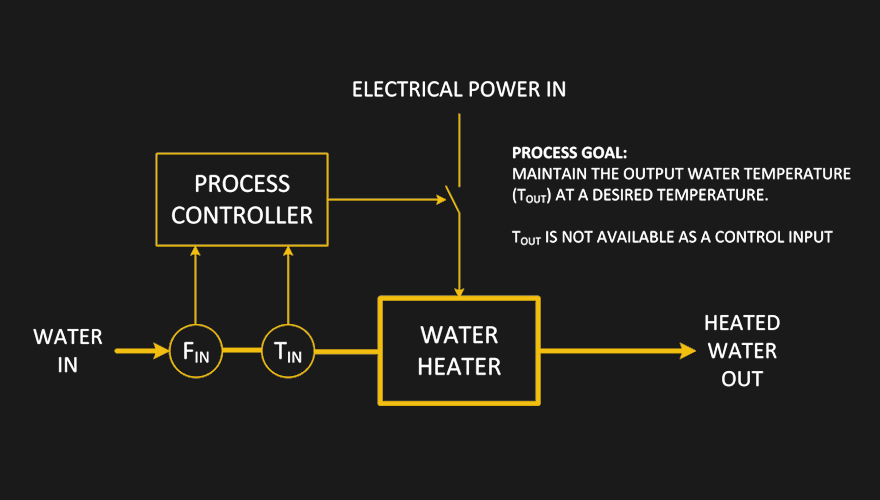
It should be no surprise to many that one can use a Raspbery Pi SBC as an industrial controller, but is it any good at that? That was the question which [Dough Reneker] and [William Shaffer] built a test rig to see how a Raspberry Pi performs in head to head tests. They compared a Python-based control loop on a Raspberry Pi 3B against an C0-12DD1E-2-D AutomationDirect CLICK Programmable Logic Controller (PLC) using a simple water heating example.

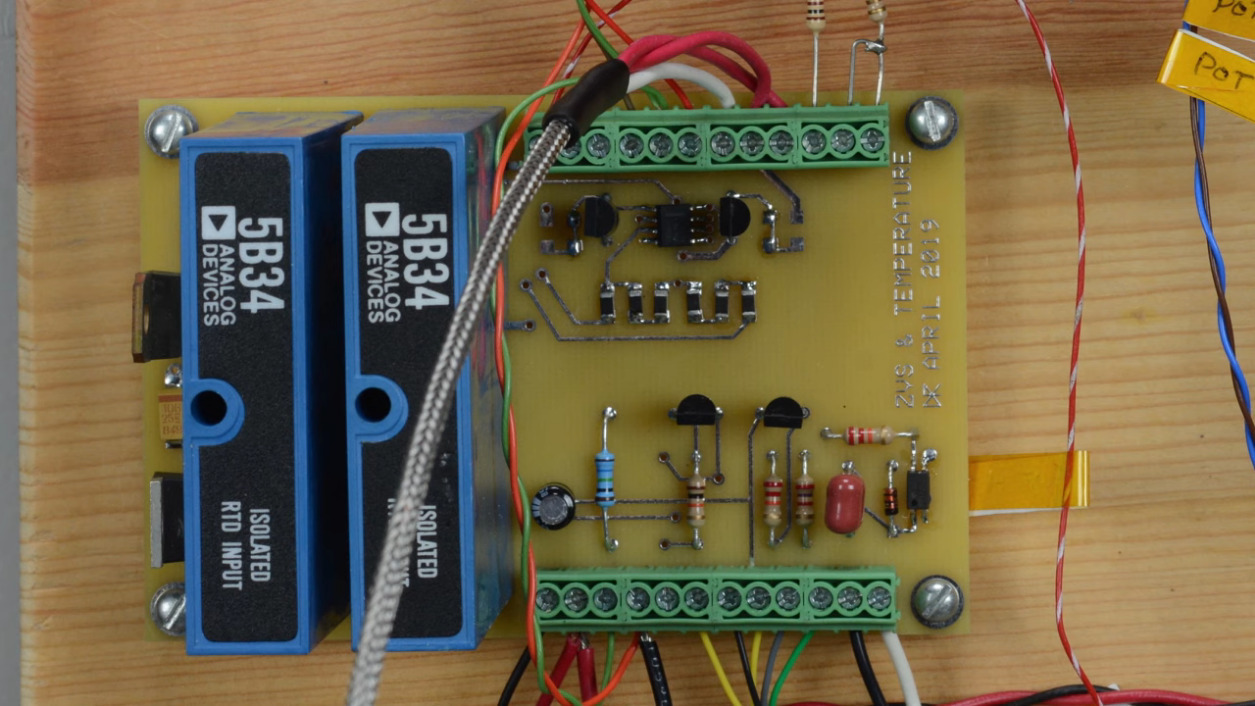
A major snag with using the Raspberry Pi as a PLC is the lack of industrial I/O capacity. This requires additional hardware, in this case adding a four-channel ADC board as well as a custom board to condition the signals. The Raspberry Pi looks for 0-3 V inputs where industrial control applications are usually in the -10 to 10 V range and often use a 4-20 mA current loop.

Using a PLC leverages so-called ladder logic, where each action depends on conditions. With each update scan, the PLC ensures that all input conditions are translated into the appropriate output conditions in real-time. It’s only job is to monitor the process at hand and it does this very well.

Here the flexibility and generic nature of the Raspberry Pi running Linux was a disadvantage. Unlike the PLC, the lack of a hard real-time OS means you can’t guarantee the Pi will be as responsive to changing inputs.

The behavior of the two systems showed that while both did the task they were programmed for, the Raspberry Pi was decidedly more erratic. Although one could program around a lot of these issues (presumably using Linux in stripped-down, soft real-time configuration with interrupt-driven native code), the effort needed to make a Raspberry Pi system suitable for an industrial environment shows why single-board computers haven’t seen adoption as replacements for PLCs.

Continue reading “Evaluating Raspberry Pi As A Programmable Logic Controller”

Transparent OLED Hitting The Market With Xiaomi’s Mi TV LUX Transparent Edition

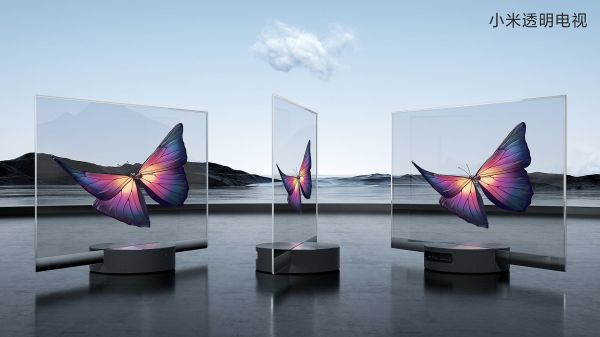
One of the major advantages of OLED over LCD panels is that the former can be made using far fewer layers as the pixels themselves are emitting the light instead of manipulating the light from a backlight. This led some to ask the question of whether it’s possible to make an OLED panel that is transparent or at least translucent. As Xiaomi’s new Mi TV LUX OLED Transparent Edition shows, the answer there is a resounding ‘yes’. Better yet, for a low-low price of about $7,200 you can own one of these 55″ marvels.

Transparent OLED technology is not new, of course. Back in 2018 LG was showing off a prototype TV that used one of the early transparent OLED panels. In the video that is embedded after the break, [Linus] from Linus Tech Tips goes hands-on with that LG prototype while at LG in South Korea, while including a number of crucial details from an interview from one of the engineers behind that panel.

As it turns out, merely removing the opaque backing from an OLED panel isn’t enough to make it transparent. In order for an OLED panel to become transparent, the circuitry in the pixel layer and TFT layer need to be aligned as best as possible to allow for many, many tiny holes to be punched through the display.

Looking at [Linus]’s experiences with the LG prototype, it does appear that this kind of technology would be highly suitable for signage purposes, while also allowing for something like an invisible television or display in a room that could be placed in front of a painting or other decoration. Once displaying an image, the screen is bright enough that you can comfortably make out the image. Just don’t put any bright lights behind the TV.

Anyone else anxious waiting for sub-10″ versions of these panels?

Continue reading “Transparent OLED Hitting The Market With Xiaomi’s Mi TV LUX Transparent Edition”

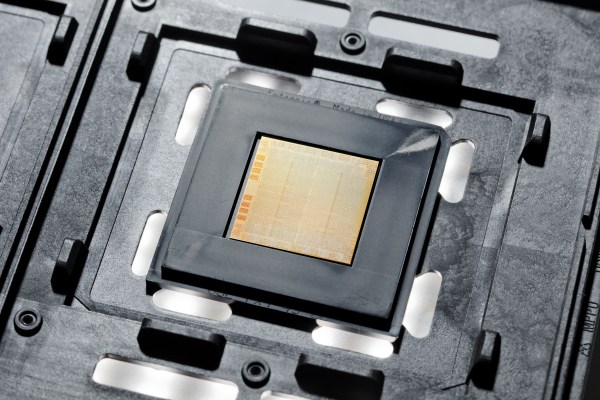
IBM Reveals POWER10 CPU Based On The OpenPOWER ISA 3.1 Specification

This week, IBM revealed their POWER10 CPU, which may not seem too exciting since it’s primarily aimed at big iron like mainframes and servers. The real news for most is that it is the first processor to be released that is based on the open Power ISA specification v3.1. This new version of the Power ISA adds a number of new instructions as well as the notion of optionality. It updates the v3.0 specification that was released in 2015, right after the founding of the OpenPOWER Foundation.

Currently, a number of open source designs for the Power ISA exists, including MicroWatt (Power v3.0, VHDL) and the similar ChiselWatt (written in Scala-based Chisel).  In June of this year, IBM also released the VHDL code for the IBM A2 processor on Github. This is a multi-core capable, 4-way multithreaded 64-bit design, with silicon-implementations running at up to 2.3 GHz and using the Power ISA v2.06 specification.

The ISA specifications and other relevant technical documentation can be obtained from the OpenPOWER website, such as for example the Power ISA v3.0B specification from 2017. The website also lists the current cores and communities around the Power ISA.

(Main image: POWER10 CPU, credit IBM)

Don’t Let Endianness Flip You Around

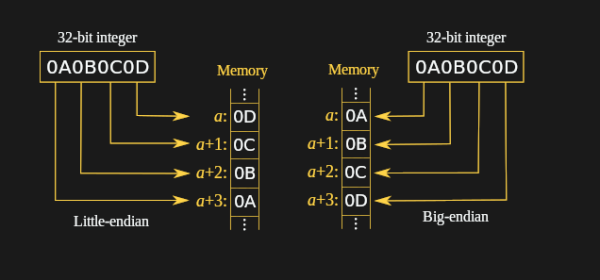
Most of the processor architectures which we come into contact with today are little-endian systems, meaning that they store and address bytes in a least-significant byte (LSB) order. Unlike in the past, when big-endian architectures, including the Motorola 68000 and PowerPC, were more common, one can often just assume that all of the binary data one reads from files and via communication protocols are in little-endian order. This will often work fine.

The problem comes with for example image formats that use big-endian formatted integers, including TIFF and PNG. When dealing directly with protocols in so-called ‘network order’, one also deals with big-endian data. Trying to use these formats and protocol data verbatim on a little-endian system will obviously not work.

Fortunately, it is very easy to swap the endianness of any data which we handle. Continue reading “Don’t Let Endianness Flip You Around”

Patent Law And The Legality Of Making Something Similar

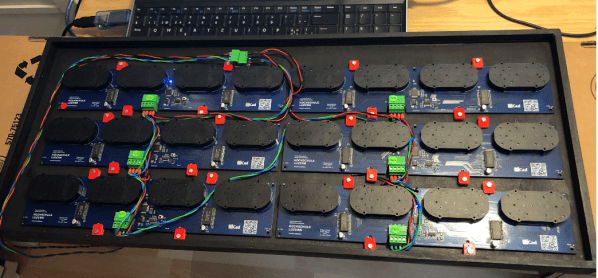
When [Erich Styger] recently got featured on Hackaday with his meta-clock project, he probably was not expecting to get featured again so soon, this time regarding a copyright claim on the ‘meta-clock’ design. This particular case ended with [Erich] removing the original blog article and associated PCB design files, leaving just the summaries, such as the original Hackaday article on the project.

Obviously, this raises the question of whether any of this is correct; if one sees a clock design, or other mechanisms that appeals and tries to replicate its looks and functioning in some fashion, is this automatically a breach of copyright? In the case of [Erich]’s project, one could argue that at first glance both devices look remarkably similar. One might also argue that this is rather unavoidable, considering the uncomplicated design of the original. Continue reading “Patent Law And The Legality Of Making Something Similar”