Why Physical Media Deserved To Die

Over the course of more than a decade, physical media has gradually vanished from public view. Once computers had an optical drive except for ultrabooks, but these days computer cases that even support an internal optical drive are rare. Rather than manuals and drivers included on a data CD you now get a QR code for an online download. In the home, DVD and Blu-ray (BD) players have given way to smart TVs with integrated content streaming apps for various services. Music and kin are enjoyed via smart speakers and smart phones that stream audio content from online services. Even books are now commonly read on screens rather than printed on paper.

With these changes, stores selling physical media have mostly shuttered, with much audiovisual and software content no longer pressed on discs or printed. This situation might lead one to believe that the end of physical media is nigh, but the contradiction here comes in the form of a strong revival of primarily what used to be considered firmly obsolete physical media formats. While CD, DVD and BD sales are plummeting off a cliff, vinyl records, cassette tapes and even media like 8-track tapes are undergoing a resurgence, in a process that feels hard to explain.

How big is this revival, truly? Are people tired of digital restrictions management (DRM), high service fees and/or content in their playlists getting vanished or altered? Perhaps it is out of a sense of (faux) nostalgia?

Continue reading “Why Physical Media Deserved To Die”

PoX: Super-Fast Graphene-Based Flash Memory

Recently a team at Fudan University claimed to have developed a picosecond-level Flash memory device (called ‘PoX’) that has an access time of a mere 400 picoseconds. This is significantly faster than the millisecond level access times of NAND Flash memory, and more in the ballpark of DRAM, while still being non-volatile. Details on the device technology were published in Nature.

In the paper by [Yutong Xing] et al. they describe the memory device as using a two-dimensional Dirac graphene-channel Flash memory structure, with hot carrier injection for both electron and hole injection, meaning that it is capable of both writing and erasing. Dirac graphene refers to the unusual electron transport properties of typical monolayer graphene sheets.

Demonstrated was a write speed of 400 picoseconds, non-volatile storage and a 5.5 × 10⁶ cycle endurance with a programming voltage of 5 V. It are the unique properties of a Dirac material like graphene that allow these writes to occur significantly faster than in a typical silicon transistor device.

What is still unknown is how well this technology scales, its power usage, durability and manufacturability.

Remembering UCSD P-System, The Pascal Virtual Machine

Long before the Java Virtual Machine (JVM) was said to take the world by storm, the p-System  (pseudo-system, or virtual machine) developed at the University of California, San Diego (UCSD) provided a cross-platform environment for the UCSD’s Pascal dialect. Later on, additional languages would also be made available for the UCSD p-System, such as Fortran (by Apple Computer) and Ada (by TeleSoft), not unlike the various languages targeting the JVM today in addition to Java. The p-System could be run on an existing OS or as its own OS directly on the hardware. This was extremely attractive in the fragmented home computer market of the 1980s.

After the final release of version IV of UCSD p-System (IV.2.2 R1.1) in 1987, the software died a slow death, but this doesn’t mean it is forgotten. People like [Hans Otten] have documented the history and technical details of the UCSD p-System, and the UCSD Pascal dialect went on to inspire Borland Pascal.

Continue reading “Remembering UCSD P-System, The Pascal Virtual Machine”

Preventing Galvanic Corrosion In Water Cooling Loops

Water is an excellent coolant, but the flip side is that it is also an excellent solvent. This, in short, is why any water cooling loop is also a prime candidate for an interesting introduction to the galvanic metal series, resulting in severe corrosion that commences immediately. In a recent video by [der8aer], this issue is demonstrated using a GPU cold plate. The part is made out of nickel-plated copper and features many small channels to increase surface area with the coolant.

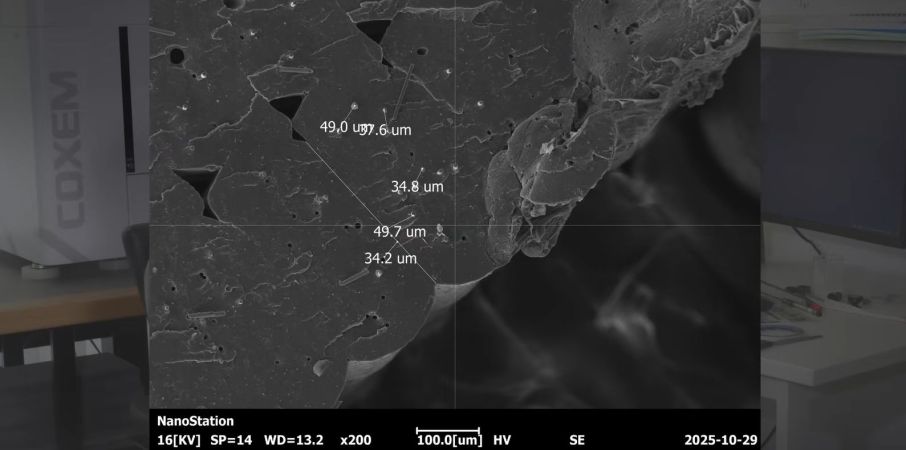
The surface analysis of the sample cold plate after a brief exposure to distilled water, showing the deposited copper atoms. (Credit: der8auer, YouTube)
The surface analysis of the sample cold plate after a brief exposure to distilled water shows the deposited copper atoms. (Credit: der8auer, YouTube)

Theoretically, if one were to use distilled water in a coolant loop that contains a single type of metal (like copper), there would be no issue. As [der8auer] points out, fittings, radiators, and the cooling block are nearly always made of various metals and alloys like brass, for example. This thus creates the setup for galvanic corrosion, whereby one metal acts as the anode and the other as a cathode. While this is desirable in batteries, for a cooling loop, this means that the water strips metal ions off the anode and deposits them on the cathode metal.

The nickel-plated cold plate should be immune to this if the plating were perfect. However, as demonstrated in the video, even a brief exposure to distilled water at 60°C induced strong galvanic corrosion. Analysis in an SEM showed that the imperfect nickel plating allowed copper ions to be dissolved into the water before being deposited on top of the nickel (cathode). In a comparison with another sample that had a coolant with corrosion inhibitor (DP Ultra) used, no such corrosion was observed, even after much longer exposure.

This DP Ultra coolant is mostly distilled water but has glycol added. The glycol improves the pH and coats surfaces to prevent galvanic corrosion. The other element is benzotriazole, which provides similar benefits. Of course, each corrosion inhibitor targets a specific environment, and there is also the issue with organic films forming, which may require biocides to be added. As usual, water cooling has more subtlety than you’d expect.

Continue reading “Preventing Galvanic Corrosion In Water Cooling Loops”

The TMSR-LF1 building seen from the sky. (Credit: SINAP)

China’s TMSR-LF1 Molten Salt Thorium Reactor Begins Live Refueling Operations

Although uranium-235 is the typical fuel for commercial fission reactors on account of it being fissile, it’s relatively rare relative to the fertile U-238 and thorium (Th-232). Using either of these fertile isotopes to breed new fuel from is thus an attractive proposition. Despite this, only India and China have a strong focus on using Th-232 for reactors, the former using breeders (Th-232 to U-233) to create fertile uranium fuel. China has demonstrated its approach — including refueling a live reactor — using a fourth-generation molten salt reactor.

Continue reading “China’s TMSR-LF1 Molten Salt Thorium Reactor Begins Live Refueling Operations”

Restoring An Abandoned Game Boy Kiosk

Back in the olden days, there existed physical game stores, which in addition to physical games would also have kiosks where you could try out the current game consoles and handhelds. Generally these kiosks held the console, a display and any controllers if needed. After a while these kiosks would get scrapped, with only a very few ending up being rescued and restored. One of the lucky ones is a Game Boy kiosk, which [The Retro Future] managed to snag after it was found in a construction site. Sadly the thing was in a very rough condition, with the particle board especially being mostly destroyed.

Display model Game Boy, safely secured into the demo kiosk. (Credit: The Retro Future, YouTube)

These Game Boy kiosks also featured a special Game Boy, which – despite being super rare – also was hunted down. This led to the restoration, which included recovering as much of the original particle board as possible, with a professional furniture restore ([Don]) lending his expertise. This provides a master class in how to patch up damaged particle board, as maligned as this wood-dust-and-glue material is.

The boards were then reassembled more securely than the wood screws used by the person who had found the destroyed kiosk, in a way that allows for easy disassembly if needed. Fortunately most of the plastic pieces were still intact, and the Game Boy grey paint was easily matched. Next was reproducing a missing piece of art work, with fortunately existing versions available as reference. For a few missing metal bits that held the special Game Boy in place another kiosk was used to provide measurements.

After all this, the kiosk was powered back on, and it was like 1990 was back once again, just in time for playing Tetris on a dim, green-and-black screen while hunched half into the kiosk at the game store.

Continue reading “Restoring An Abandoned Game Boy Kiosk”

Haircuts In Space: How To Keep Your Astronauts Looking Fresh

NASA astronaut Catherine Coleman gives ESA astronaut Paolo Nespoli a haircut in the Kibo laboratory on the ISS in 2011. (Credit: NASA)

Although we tend to see mostly the glorious and fun parts of hanging out in a space station, the human body will not cease to do its usual things, whether it involves the digestive system, or even something as mundane as the hair that sprouts from our heads. After all, we do not want our astronauts to return to Earth after a half-year stay in the ISS looking as if they got marooned on an uninhabited island. Introducing the onboard barbershop on the ISS, and the engineering behind making sure that after a decade the ISS doesn’t positively look like it got the 1970s shaggy wall carpet treatment.

The basic solution is rather straightforward: an electric hair clipper attached to a vacuum that will whisk the clippings safely into a container rather than being allowed to drift around. In a way this is similar to the vacuums you find on routers and saws in a woodworking shop, just with more keratin rather than cellulose and lignin.

On the Chinese Tiangong space station they use a similar approach, with the video showing how simple the system is, little more than a small handheld vacuum cleaner attached to the clippers. Naturally, you cannot just tape the vacuum cleaner to some clippers and expect it to get most of the clippings, which is where both the ISS and Tiangong solutions seems to have a carefully designed construction to maximize the hair removal. You can see the ISS system in action in this 2019 video from the Canadian Space Agency.

Of course, this system is not perfect, but amidst the kilograms of shed skin particles from the crew, a few small hair clippings can likely be handled by the ISS’ air treatment systems just fine. The goal after all is to not have a massive expanding cloud of hair clippings filling up the space station.