Flying Drones That Can Walk And Jump Into The Air: An Idea With Legs?

When we look at how everyone’s favorite flying dinosaurs get around, we can see that although they use their wings a lot too, their legs are at least as important. Even waddling or hopping about somewhat ungainly on legs is more energy efficient than short flights, and taking off from the ground is helped by jumping into the air with a powerful leap from one’s legs. Based on this reasoning, a team of researchers set out to give flying drones their own bird-inspired legs, with their findings published in Nature (preprint on ArXiv).

The prototype RAVEN (Robotic Avian-inspired Vehicle for multiple ENvironments) drone is capable of hopping, walking, jumping onto an obstacle and jumping for take-off. This allows the drone to get into the optimal position for take-off and store energy in its legs to give it a boost when it takes to the skies. As it turned out, having passive & flexible toes here was essential for stability when waddling around, while jumping tests showed that the RAVEN’s legs provided well over 90% of the required take-off speed.

During take-off experiments the drone was able to jump to an altitude of about 0.4 meters, which allows it to clear ground-based obstacles and makes any kind of ‘runway’ unnecessary. Much like with our avian dinosaur friends the laws of physics dictate that there are strong scaling limits, which is why a raven can use this technique, but a swan or similar still requires a bit of runway instead of jumping elegantly into the air for near-vertical take-off. For smaller flying drones this approach would however absolutely seem to have legs.

Continue reading “Flying Drones That Can Walk And Jump Into The Air: An Idea With Legs?”

Trying To Shatter The World’s Fastest RC Car Record

The RC car is controlled via an FPV setup. (Credit: Luke Bell, YouTube)

Fresh off a world record for the fastest quadcopter, [Luke Bell] decided to try his luck with something more own to earth, namely trying to tackle the world record for the fastest RC car, with the current record set at 360 km/h. Starting off with a first attempt in what will be a video series, the obvious approach seems to be to get some really powerful electric motors, a streamlined body and a disused runway to send said RC car hurtling along towards that golden medal. Of course, if it was that easy, others would have done it already.

With the quadcopter record of nearly 500 km/h which we covered previously, the challenge was in a way easier, as other than air resistance and accidental lithobraking there are no worries about ground texture, tire wear or boundary layer aerodynamics. In comparison, the RC car has to contend with all of these, with the runway’s rough tarmac surface being just one of the issues, along with making sure that the wheels would hold up to the required rotation speed. For the wheels you got options like foam, hard rubber, etc., all with their own advantages and disadvantages, mostly in terms of grip and reliability.

So far speeds of over 200 km/h are easy enough to do, with foam wheels being the preferred option. To push the RC car to 300 km/h and beyond, a lot more experimentation and trial runs will have to be performed. Pending are changes to the aerodynamic design with features also commonly seen in F1 race cars such as downforce spoilers, diffusers and other tricks which should prevent the RC car from (briefly) becoming an RC airplane.

Continue reading “Trying To Shatter The World’s Fastest RC Car Record”

Raspberry Pi 500 And The Case Of The Missing M.2 Slot

Raspberry Pi just dropped the new Raspberry Pi 500, which like its predecessor puts the similarly named SBC into a keyboard. In a detailed review and teardown video, [Jeff Geerling] goes over all the details, and what there is to like and not like about this new product.

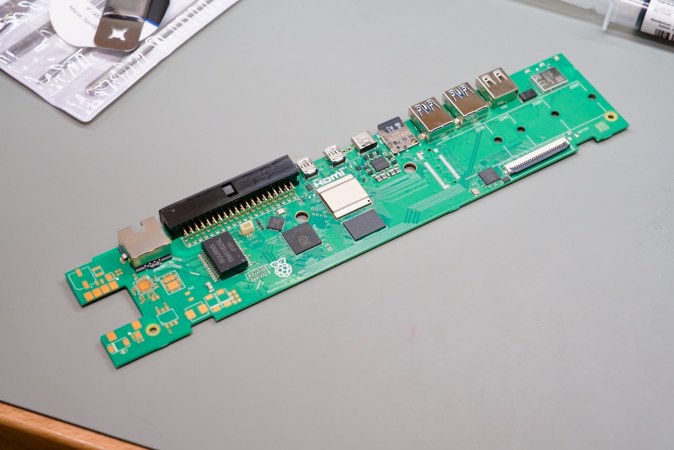
The new Raspberry Pi 500 with the new Raspberry Pi Monitor. (Credit: Jeff Geerling)

Most of the changes relative to the RP400 are as expected, with the change to the same BCM2712 SoC as on the Raspberry Pi 5, while doubling the RAM to 8 GB and of course you get the soft power button. As [Jeff] discovers with the teardown, the odd thing is that the RP500 PCB has the footprints for an M.2 slot, as seen on the above image, but none of the components are populated.

Naturally, [Jeff] ordered up some parts off Digikey to populate these footprints, but without luck. After asking Raspberry Pi, he was told that these footprints as well as those for a PoE feature are there for ‘flexibility to reuse the PCB in other contexts’. Sadly, it seems that these unpopulated parts of the board will have to remain just that, with no M.2 NVMe slot option built-in. With the price bump to $90 from the RP400’s $70 you’ll have to do your own math on whether the better SoC and more RAM is worth it.

In addition to the RP500 itself, [Jeff] also looks at the newly launched Raspberry Pi Monitor, a 15.6″ IPS display for $100. This unit comes with built-in speakers and VESA mount, but as [Jeff] notes in his review, using this VESA mount also means that you’re blocking all the ports, so you have to take the monitor off said VESA mount if you want to plug in or out any cables.

Continue reading “Raspberry Pi 500 And The Case Of The Missing M.2 Slot”

Debugging The UE1 Paper Tape Reader And Amplification Circuit

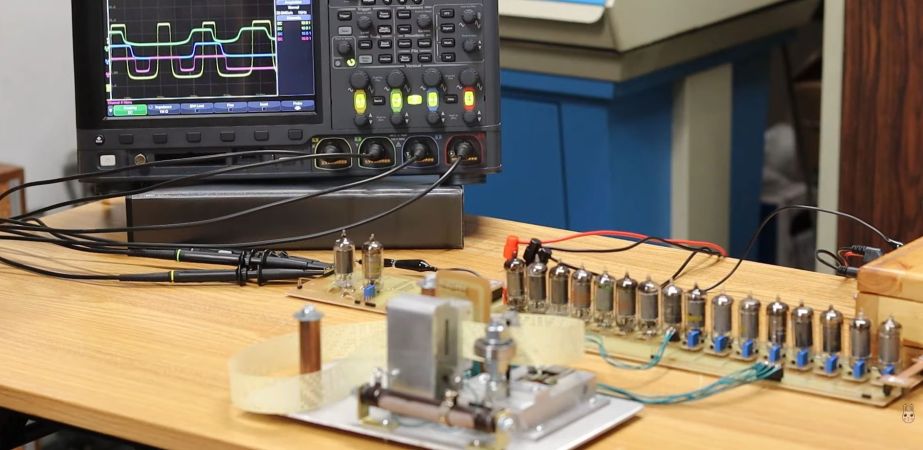
The tape reader and amplifiers mounted with the other UE1 modules. (Credit: David Lovett, YouTube)

After recently putting together the paper tape reader for his custom tube-based UE1 computer, [David Lovett] did get squiggles on the outputs, but not quite the right ones. In the most recent video, these issues are addressed one by one, so that this part of the UE1 1-bit computer can be called ‘done’. Starting off the list of issues were the odd readings from the photodiodes, which turned out to be due to the diodes being misaligned and a dodgy solder joint. This allowed [David] to move on to building the (obviously 6AU6 tube-based) amplifier for the photodiode output signals.

Much like the Bendix G-15’s tape reader which served as inspiration, this also meant adding potentiometers to adjust the gain. For the clock signal on the tape, a clock recovery PCB was needed, which should provide the UE1 computer system with both the clocks and the input data.

Using the potentiometers on the amplification board, the output signals can be adjusted at will to give the cleanest possible signal to the rest of the system, which theoretically means that as soon as [David] adds the permanent wiring and a few utility boards to allow the code to manipulate the tape reader (e.g. halt) as well as manual inputs. The UE1 computer system is thus being pretty close to running off tape by itself for the first time and with it being ‘complete’.

Continue reading “Debugging The UE1 Paper Tape Reader And Amplification Circuit”

Silicon Carbide May Replace Zirconium Alloys For Nuclear Fuel Rod Cladding

Since the construction of the first commercial light water nuclear power plants (LWR) the design of their fuel rods hasn’t changed significantly. Mechanically robust and corrosion-resistant zirconium alloy (zircalloy) tubes are filled with ceramic fuel pellets, which get assembled into fuel assemblies for loading into the reactor.

A 12' SiGa fuel assembly, demonstrating the ability to scale to full-sized fuel rods. (Credit: DoE)
A 12′ SiGa fuel assembly, demonstrating the ability to scale to full-sized fuel rods. (Credit: DoE)

Now it seems that silicon carbide (SiC) may soon replace the traditional zirconium alloy with General Atomics’ SiGa fuel cladding, which has been tested over the past 120 days in the Advanced Test Reactor at Idaho National Laboratory (INL). This completes the first of a series of tests before SiGa is approved for commercial use.

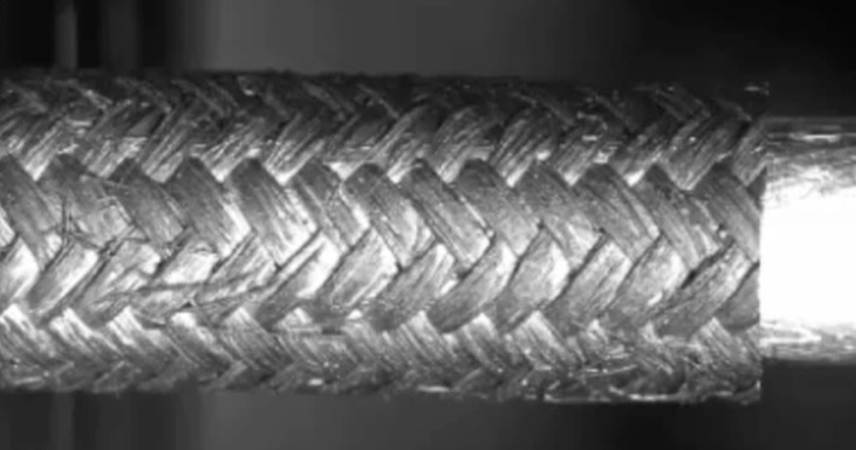
One of the main advantages of SiC over zircalloy is better resistance to high temperatures — during testing with temperatures well above those experienced with normal operating conditions, the zircalloy rods would burst while the SiC ones remained intact (as in the embedded video). Although normally SiC is quite brittle and unsuitable for such structures, SiGa uses a SiC fiber composite, which allows it to be used in this structural fashion.

Although this development is primarily part of the Department of Energy’s Accident Tolerant Fuel Program and its focus on melt-down proof fuel, the switch to SiC could also solve a major issue with zirconium, being its use as a catalyst with hydrogen formation when exposed to steam. Although with e.g. Fukushima Daiichi’s triple meltdown the zircalloy fuel rods were partially destroyed, it was the formation of hydrogen gas inside the reactor vessels and the hydrogen explosions during venting which worsened what should have been a simple meltdown into something significantly worse.

Continue reading “Silicon Carbide May Replace Zirconium Alloys For Nuclear Fuel Rod Cladding”

New Tullomer Filament Claims To Beat PEEK

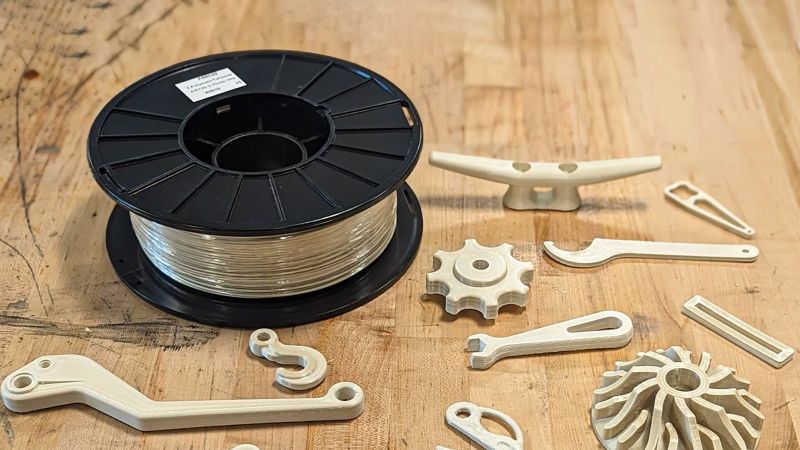
Recently a company called Z-Polymers introduced its new Tullomer FDM filament that comes with a lofty bullet list of purported properties that should give materials like steel, aluminium, and various polymers a run for their money. Even better is that it is compatible with far lower specification FDM printers than e.g. PEEK. Intrigued, the folks over at All3DP figured that they should get some hands-on information on this filament and what’s it like to print with in one of the officially sanctioned Bambu Lab printers: these being the X1C & X1CE with manufacturer-provided profiles.

The world of engineering-grade FDM filaments has existed for decades, with for example PEEK (polyether ether ketone) having been around since the early 1980s, but these require much higher temperatures for the extruder (360+℃) and chamber (~90℃) than Tullomer, which is much closer (300℃, 50℃) to a typical high-performance filament like ABS, while also omitting the typical post-process annealing of PEEK. This assumes that Tullomer can match those claimed specifications, of course.

One of the current users of Tullomer is Erdos Miller, an engineering firm with a focus on the gas and oil industry. They’re using it for printing parts (calibration tooling) that used to be printed in filaments like carbon fiber-reinforced nylon (CF-PA) or PEEK, but they’re now looking at using Tullomer for replacing CF-PA and machined PEEK parts elsewhere too.

It’s still early days for this new polymer, of course, and we don’t have a lot of information beyond the rather sparse datasheet, but if you already have a capable printer, a single 1 kg spool of Tullomer is a mere $500, which is often much less or about the same as PEEK spools, without the requirement for a rather beefy industrial-strength FDM printer.

The £25,000 Tom Evans Pre-Amp Repair And A Copyright Strike

We were recently notified by a reader that [Tom Evans] had filed a copyright claim against [Mark]’s repair video on his Mend it Mark YouTube channel, taking down said repair video as well as [Mark]’s delightful commentary. In a new video, [Mark] comments on this takedown and the implications. The biggest question is what exactly was copyrighted in the original video, which was tough because YouTube refused to pass on [Mark]’s questions or provide further details.

In this new video the entire repair is summarized once again using props instead of the actual pre-amp, which you can still catch a glimpse of in our earlier coverage of the repair. To summarize, there was one bad tantalum capacitor that caused issues for one channel, and the insides of this twenty-five thousand quid pre-amp looks like an artistic interpretation of a Jenga tower using PCBs. We hope that this new video does stay safe from further copyright strikes from an oddly vengeful manufacturer after said manufacturer event sent the defective unit to [Mark] for a repair challenge.

Since this purportedly ‘audiophile-level’ pre-amplifier uses no special circuits or filtering – just carefully matched opamps – this is one of those copyright strike cases that leave you scratching your head.

Continue reading “The £25,000 Tom Evans Pre-Amp Repair And A Copyright Strike”