Raspberry Pi RP2350 A4 Stepping Addresses E9 Current Leakage Bug

The RP2350 MCU in A4 stepping.

When Raspberry Pi’s new RP2350 MCU was released in 2024, it had a slight issue in that its GPIO pins would leak a significant amount of current when a pin is configured as input with the input buffer enabled. Known as erratum 9 (E9), it has now been addressed per the July 29 Product Change Note from Raspberry Pi for the A4 stepping along with a host of other hardware and software issues.

Although the PCN is for stepping A4, it covers both steppings A3 and A4, with the hardware fixes in A3 and only software (bootrom) fixes present in A4, as confirmed by the updated RP2350 datasheet. It tells us that A3 was an internal development stepping, ergo we should only be seeing the A4 stepping in the wild alongside the original defective A2 stepping.

When we first reported on the E9 bug it was still quite unclear what this issue was about, but nearly a month later it was officially defined as an input mode current leakage issue due to an internal pull-up that was too weak. This silicon-level issue has now finally been addressed in the A3 and thus new public A4 stepping.

Although we still have to see whether this is the end of the E9 saga, this should at least offer a way forward to those who wish to use the RP2350 MCU, but who were balking at the workarounds required for E9 such as external pull-downs.

Railway Time: Why France’s Railways Ran Five Minutes Behind

With us chafing at time zones and daylight saving time (DST) these days, it can be easy to forget how much more confusing things were in the late 19th century. Back then few areas had synchronized their clocks to something like Greenwich Mean Time (GMT) or other standards like London time or Paris time, with everyone instead running on local time determined by as solar time. This created a massive headache for the railways, as they somehow had to make their time schedules work across what were effectively hundreds of tiny time zones while ensuring that passengers got on their train on time.

In a recent video [The Tim Traveller] explains how the creation of so-called Railway time sort-of solved this in France. As railroads massively expanded across the world by the 1850s and travel times dropped rapidly, this concept of Railway time was introduced from the US to Europe to India, creating effectively a railway-specific time zone synchronized to e.g. London time in the UK and Paris time in France. In addition to this, French railways also set the clocks inside the stations to run five minutes behind, to give travelers even more of a chance to get to their train on time when stuck in a long goodbye.

By 1911, across Europe GMT was adopted as the central time base, and the French five minute delay was eliminated as French travelers and trains were now running perfectly on time.

Continue reading “Railway Time: Why France’s Railways Ran Five Minutes Behind”

Destructive Testing Of ABS And Carbon Fiber Nylon Parts

PAHT-CF part printed at 45 degrees, with reinforcing bolt, post-failure. (Credit: Functional Print Friday, YouTube)

The good part about FDM 3D printing is that there are so many different filament types and parameters to choose from. This is also the bad part, as it can often be hard to tell what impact a change has. Fortunately we got destructive testing to provide us with some information here. Case in point [Functional Print Friday] on YouTube recently testing out a few iterations of a replacement part for a car.

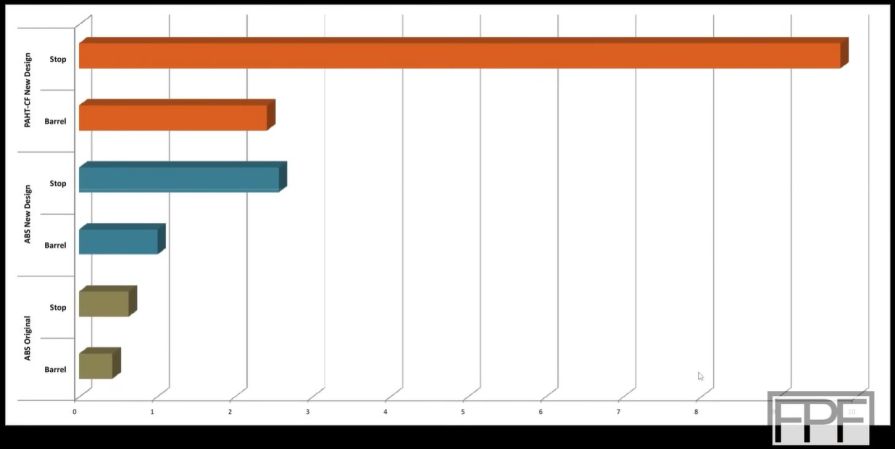
The original part was in ABS, printed horizontally in a Bambu Lab FDM printer, which had a protruding element snapped off while in use. In addition to printing a replacement in carbon fiber-reinforced nylon (PAHT-CF, i.e. PA12 instead of the typical PA6), the part was now also printed at a 45° angle. To compare it with the original ABS filament in a more favorable way, the same part was reprinted at the same angle in ABS.

Another change was to add a machine screw to the stop element of the part, which turned out to make a massive difference. Whereas the original horizontal ABS print failed early and cleanly on layer lines, the angled versions put up much more of a fight, with the machine screw-reinforced stop combined with the PA12 CF filament maxing out the first meter.

The take-away here appears to be that not only angles are good, but that adding a few strategic metal screws can do wonders, even if you’re not using a more exotic filament type.

Continue reading “Destructive Testing Of ABS And Carbon Fiber Nylon Parts”

Be More Axolotl: How Humans May One Day Regrow Limbs And Organs

Although often glossed over, the human liver is a pretty amazing organ. Not just because it’s pretty much the sole thing that prevents our food from killing us, but also because it’s the only organ in our body that is capable of significant regeneration. This is a major boon in medicine, as you can remove most of a person’s liver and it’ll happily regrow back to its original volume. Obviously this is very convenient in the case of disease or when performing a liver transplant.

Despite tissue regeneration being very common among animals, most mammalian species have only limited regenerative ability. This means that while some species can easily regrow entire limbs and organs including eyes as well as parts of their brain, us humans and our primate cousins are lucky if we can even count on our liver to do that thing, while limbs and eyes are lost forever.

This raises many questions, including whether the deactivation of regenerative capabilities is just an evolutionary glitch, and how easily we might be able to turn it back on.

Continue reading “Be More Axolotl: How Humans May One Day Regrow Limbs And Organs”

Wayland Will Never Be Ready For Every X11 User

After more than forty years, everyone knows that it’s time to retire the X Window System – X11 for short – on account of it being old and decrepit. Or at least that’s what the common narrative is, because if you dig into the chatter surrounding the ongoing transition there are some real issues that people have with the 16-year old spring chicken – called Wayland – that’s supposed to replace it.

Recently [Brodie Robertson] did some polling and soliciting commentary from the community, breaking down the results from over 1,150 comments to the YouTube community post alone.

The issues range from the expected, such as applications that haven’t been ported yet from X11 to Wayland, to compatibility issues – such as failing drag and drop – when running X11 and Wayland applications side by side. Things get worse when support for older hardware, like GeForce GT610 and GT710 GPUs, and increased resource usage by Wayland are considered.

From there it continues with the lack of global hotkeys in Wayland, graphics tablet support issues, OBS not supporting embedded browser windows, Japanese and other foreign as well as onscreen keyboard support issues that are somehow worse than on X11, no support for overscanning monitors or multiple mouse cursors, no multi-monitor fullscreen option, regressions with accessibility, inability of applications to set their (previously saved) window position, no real automation alternative for xdotool, lacking BSD support and worse input latency with gaming.

Some users also simply say that they do not care about Wayland either way as it offers no new features they want. Finally [Brodie] raises the issue of the Wayland developers not simply following standards set by the Windows and MacOS desktops, something which among other issues has been a point of hotly debated contention for years.

Even if Wayland does end up succeeding X11, the one point that many people seem to agree on is that just because X11 is pretty terrible right now, this doesn’t automatically make Wayland the better option. Maybe in hindsight Mir was the better choice we had before it pivoted to Wayland.

Continue reading “Wayland Will Never Be Ready For Every X11 User”

When The UK’s Telephone Network Went Digital With System X

The switch from analog telephone exchanges to a purely digital network meant a revolution in just about any way imaginable. Gone were the bulky physical switches and associated system limitations. In the UK this change happened in the early 1980s, with what the Post Office Telecommunications (later British Telecom) and associated companies called System X. Along with the system’s rollout, promotional videos like this 1983 one were meant to educate the public and likely any investors on what a smashing idea the whole system was.

Although for the average person in the UK the introduction of the new digital telephone network probably didn’t mean a major change beyond a few new features like group calls, the same wasn’t true for the network operator whose exchanges and networks got much smaller and more efficient, as explained in the video. To this day System X remains the backbone of the telephone network in the UK.

To get an idea of the immense scale of the old analog system, this 1982 video (also embedded below) shows the system as it existed before System X began to replace it. The latter part of the video provides significant detail of System X and its implementation at the time, although when this video was produced much of the system was still being developed.

Thanks to [James Bowman] for the tip.

Continue reading “When The UK’s Telephone Network Went Digital With System X”

The Death Of Industrial Design And The Era Of Dull Electronics

It’s often said that what’s inside matters more than one’s looks, but it’s hard to argue that a product’s looks and its physical user experience are what makes it instantly recognizable. When you think of something like a Walkman, an iPod music player, a desktop computer, a car or a TV, the first thing that comes to mind is the way  that it looks along with its user interface. This is the domain of industrial design, where circuit boards, mechanisms, displays and buttons are put into a shell that ultimately defines what users see and experience.

Thus industrial design is perhaps the most important aspect of product development as far as the user is concerned, right along with the feature list. It’s also no secret that marketing departments love to lean into the styling and ergonomics of a product. In light of this it is very disconcerting that the past years industrial design for consumer electronics in particular seems to have wilted and is now practically on the verge of death.

Devices like cellphones and TVs are now mostly flat plastic-and-glass rectangles with no distinguishing features. Laptops and PCs are identified either by being flat, small, having RGB lighting, or a combination of these. At the same time buttons and other physical user interface elements are vanishing along with prominent styling, leaving us in a world of basic geometric shapes and flat, evenly colored surfaces. Exactly how did we get to this point, and what does this mean for our own hardware projects?

Continue reading “The Death Of Industrial Design And The Era Of Dull Electronics”