Time For The Prize: Urban Gardening And Living Off The Land

What kind of impact does growing your own food have on the world’s resources? Jump aboard for a little thought exercise on this week’s Time for the Prize challenge to brainstorm urban gardening and living off the land.

We figure for any kind of meaningful impact there would need to be wide-spread adoption of people growing at least some of their own food locally. This means making the process fun and easy, a challenge well suited for 2015 Hackaday Prize entries. Write down your ideas as a project on Hackaday.io, tag it 2015HackadayPrize and you could win this week’s prizes which are listed below.

Space, Information, and Automation

urban-gardening-thumbTo get rolling, we started thinking about three things that are needed to convince people to grow their own food or live off the land.

First up, you need space to grow. This has been the subject of a number of urban farming hacks like the one seen here which uses downspouts as a vertical garden apparatus. Openings are cut into the front of the tubes, which are each hanging from a PVC rack. Each opening hosts a plant, holding them where they have access to sunlight, while taking up very little space on a sunny balcony or sidewalk.

The concept also includes a bit of automation. It’s a hydroponic garden and simple sensors and controllers handle the water circulation while providing feedback for the gardener through a smartphone app. We think the technology of the system is one way to attract people who would otherwise not take up seed and trowel.

For those new to taking care of plants the other thing to consider is information. Not only does the sensor network need to monitor the system, but something valuable needs to be done with the data. Perhaps someone has an idea for city-wide aggregate data which will look at successes from one urban garden and make suggestions to another?

This is your time to shine. Get those ideas flowing and post them as your entry for the Hackaday Prize. Even if you don’t see the build through the idea can still help someone else make the leap to greatness in their own brainstorming.

This Week’s Prizes

time-for-the-prize-week-4-prizes

We’ll be picking three of the best ideas based on their potential to help alleviate a wide-ranging problem, the innovation shown by the concept, and its feasibility. First place will receive an RGB Shades Kit. Second place will receive a GoodFET42 JTAG programmer and debugger. Third place will receive a Hackaday CRT Android tee.


The 2015 Hackaday Prize is sponsored by:

Projects For Solving Big Water Problems

We’re looking for solutions to problems that matter and water waste is high on that list. This week we challenged you to think about Big Water; ideas that could help conserve the water used in agricultural and industrial applications. Take a look at some of the entries, get excited, and start working on your own idea for the 2015 Hackaday Prize.

Windtraps

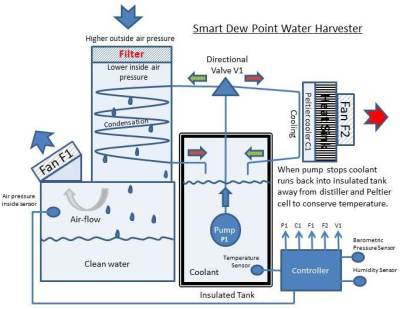
smart-dewpoint-harvesterThat’s right, windtraps. Like the Fremen of Arrakis there were a few hackers who propose systems to pull moisture from the air.

The RainMaker is targeted for urban farming and explores the possibility of passive systems that water themselves automatically. [Hickss] admits that there are some limitations to the concept. Small systems would have limited ability to collect moisture and a need for direct sunlight in order to be solar powered. However, if you’re growing food we figure direct sunlight was a pre-requisite anyway.

On a bit grander scale is the Smart Dew-Point Water Harvester which is shown off in this diagram. The proof of concept at this point is a desktop system that collects moisture on a small heat-sync. Scroll down to that project’s comments and read about the possibility of building the system underground to take advantage of the naturally colder area.

For us the interesting question is can this be done in conjunction with traditional irrigation? Is a lot of irrigation water lost to evaporation and could reclamation through these means make an impact?

Moisture Sensing

water-sensing-orb-thumbSimple but powerful: only water when the plants need it! Here are several entries focused on sensors that make sure fields are being watered more efficiently.
The Adaptive Watering System focuses on this, seeking to retrofit current setups with sensor pods that make up a mesh network. We found the conjecture about distributing and retrieving these pods using a combine harvester quite interesting.

Going along with the networked concept there is a Moisture Monitoring Mesh Network which proposes individual solar-powered spikes. Much of the info for that project is embodied in the diagram, including a mock-up of how the data could be visualized. One thing we hadn’t spent much time thinking about is that fields may be watered unevenly and a sensor network would be a powerful tool in balancing these systems.

Wrapping up this concept is the Soil Moisture Sensor for Agriculture. [JamesW_001] rendered the image seen above as his concept for the sensor. Toss the orbs throughout the fields and the rings of contacts on the outside make up the sensor while the brains held safely inside report back wirelessly.

Plumbing

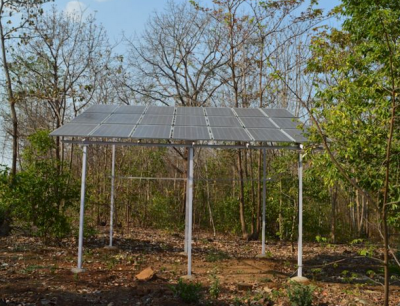
solar-water-pumpTwo projects tackled plumbing. The first is the Solar Water Pump seen here. Focused on the developing world, this array provides water for multiple applications, including agricultural irrigation, and can be used for wells or surface water sources.

Once that pump gets the water moving it will be taking a trip through some pipes which are another potential source of waste. When buried pipes leak, how will you know about it? That’s the issue tackled by the Water Pipeline Leak Detection and Location project. When the water pipe is buried, two sets of twisted-pair conductors in permeable sheathing are also buried along with it. These redundant sensors would use Time-Domain Reflectometry (TDR) to detect the location of a short between conductors. We’re a bit fuzzy on how this would detect leaks and not rain or irrigation water but perhaps the pipe/wire pairs would be in their own water-shedding sleeve?

This Week’s Winners

time-for-prize-prizes-week-3

First place this week goes to the Smart Garden and will receive a DSLogic 16-channel Logic Analyzer.

Second place this week goes to Soil Moisture Sensor for Agriculture and will receive an Adafruit Bluefruit Bluetooth Low Energy sniffer.

Third place this week goes to Solar Water Pump and will receive a Hackaday robot head tee.

Next Week’s Theme

We’ll announce next week’s theme a bit later today. Don’t let that stop you from entering any ideas this collection of entries may have inspired. Start your project on Hackaday.io and add the tag 2015HackadayPrize.


The 2015 Hackaday Prize is sponsored by:

Hackaday Prize Worldwide: Toronto

Tomorrow, April 15th at 7pm, join Hackaday at the Toronto HackLab.

Our own Mythical Creature, [Sophi Kravitz] is headed North of the border to talk about all things hardware hacking! As always, we love to see what people are working on in their labs, basements, garages, and workplaces. Make sure to bring your builds with you to show off to the rest of the crowd. [Sophi] will have her Breathe project on hand. Solenoids, balloons, compressed air, and visualizations are the secret sauce behind this clever interactive build.

Since there will be snacks, hacks, drinks, and swag we’d appreciate a quick RSVP (use the link at the top of this post) just so we know you’re incoming. Apart from seeing a slew of cool builds there will be lightning talks, some information about the 2015 Hackaday Prize, and if you haven’t been to the Hacklab before this is the perfect time for your first tour. We know there’s a lot of awesome to be seen there!


The 2015 Hackaday Prize is sponsored by:

Cyclist Pulled Over For Headphones Builds Neighborhood Shaking Bicycle Boombox

Riding around with headphones on is not the safest of things; those people are trying to could hit you! [Victor Frost] was actually pulled over for doing it. Although the bicycle police didn’t ticket him, they did push him over the edge to pursuing a compromise that lets him listen to tunes and perhaps still hear the traffic around him.

The build puts 200 Watts of audio on his rear luggage rack. He used a couple of file totes as enclosures, bolting them in place and cutting one hole in each to receive the pair of speakers. The system is powered by two 6V sealed lead-acid batteries which are topped off by a trickle-charger when the bike is parked.

Looking through this log we almost clicked right past this one. It wasn’t immediately apparent that this is actually version four of the build, and these are completely different spins each time. The top-down view of plastic-tacklebox-wrapped-v3 is sure to make you grin. Video overviews of the first two versions are linked in [Victor’s] details section of the project page linked at the top of this post. The progress is admirable and fun time digging through. They’re all quite a bit different but bigger, better, and more self-contained with each iteration.

Okay, okay, maybe this isn’t going to shake the neighborhood… until he adds a Bass Cannon to it.

Hackaday Part Of TechCrunch NY Hackathon

The Hackaday Prize Worldwide is coming to New York! Hackaday is adding a hardware-centric twist to the TechCrunch Disrupt in May. They’re kicking off the conference with a weekend hackathon which traditionally has been a software event. This year Hackaday is partnering with TC to make a change. If you’re a software-only sort of person, grabbing a ticket to the event is extremely tough. But those Hackaday community members who want to prove they can make electrons do their bidding still have hope; Hackaday can get you in!

Twenty Hours of Hardware

Show up at 12:30pm on Saturday, May 2nd. By 9:30am the next morning you must have a working piece of hardware having been totally built on-site. Starting at 11am on Sunday you have 60-seconds to show off your build. We’re not kidding around when we say the judging criteria for this hackathon is “Awesomeness”. TC is putting up $5,000 to the winning team. Obviously someone who hangs out around Hackaday should be the winner here so go sign up!

Ticket Registration is a Hack:

TC hackathon tickets are released in shifts and gobbled up immediately, but because you are a friend of Hackaday we’ll can get you in for some epic hardware hacking. Even signing up is a bit of hack but here’s how:

  1. Follow this link which includes a promo code to get a Hackers – Friends of TC ticket
  2. Form/Find a team (up to 5 people) in advance through ChallengePost or you may do so onsite. You’ll notice the tags are software-related so put in “other” and add “hardware” and specific tags you can think of.

The Hardware

We’ll be bringing the basics: lots of dev boards, sensor breakout boards, and tools you need to hook them together. We’ll be posting information about the items we are bringing on our Hackaday Prize Worldwide: New York City page. Make sure you check in for updates so that you can familiarize yourself with what we’ll have on-hand. It is highly recommended that you set up any IDE or other dev tools before arriving at the event.


The 2015 Hackaday Prize is sponsored by:

Showing An AVR Programmer Who’s Boss

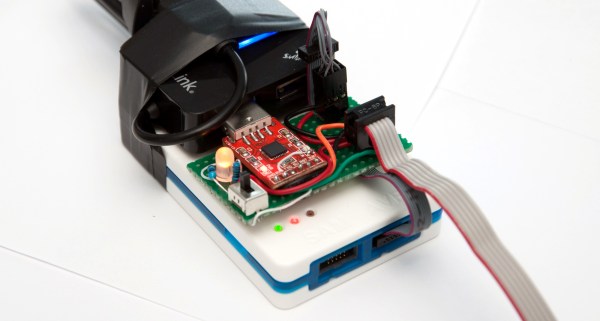
[Bogdan] makes a good point. When you use a dev board you get programming, debugging, power sourcing, and usually a UART. When you go to the trouble of hooking up a programmer why don’t you get the same thing? Astutely, he points out that all you usually get with programmers is programming. So he set out to add features to the hardware he uses to program XMEGA.

The first part of the trick hinges on his use of PDI programming. This is slightly different from ISP programming. Both use a six-pin connector cable but with PDI two of these pins are unused. He took this opportunity to reroute the chip’s TX and RX pins through the cable, which now gives him an avenue to use a UART-to-USB adapter without adding any cables to his target board. Rather than add a second USB cable he rolled a USB hub into the mix. An LM1117 regulates the 5V USB rail down to 3.3V as a source for the target board.

The programmer being used is an Atmel ICE. As you might imagine he didn’t want to make permanent alterations to it. His modifications are all handled externally, with one IDC cable connecting the programmer to his added circuitry and another headed off to the target board. For now he’s jumpering RX/TX to the programming header but plans to route the signals on future PCBs.

We Have A Problem: Mass Versus Local Production

Hackaday, we have a problem. We’re trying to engineer a brighter future; a task that calls for a huge mental leap. This week, instead of discussing a concrete problem, let’s gather around the digital campfire to gnaw on a thought exercise. In thinking abstractly I hope we’ll trigger a slew of ideas you can use as your entry in the 2015 Hackaday Prize in which you can win a Trip to Space or hundreds of other prizes.

Shipping Mass Produced vs. Producing Locally

This morning I was reading an interesting story about an email server that couldn’t deliver message to any ISP physically located more than 500 miles away. In that case it turns out that the limiting factor was misconfiguration and the speed of light. But it got me thinking about things we transport in bulk versus things being transported individually. I often think about the transport of finished goods and compare where we are now to the fabrication visions [Neal Stephenson] talked about in his novel The Diamond Age. In that picture of the future, it is common building blocks of matter that are delivered to every home and business and not finished goods. Interesting.

What kind of resources are consumed in local production versus centralized mass production? Is there merit in using technology to change the way we’ve always done some things? Certainly there will not be one answer for everything so let’s talk about a few examples that might be done differently.

Scenario #1: You send a greeting card with your hand-written message to your mother for her Birthday.

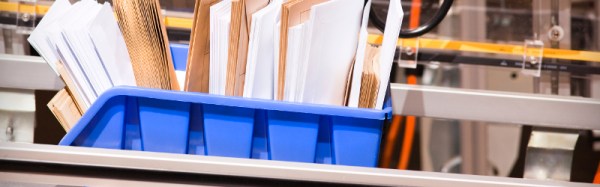
handwritten-message-cardThe way things work right now, you go to the store and pick out a card. You write a personal message inside, lick, stamp, and send it through the mail. The thing is, this card is probably already in a store down the street from your mother. What if you could digitize your handwritten message and have it printed on the card and delivered from a local repository? Take it a step further, assuming that these cards are bulk-printed in one central location and distributed widely, does it save any resources to decentralize the production of the cards and make production local so that the finished goods are not being transported more than 500 miles? And for those skeptics saying that you can’t add a check or cash to the card when done this way… yes you can!

Scenario #2: The meal is finished and just as you close the door to the dishwasher you hear a horrible crack as the plastic latch that holds the door closed breaks.

Recycled household appliancesStandard practice is that the part be ordered from a parts supplier (either by you or by a serviceman). These suppliers keep a stock of common parts which are well documented in a huge library of service manuals for the myriad of home appliances out there. But when you get right down to it, it’s just a little plastic bauble. Let’s assume all of these are made in a single factory in huge production runs that supply both the manufacturer and the legacy parts houses. What if instead of this you could have these parts 3D printed by a business within 500 miles of where they are needed. There are industrial-grade 3D printing techniques that produce parts strong enough to act as a replacement. Where do you come down on resource saving between the two methods?



Scenario #∞: It’s your turn to come up with an example.

We want to hear your ideas on local production versus centralized mass production. Don’t be afraid to share half-baked ideas. The entire point of We Have a Problem is to spark civil debate on issue which could lead to world-changing solutions. Help us start the idea mill and jump on to see where it takes us. Don’t forget to carry the inspiration you find into your entry for the Hackaday Prize.


The 2015 Hackaday Prize is sponsored by: