Robot-Army IRL Plus A Massive Build Log

We went to “the dark room” at Maker Faire once more for an interview with [Sarah] of Robot-Army. She and [Mark], who handles software development for the project, were showing off 30 delta robots who know how to dance. Specifically they’re dancing in unison to the movements of another faire-goer. A Kinect sensor monitors those movements and translates them to matching motions from the deltabots.

You should remember seeing this project back in November. Now that the standards for this model have been worked out it was just a matter of sinking about three-weeks into assembling the army. We’re happy to see that the Kickstarter made it to 250% of the goal at the beginning of March, and with that there are even bigger plans. [Sarah] says the goal remains to fill a room with the robots and a we may even see a much larger version some day.

The interview is a bit short since the Robot-Army booth was right next to Arc Attack (hence the noise-cancelling headphones) and we had to try to get in and out between their ear-drum-shattering interruptions. But you can see a ton more about the project in this huge build log post over on Hackaday.io. Also check out the Robot-Army webpage. There’s a nice illustration of their adventures at MFBA and the foam Jolly Wrencher made it into the piece!
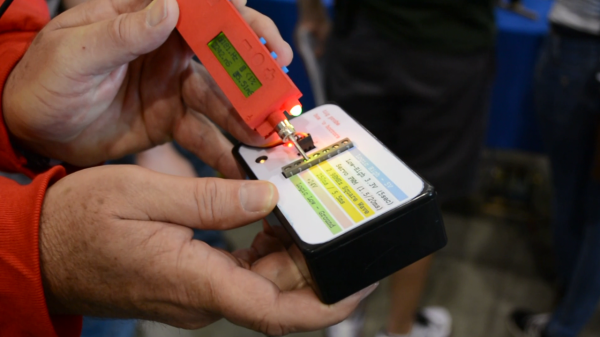
TIQ probe and test box

TIQ Probe Is More Logical Than Most

[youtube=https://www.youtube.com/watch?v=XZz1W-LurlU&w=580]


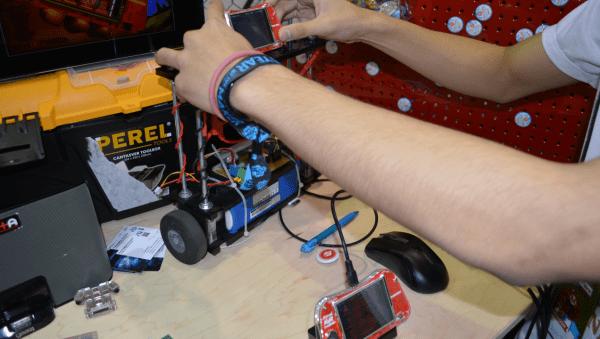
We had [Mark] on our “dance card” for people to find at Maker Faire. But before we could track him down he bumped into us holding the TIQ Probe in one hand and a testing box in the other. TIQ is conceived in the form factor of a traditional logic probe but thanks to the Cypress PSoC 5LP inside it’s much, much smarter than the decades-old bench tools. Sure, it can tell you if that uC pin is a 1 or a 0, but it can also detect what type of signal it’s probing and has built-in protection for over-voltage.

The point of the tool is to bridge the gap between things which would be measured with a DMM and those measured with a proper Oscilloscope. We think he did a pretty good job of including the things that someone just starting out without expensive bench equipment might want. For instance, you can set it to trigger on common data protocols like i2c, and use the probe itself as a rudimentary pulse generator.

The bulk of the details on the probe can be found on its Kickstarter page (which has just a few days left). You may also be interested in his company page. We’re curious about the insides of the test rig he was hauling around. [Mark] is a regular reader so hopefully he’ll leave a comment below with the details of that black box.

Hackable Arduino Cellphone

Phoenard: Arduino Phone As Small As An Arduino Mega

[youtube=https://www.youtube.com/watch?v=_hXgwTRqwRU&w=580]


Hanging out at one side of the Atmel booth at Maker Faire was [Pamungkas Sumasta] who was showing off his Arduino cellphone called Phoenard. We really like the form-factor but its hackability is where it really shines. [Sumasta] showed off the menu system which is quite snappy and makes it simple for you to add your own applications. Software isn’t the only thing you can customize, as there’s a connector at the bottom of the phone. He showed off a breadboard attachment which was hosting LEDs of various colors. Their intensity can be altered using a simple slider app on the touchscreen. But there’s more power if want it. Also on exhibit was a self-balancing robot body which has a connector at the top for the phone.

[Sumasta] won the Atmel Hero contest and we assume that’s how he made it all the way to San Francisco from The Netherlands for Maker Faire. You can learn a few more technical details about Phoenard on the Facebook page.

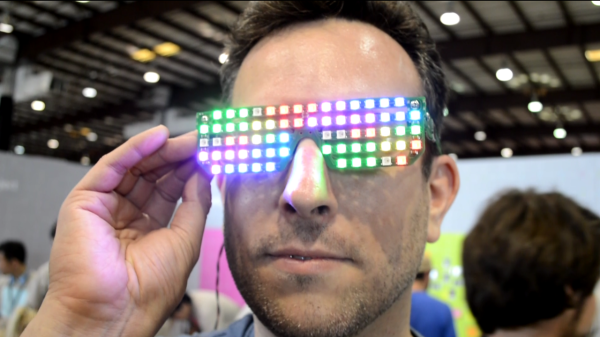
Blinding Shades Hide Wearer’s Four Eyes

We ran into [Garrett Mace] at Maker Faire. He wasn’t exhibiting, but in keeping with the fun he made something to show off. This pair of RGB LED Shades was assembled the night before. They may have been hacked together, but they were in no way a hack. Especially of interest to us is the hinge design which is made of PCB substrate and a few machine screws.

Our video above does a pretty good job of showing off the blinky patterns he coded. What’s surprising to us is that the wearer is almost no view of the light the specs are emitting. The slots aren’t that hard to see out of either, and they hide [Garrett’s] prescription glasses quite nicely. This pair steps up from the single color version we saw a couple of years back. That set was also on display, but you really do need to get a closer look at the newer design. Luckily it took us so long to get this video edited that the Macetech blog now has complete details.

10,000 Hackers


Our little community might not be so very little. Today the 10,000th Hacker registered an account on Hackaday.io! You may remember that we just launched our project hosting site at The Gathering on January 21st and made it public in February. There were a few pre-Alpha testers already registered, but still, that’s 10k people in four months. Why? Because hacking is awesome and it’s made better if you show off what you do!

Of course we’re not anywhere near done yet (technically we’re still in Alpha). We want help shaping the existing features and developing new ones. Share your ideas as comments on the Feedback project; we read those.

Hackaday.io is also the gathering point for The Hackaday Prize. Give the interface a whirl, contribute to open hardware, and win a trip into space or hundreds of other prizes. What are you waiting for?

Oh, one last thing, if you’re wondering what 10,000 Hackers looks like, we have a Jolly Wrencher for every one of you after the break.

Continue reading “10,000 Hackers”

[Lenore] Eviscerates Her Racing Snail

[youtube=https://www.youtube.com/watch?v=pzymwuPdQp4&w=580]


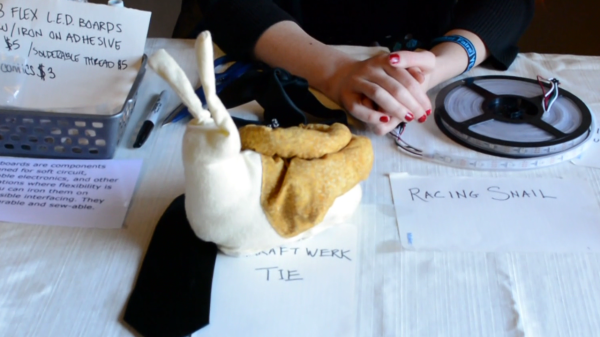
You may have walked past [Lenore’s] unassuming card table at Maker Faire this year. But we’re really glad we stopped for a little chat. She went so far as to pull the working parts out of her racing snail to show them to us!

Wait, wait… racing snail? Yeah, this is a pretty neat one from a few years ago. The snail is a relatively large version of a bristlebot (incidentally, we believe bristlebots were originated by EMSL). The thing that’s missing here are the bristles. Instead of using a scrub-brush for this large version, [Lenore] discovered that velvet has a somewhat uni-directional grain. But using a piece of mouse-pad cut to the same footprint as the velvet she was able to get the flat-footed snail to move in a forward direction purely through the jiggle of a vibrating motor.

If this sparked your interest there are tons of other bristlebot variations to be found around here. One of our favorites is still this abomination which shifts weight to add steering.

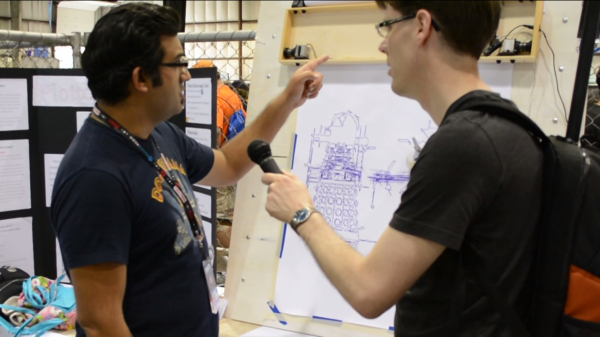
Standing in front of a gravity based pen plotter

Plotterbot Drawing Daleks


Two strings, two motors, and some very creative software. That’s the magic behind the Plotterbot, which was drawing Daleks when we crossed its path at Maker Faire. This is the Mark II, which was built after cannibalizing Mark I. Unfortunately we can’t tell you what the difference is between the two.

The machine itself is a pretty nice little package. There is a box that hangs on the wall with a motor/spool combination at each end. In the middle of those two is an Arduino Mega with a custom driver shield. It takes an SD card with the drawing files on it. There is also a small touchscreen display which allowed for easy selection of what you’d like drawn on that paper taped to the wall below the unit.

Back when we were running the Trinket contest [Jay] used the Plotterbot to draw a Skull and Wrenches made out of a multitude of smaller Skull and Wrenches. He was nice enough bring that piece of art and present it to us at the Faire. Thanks [Jay]!

Continue reading “Plotterbot Drawing Daleks”