Recover Acer Aspire One From “failed To Initialize HAL” Error

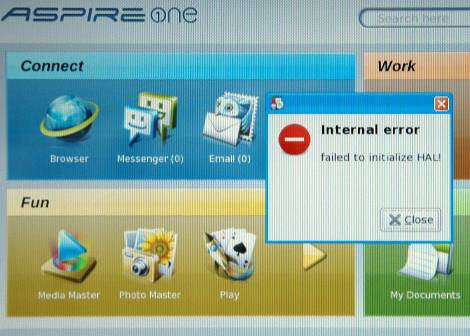
The Acer Aspire One is a netbook that often ships with a Linux OS preinstalled. This is great for fans of open source as market share is calculated based on units shipped, not what users install after they buy the hardware. Unfortunately there is a pretty major flaw that can cause a “failed to initialize HAL” error as seen above. [Michael Crummy] came up with a set of steps you can use to recover from this error.

So what is this error? HAL stands for Hardware Abstraction Layer and it’s what allows one user interface to communicate with many different types of hardware. If you’re the proud owner of an Aspire One and are struck with this error you will suddenly find that you can no longer use the USB ports, card readers, wired or wireless network connectors, or the sound card. So you can’t connect to the Internet, and you can’t get any files on or off of the device using the currently installed operating system. For an OS that [Neal Stephenson] once described as “like the M1 tanks of the U.S. Army, made of space-age materials and jammed with sophisticated technology” this is a very big problem.

We know what you’re thinking… boot into a live session on a thumb drive and get what you need from the hard disk. Well that’s all fine and dandy, but you shouldn’t ever be forced to clean install Linux to fix a problem. So check out [Michael’s] method and make sure you turn off the Acer live update server which was mostly likely the cause of the problem in the first place.
On Air Light Parses Webpage Data Wirelessly Without A Computer

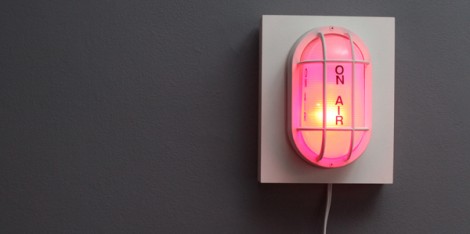
[Matt Richardson] built this on-air light to indicate whether a Make streaming show is currently in progress. Despite the obvious cord leaving the bottom of the base (it’s a power cord) his creation is pulling data from the Internet wirelessly. He’s using an Xbee module along with an Arduino to pull this off.

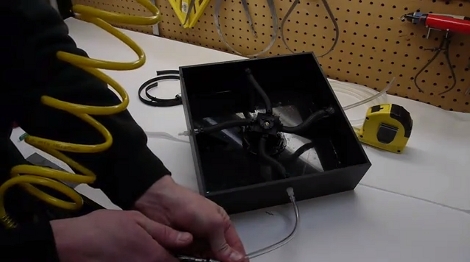
In addition to the light itself there’s a base station that we haven’t seen before. The hardware is a Digi ConnectPort Zigbee-to-Internet Gateway. That’s a mouthful but it’s just a box that acts as an Xbee node and facilitates communication between its own Ethernet port and other Xbee devices in the network. So no, you don’t need a computer but you do need an Ethernet connection somewhere for the base station. [Matt] is running an open source software package on the ConnectPort call Xbee Internet Gateway (xig). Watch the video after the break to see the configuration for this package. It’s a snap, and if you’ve never used an Xbee module before this gives you a good idea of how easy it really is.

Continue reading “On Air Light Parses Webpage Data Wirelessly Without A Computer”

Haptic Feedback Joystick Uses Air Muscles

[Ben Krasnow] is working on a force-feedback joystick. It centers around the concept of an air muscle which transfers pressure into linear motion. He cites another air muscle project as part of the inspiration in his build, but where he’s gone with it is one of the better uses for these blow-up components that we’ve seen.

Basically you have a bladder, in this case rubber tubing. A mesh surrounds it to reinforce the material and cause inflation to shorten the length of the package. In the image above there are four black air muscles that connect the base of a joystick with the outer frame that houses it. How and when each muscle is pressurized determines the type of motion the user will feel on the joystick. This is where his pressure controller comes into play. It uses a voltage-to-pressure transducer to feed a manifold, the combination of which not only makes each muscle addressable but allows him to dial in the force sent to the muscles. Check out the video after the break for his start-to-finish walk through.

Continue reading “Haptic Feedback Joystick Uses Air Muscles”

LEGO Pendulum Clock

Put a case around it and it would be a grandfather clock but for now it’s a pendulum clock made from LEGO pieces. The video after the break shows a great overview of the build. You can see the workings at several different angles, as well as a clip that has been sped up to show the movement of the weights over time. One weight, made from dead AA batteries, drives the clock and the other weight switches the winding motor. That motor acts to automatically wind the clock when the drive weight reaches the end of its rope.

This is a nice departure from the majority of clock projects we see as it utilizes mechanical concepts instead of electronic. Most of [Pmroskelly’s] build details are shared as comments on the Picasa album found at the link above. There are also some other videos such as the one showing how the escapement works.

Continue reading “LEGO Pendulum Clock”

How Escher’s Impossible Waterfall Was Faked

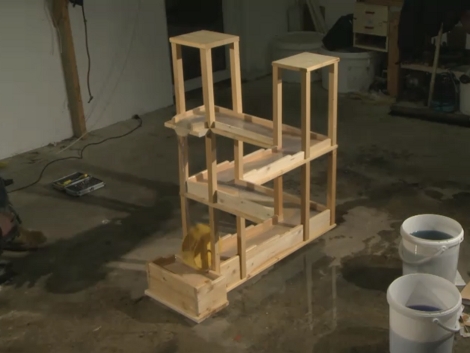
Study the image above closely. You’ll notice that physically it is an impossible object, yet this is a screenshot of full-motion video. The clip after the break shows a gentleman pouring water into the waterfall where the wheel is located. The liquid flows in a direction that appears to be uphill, then falls onto the waterwheel where it was originally poured. Ladies and Gentleman, we have the solution to the world’s energy crisis. Nope, we have a hoax and the real question is how was it done?

[David Goldman] has come up with quite the explanation. He watched the video very closely and the put together a three-dimensional diagram showing how he would build the apparatus. If you saw the movie Inception (we highly recommend you do) you will remember the infinite stair puzzle that is exposed as an optical illusion. [David’s] proposed method for debunking this hoax uses a similar build that comes in four different, precisely placed elements.

We’ve got to hand it to him. That’s a brilliant theory! Of course the first commenter on the post linked above calls this out as CGI and we’re inclined to go with that answer but that’s much less fun.

Continue reading “How Escher’s Impossible Waterfall Was Faked”

Jittering Hexapod Dances To The Strokes Of Your Bluetooth Keyboard

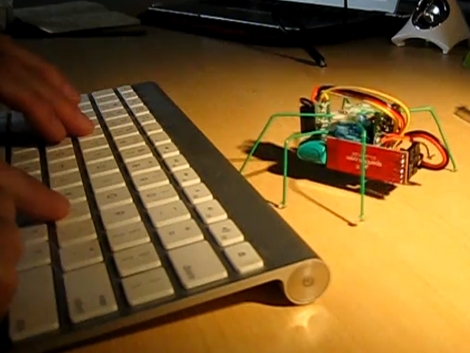
Here’s a small but functional hexapod that is controlled via Bluetooth. [Sigfpe] started with the hexapod kit sold by Polulu and added a BlueSMiRF modem to get the little guy’s communications up and running. But since the bot is merely three servos, a microcontroller board, sensors, and miscellaneous parts it’s an easy build for most electronic hobbyists.

Check out the video after the break to see the delightful dance it can perform at your bidding. When we first looked at the project we thought that the keyboard was directly paired with the bot for control, but a look at the code makes us think the computer is controlling it after processing keystrokes. Either way the BlueSMiRF should have no problem pairing with other Bluetooth devices so it’s just a matter of coding to get it taking commands from your device of choice. We’d love to see Android control but for the really hard-core code monkeys we think this should be voice controlled with a Bluetooth headset.

Continue reading “Jittering Hexapod Dances To The Strokes Of Your Bluetooth Keyboard”

Arduino Based Ambient Lighting Improvements

[Simon] improved upon an existing hack by making this Arduino ambient lighting system that has four different color regions. He was inspired by [Roy’s] processing-based setup which we saw a few weeks ago. That system used processing to determine the average color of the currently displayed image, then it displayed the color on a single RGB LED strip. [Simon] was thinking a little bit bigger.

He purchased a lighting strip that could be cut into different sections and then set out to develop his own software for multiple color regions. He had little or no experience with Processing so he went one abstraction layer lower and used Java to code his interface. It’s got a lot of nice settings where you can tweak how, when, and why colors are displayed. In the end he has four independently addressable color strip on the left, right, top-left, and top-right of the screen. The best part is that the Java suite he developed can be used on different platforms, having been already tested on Windows and Linux.