Nerf Sentry Turret

With exams behind him [Adam Greig] had time to make a Nerf sentry gun. It’s actually quite easy to pull everything together. He’s got a netbook running Motion, an open source motion sensing program for use with a webcam. When movement is detected an Arduino, connected via a USB cable, actuates a servo to pull the trigger of the gun. The turret itself has seen a battery upgrade that increases the firing speed. It’s fun to see hardware prototyping done with a few pencils and a fist full of cable ties. Check it out after the break.

This particular toy, the Nerf N-Strike Vulcan, has become quite a popular starting point for turrent projects. We’ve seen one that uses a motorized base, and another that was part of a final project at Cornell.
Continue reading “Nerf Sentry Turret”

Candle Stop Motion: How’s It Done?

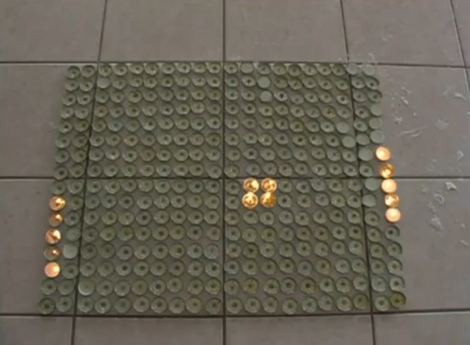
[Ollie] tipped us off about a stop motion video that uses a grid of tea candles to animate some classically pixellated game graphics. The image above is obviously a game of pong in progress. It’s interesting to watch but for us the fun is trying to decide how it’s done. Click through the break to see the video and discuss the methodology.

Continue reading “Candle Stop Motion: How’s It Done?”

Velosynth Annoys Those Around You As You Ride

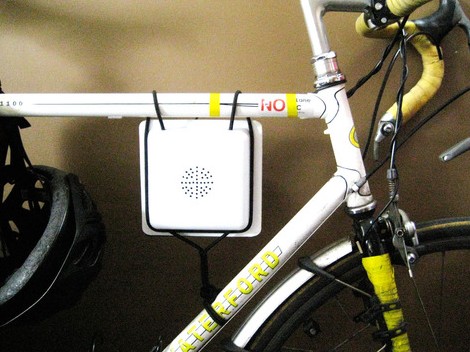
We’ve always put stock in ‘the quieter the better’ when it comes to road bikes. You’ll find this truth if you spend 100k on the back wheel of someone with a sqeaky rear derailleur. But apparently the folks at Effalo never learned this lesson as they’ve produced a bike computer that generates noise as you ride.

Perhaps it just takes some ingenuity to turn this into a beautiful music maker along the lines of the Force Trainer hack. No problem because the velosynth is a hackable design. The case was made with a vacuum form and inside you’ll find a bunch of small breadboards. The JeeNode, which is an Arduino/Xbee combination, serves as the heart of the device by taking speed and acceleration data from the bicycle wheel. From there it is passed on to various modules, Bob’s your uncle, and sound comes out. Check out their sales pitch after the break and if you’re starting to get some ideas about using this check out the open source info they’ve provided.

Continue reading “Velosynth Annoys Those Around You As You Ride”

The PR2 Calls The Shots

Can you beat this robot at pool? This sparks something of a “let the wookie win” attitude for us, but we still love to watch the video. This is the PR2 playing pool thanks to the folks over at the Willow Garage. It uses a laser sensor to detect the legs of the pool table, and cameras to find the diamonds and balls at the playing surface rather than using an overhead camera. They cut down on the coding work needed by using FastFiz, an open source Billiards physics library. The final step was building an interface so the robot could use a cue. Check it out after the break (no pun intended).

Continue reading “The PR2 Calls The Shots”

Replacement Speedometer

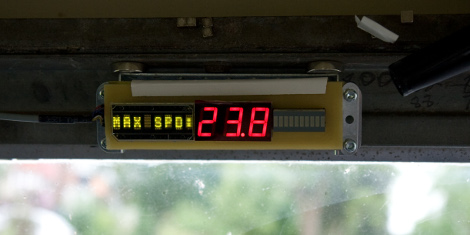
[Howard] built his own replacement speedometer for his truck after the original speedometer cable broke. He’s using surface mount components and produced a two-board design that is quite nice. When he tipped us off he mentioned that this is Arduino powered and uses a hall effect sensor. There’s not talk of this in his writeup but we gather that he’s just using the bootloader on an AVR chip and that he hall effect sensor measures the rotation of one of the wheels. When the vehicle isn’t moving the board alternates between max speed and trip distance. Once he’s on the roll it shows current speed.

Building A Cluster Of IPaq PCs

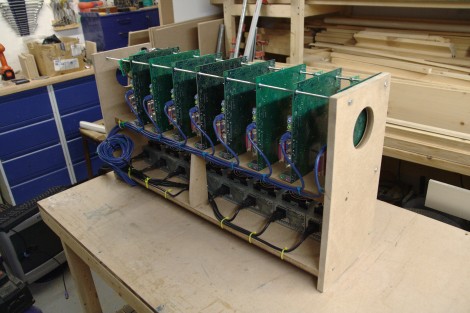
[Steven Pigeon] got his hands on ten iPaq computers that a friend acquired through an eBay auction. The older machines were in good condition but the march of technology had left them behind as casualties. He’s given them new life by assembling a cluster. The first order of business was testing the hardware to make sure it’s working. [Steven] used memtest86+ that comes along with the Ubuntu distribution of Linux to find one bad memory chip in the bunch (a revelation that took 10 hours to discover on the slow hardware). He assembled the unit above with MDF as a support structure and threaded rod to hang the boards. He ended up with a beautiful module and his next step is to choose the operating system that will pull the whole thing together.

We find this build every bit as beautiful as the file cabinet cluster. It’ll be interesting to check back with him and see what kind of performance he can get out of it.

No Nonsense Mbed Development Demo

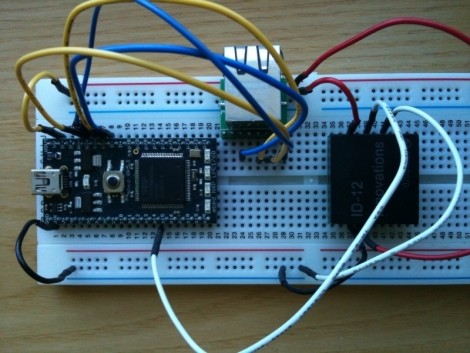
This tweeting RFID reader is a great working example for the mbed. When an RFID tag is read it is matched with the name of the owner and a Twitter message is sent out. This is very similar to the RFID cat tracker that used an Arduino.
The code is short and simple due to the use of available mbed libraries. The hardware needs just two extra modules, an RFID reader and an Ethernet socket. If you’re trying to decide if you can make the jump over to ARM development this certainly presents an easy learning curve and an opportunity to get comfortable with the code and the libraries before you make a purchase. It’s also a great set of test code to start with if you have an mbed and the two supplementary modules on hand. The quick video clip after the break will walk you through the components and the code.