Prison Inmates: The World’s Least Admirable Hackers

prison_makers_diy_radio_transmitter_bug

One thing that always amazes us is the ingenuity displayed by prison inmates, as demonstrated in the tools and weapons they create while under the watchful eye of the law. Unlike most people however, these individuals have nothing but time on their side, which lends to the wide range of implements they inevitably dream up.

[Marc Steinmetz] took some time to photograph a handful of contraband items which were confiscated in various prisons. They range from the relatively benign bed sheet ladder to more sophisticated items such as battery-powered shotguns constructed from iron bedposts. While weaponry and escape aids are the most common prison yard creations, he also came across a DIY toaster, a hidden radio receiver, and one of our favorites – the surveillance bug pictured above, which was used to listen in on guards’ conversations.

While the use of any of these items in a controlled prison environment is questionable at best, it’s still interesting to see what people can hack together with limited resources and a heck of a lot of time.

[via Neatorama via Environmental Graffiti]
An Arduino Board For Your Tiniest Of Projects

1inch_by_1inch_mini_arduino_board

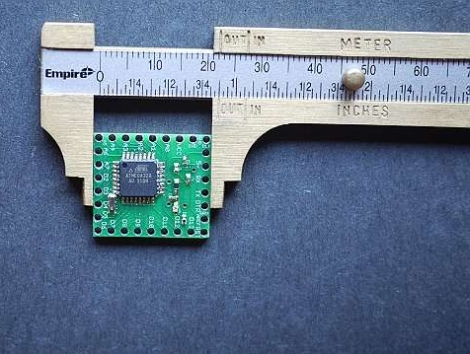
Instructables user [dustinandrews] just took the wraps off his latest creation, a DIY Arduino Pro Mini clone.

Actually, to call it an clone is technically incorrect – while he aimed to produce a tiny Arduino-compatible board, his goal was not to replicate the Mini’s design. Instead, he developed a 1” x 1” board from scratch, covering the construction process in great detail.

When you are working with components this tiny, the only reasonable way to get things done is via solder reflow. He walks through the steps he took to produce the board, which should be enough to guide those doing reflow for the first time through the process without too much trouble.

The end result looks pretty nice, and when he puts it up side by side against the Arduino Pro Mini, his board can definitely hold its own. While his design lacks an on-board power regulator and reset button, he does provide two more analog I/O pins than the Mini, along with several other enhancements.

Air Conditioner Regulation Using A Hobby Servo

automatic_mechanical_ac_control

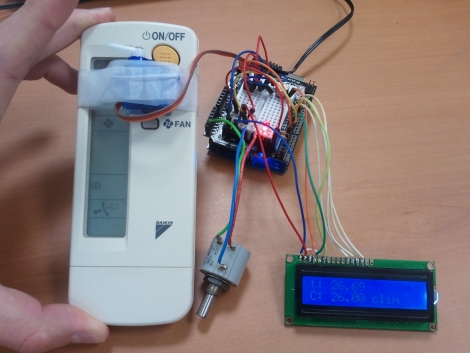
For anyone that works in a large office building, odds are you know the pains of dealing with a poorly regulated HVAC system. [Robovergne] and his co-workers recently moved to a new location, and found that the air conditioning control was less than effective, leaving the office as hot as a sauna or as cold as a meat locker.

While they manually triggered the A/C on and off every half hour for a while, that grew tiring, so [Robovergne] decided to take things into his own hands. He had never used an Arduino before, and figured that regulating the air would be a great first project. He mounted a small hobby servo onto the front of the A/C remote, and wired a DS18B21 temperature probe to the Arduino. A small pot is used to adjust the temperature setpoints, which are displayed on the attached LCD screen. Now, when the temperature starts to rise, the Arduino triggers the servo to turn the air conditioning on without human interaction.

[Robovergne] says that while his solution is ugly, it works quite well. It definitely gets the job done, we can’t argue with that!

Continue reading to see a video of his automatic A/C controller in action.

Continue reading “Air Conditioner Regulation Using A Hobby Servo”

DIY Propeller-based ECG

propeller_ecg

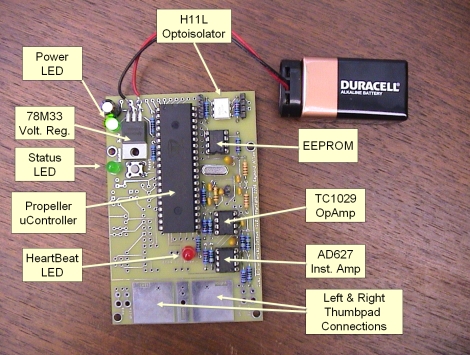
[Ray] likes to build all sorts of Propeller-based projects, but one of the more interesting items we came across was this DIY ECG. While we have covered other DIY electrocardiograms before, he left the breadboard behind and put together a nicely done PCB for his build.

The ECGs design should be pretty familiar to anyone that has seen our ECG coverage in the past. The user places his thumbs on the large built-in pads, which allow the circuit to sense the electrical signals produced by heart’s contractions. These small electrical impulses are then amplified using an AD627 instrument amplifier before being further amplified via a dual op-amp.

The amplified signal is filtered and then fed into the Propeller’s ADC, which displays the user’s heart rhythms via an LED. The data can also be fed into a computer via an optoisolated serial connection.

[Ray] lays out a litany of warnings and precautions that should be followed before downloading his schematics and firmware. We have to echo those warnings, as it doesn’t take a large well-placed shock to disrupt the heart.

Dedicated Hacker Adds USB Capabilities To His Commodore 64

usb_basic_commodore_64

To say that Commodore 64 aficionados are a dedicated group would be quite the understatement. There are still quite a few individuals that spend all sorts of time building and programming for the C64 in order to make using them enjoyable, and to keep up to date with current technologies.

[Luigi] is one of these people. He wanted a way to easily transfer files between his PC and his C64 that was fast but cheap. To [Luigi], this meant USB file transfers, which would take quite a bit of work to implement. He started out by rolling his own BASIC interpreter which could eventually be extended to support USB. Using his BASIC-Plus interpreter, he was able to implement a USB Kernel, which could transfer files at 1.2 KB/s via a USB to serial adapter. Wanting faster file transfers, he built a USB to parallel adapter, which resulted in a nearly 8-fold increase in speed.

So, if you have been dying to have USB capabilities on your C64, look no further, [Luigi] has just what you need!

Continue reading to see a quick video of USB-64 in action.

[Thanks, Matt]

Continue reading “Dedicated Hacker Adds USB Capabilities To His Commodore 64”

Peltier Powered Sous-vide Rig Gets It Right Every Time

diy_sous_vide_refrigerator_cooker

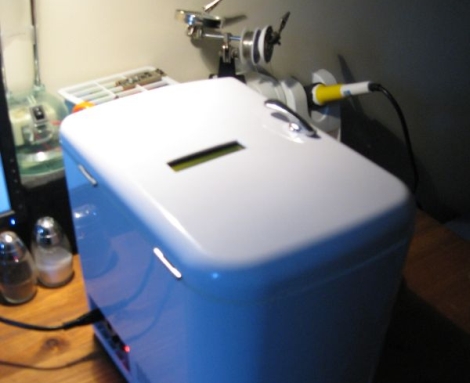
It seems that sous-vide cooking is becoming increasingly popular lately. [Meseta] caught the sous-vide bug and wanted to try his hand at it, though he did not have enough money for a premade sous-vide cooker. After seeing a good handful of lackluster DIY sous-vide rigs online, he decided that he would design and build a sous-vide cooker of his own.

He already had a Forebrain microcontroller at his disposal to use as a PID controller, but what he really needed was a cooking vessel. Rather than use an old crock pot or similar device, he purchased a small personal refrigerator that could be used for cooling or heating. The unit ran off a Peltier cooler that could be switched between modes, making it quite easy for him to control.

In his blog, he discusses the modification from beginning to end, and even shows off the results of his cooking endeavors. He hasn’t posted code as of yet, but he says that he is more than happy to share it with anyone who might be interested in building their own sous-vide cooker.

Come See What’s Cooking In The Arduino Kitchen

arduino_labs

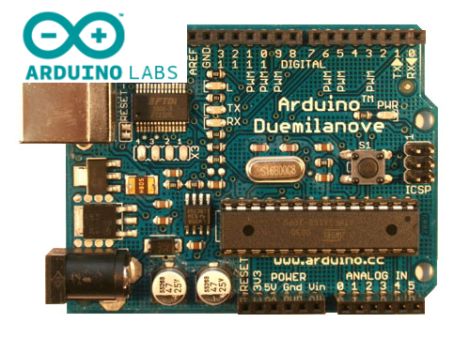
The crew that brought you the Arduino is always hard at work trying to bring the community closer together and to foster collaborative development. They recently rolled out a new feature on their site that is sure to be of interest to Arduino veterans and neophytes alike.

Arduino Labs is a platform which the team plans on using as an incubator of sorts, for projects that are underway, but not fully baked. Currently, they have highlighted two in-progress initiatives, including the Arduino Mega ADK, as well as a GSM/GPRS shield that the team has been developing in collaboration with Telefonica I+D.

As of right now, the site looks to be a one-way information outlet for the Arduino team to the community, but they stress that their aim is to create a more open development process within the Arduino project. While there is no official statement on the matter, we hope that the site will eventually allow members of the community to offer both their feedback and lend manpower to forthcoming projects.

[via Adafruit blog]