Tiny Forth Could Be The Smallest

When you think of a programming language, you probably think of a hefty compiler or interpreter. Maybe its on a bunch of floppies, a CD, or even an EEPROM. But what about a language that fits in a single disk sector? A language like that would — in theory — be used to help bootstrap a computer system and that was the idea behind Sector Forth and, later, Sector Lisp. However, there’s a new game in town: milliForth, which claims to be the smallest ever at 422 380 bytes.

Why would you want such a thing? Well, first of all, why not? Even as a form of code golf, packing a functioning language into a tiny space seems interesting. However, you could also presumably use something like this to boot a small system or on a system with limited storage.

Continue reading “Tiny Forth Could Be The Smallest”

Virginia To Get Large-Scale Wind Farm

If you go about 27 miles off the coast of Virginia, you’ll find two windmills jutting up out of the sea. Two windmills aren’t particularly interesting until you realize that these two are on the edge of a 2,100-acre lease that Dominion Energy is placing in Federal water. According to the company, those two will be joined by 176 more windmills on a nearly 113,000-acre adjacent lease. The project has been in the planning and pilot phase for a while, but it was recently given the green light by the US government. You can see a promotional video about the project below. There’s also a video of the first monopiles — the mounts for the windmills — arriving in the area.

The project will eventually have three offshore substations that feed the power to the state military reservation and, from there, to Naval Air Station Oceania, where it feeds the commercial power grid. The final project will power 660,000 homes.

Continue reading “Virginia To Get Large-Scale Wind Farm”

Machine Teaches Morse Code

If you are a ham radio operator of a certain age, you probably remember ads for “The Instructograph,” a mechanical device for learning Morse code. [Our Own Devices] has an ancient specimen of the machine and shows us how it works in the video below. The machine is a model of simplicity. You wind up a spring-driven motor like you would for an old record player or music box. A slider sets the playback rate, and paper tape starts to spin.

The paper tape looks like computer tape, but since it only has literal long and short notches, it has two distinct sides. When you learned one set of messages, you could flip the tape over and get more practice that way. How did the machine read the paper tape? With a mechanical contact. Literally, if the paper had a hole in it, you made the circuit. If it didn’t, the circuit was broken. A buzzer and batteries or some other kind of sounder was all you needed.

The company was in business for 50 years. The newer versions had more electronics, but they always used the paper tape mechanism to store the code practice sessions. A 1962 ad noted that the machine could play back the tapes from three words a minute up to 40. You could buy or rent the machine, and we always assumed it was pretty pricey for its day. Around 1965, a new unit would cost $53 but did not include a headset or a key. So that was actually more reasonable than we expected. In 1965, a brand-name clock radio cost about $50, so it wasn’t any more than that.

Everyone has their own favorite method for learning code, especially [Ludwig Koch]. At least you don’t have to learn Alex-style.

Continue reading “Machine Teaches Morse Code”

Robot Sunflower Follows The Sun

Real flowers do it, and even the Beatles did it. [Robo Hub] now has a plastic sunflower that tracks the sun using, of course, an Arduino. It may not qualify as a real robot, but it does mimic a real sunflower. The electronics aren’t earth-shattering, of course. An Arduino, a light sensor, and a servo motor are all you really need. But we enjoyed the whimsy and the artistic sensibility. This would be a great school project, for example. Interesting enough to get kids interested but not so hard as to be undoable. You can see a video of the ersatz flower below.

There are actually a pair of light sensors, as you might expect. That way you can determine which sensor is getting the most light. Obviously, these can’t be on-off sensors. They are, in fact, light-dependent resistors, so you get a nice analog reading.

Of course, you might not need an Arduino for this. A 555 driving a servo and a handful of discrete components could measure a bridge with the photoresistors and get the same effect. On the other hand, a microcontroller these days is inexpensive and versatile, so why not?

Usually, people tracking the sun are trying to get more energy. That doesn’t have to be any more complicated, though.

Continue reading “Robot Sunflower Follows The Sun”

Particle Accelerator… On A Chip

When you think of a particle accelerator, you usually think of some giant cyclotron with heavy-duty equipment in a massive mad-science lab. But scientists now believe they can create particle accelerators that can fit on a chip smaller than a penny. The device uses lasers and dielectrics instead of electric fields and metal. The conventional accelerators are limited by the peak fields the metallic surfaces can withstand. Dielectric materials can withstand much higher fields but, of course, don’t conduct electricity.

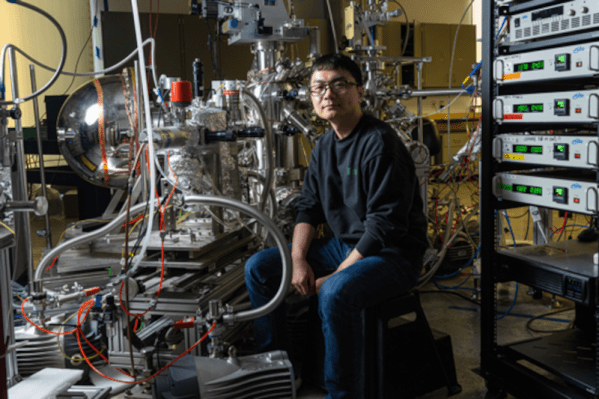
Physicists fabricated a 225 nanometers wide channel in various sizes up to 0.5 millimeters long. An electron beam moves through the channel. Very short infrared laser pulses on top of the channels accelerate the electrons down it using tiny silicon pillars.

The electron beam entered the channel at 28,400 electron volts. They exited at 40,700 electron volts, a substantial increase. The tiny pillars are only two microns high, so fabrication is tricky. Possible applications include cancer treatment, electron microscopy, and the creation of compact high-energy lasers.

The nanofabrication required for these devices won’t be in our garage any time soon. However, we hope this might lead to a new class of devices that we can use to build exciting new things. After all, remember how it used to be hard to build things using a laser?

We’ve seen laser-based accelerators before. If you want a history of particle accelerators, we can help you there, too.

All Inverters Are (Not) Created Equal

Building a crystal clock source for a CPU used to be a bit of an effort but these days, there’s nothing to it. Even if your CPU or other device needs an external clock, you just slap in an inverter, a crystal, and two capacitors together, and you are done, right? Maybe not. [Dave Collins] got interested in the common circuit and pulled out his scope and an array of different kinds of inverters. He looked at inverters and NAND gates and a few common circuit configurations.

This is one of those things you just assume is of little importance, but it turns out your choice of circuit architecture and active device can have a big impact on the output. But who has time to do all the testing? Thanks to [Dave] you don’t have to.

Continue reading “All Inverters Are (Not) Created Equal”

Ham Radio May Speed Up Soon

The FCC is circulating a proposal for new rules pertaining to amateur radio in the United States. In particular, they want to remove certain baud rate restrictions that have been in place since 1980. It appears the relaxed rules would apply only to some bands, notably some VHF and UHF bands along with the 630 meter and 2200 meter bands, which — we think — are lightly used so far. We’ll save you from grabbing the calculator. That’s around 475 kHz and 136 kHz.

Ham radio operators have long used digital modes like radio teletype and with restrictions on antennas and increasing interference from wireless networking to solar panels and more, digital has become even more popular than in the past. Besides that, cheap computer soundcards make it easier than ever and sophisticated digital modulation techniques have long left the old, clunky TeleType in the dust.

However, the FCC currently limits the baud rate to 300 baud or less, ostensibly to restrict signal bandwidth. No one wants to have an entire band consumed by a 10 Gb RF network. However, modern techniques often squeeze more into less and the FCC will finally recognize that by converting the limit to signal bandwidth, not baud rate.

What’s the bandwidth? For the common bands, it sounds like 2.8 kHz is the answer. For the VLF bands, they are asking for suggestions. The 2200 meter band isn’t even 2.8 kHz wide to start with!

All this talk makes us want to build something for the 2200 meter band. We better start winding the coil now. Then again, maybe we should go piezo. You know, just in case Thomas Dolby tells us that one of our submarines is missing.