3D Imaging For Natural Science — For Free

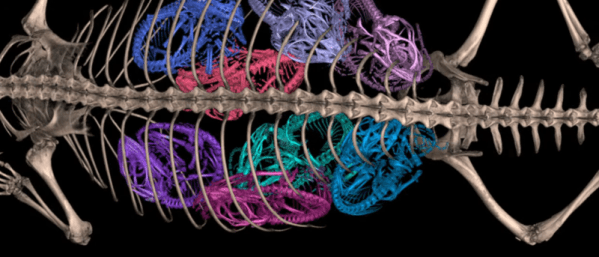
It isn’t that unusual for a home lab to have a microscope, but wouldn’t it be cool to have a CT scanner? Well, you probably won’t anytime soon, but if you are interested in scans of vertebrates — you know, animals with backbones — a group of museums have you covered.

The oVert project is scanning 20,000 specimens and making the results available to everyone. This should be a boon to educators and might even be useful for 3D printing animal forms. Check out the video about the project below.

Continue reading “3D Imaging For Natural Science — For Free”

Measuring Nanometers At Home

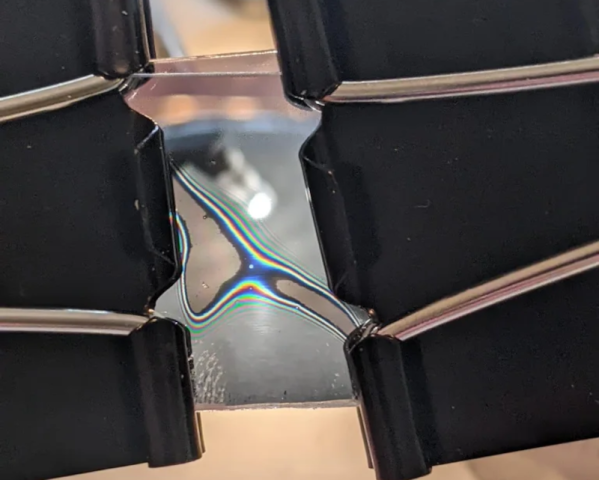
If someone asked you to measure a change in distance at about one ten thousandths of the diameter of a proton, you’d probably assume you would need access a high-tech lab. The job is certainly too tight for your cheap Harbor Freight calipers. [Opticsfan], though, has a way to help. You might not be able to get quite that close, but the techniques will allow you to measure a surprisingly small distance.

The technique requires a Fabry Perot cavity, an inexpensive spectrometer, and an online calculator to interpret the data. This type of cavity is two parallel mirrors facing each other with a slight gap between them. Light can only pass through the cavity when it is in resonance with the cavity. These have been around since 1899, so they aren’t that exotic. In fact, they are often used in laser communication systems, according to the post.

Continue reading “Measuring Nanometers At Home”

Ford Patent Wants To Save Internal Combustion

There’s no doubt the venerable internal combustion engine is under fire. A recent patent filing from Ford claims it can dramatically reduce emissions and, if true, the technology might give classic engines a few more years of service life, according to [CarBuzz].

The patent in question centers on improving the evaporative emission system’s performance. The usual evaporative emission system stores fuel fumes in a carbon-filled canister. The canister absorbs fuel vapor when under high pressure. When the engine idles and pressure in the cylinder drops, the canister releases fumes, which are combusted with ordinary fuel/air mixture.

Continue reading “Ford Patent Wants To Save Internal Combustion”

STM32 Draws On Scope

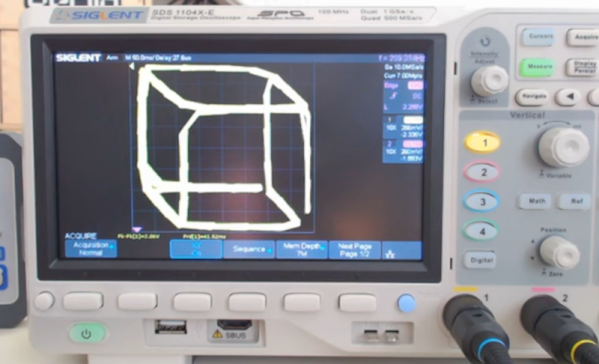
Drawing on an oscilloscope’s XY mode isn’t a new idea. However, if you’ve ever wanted to give it a go, you’d be hard-pressed to find more information than the nearly hour-and-a-half video about the topic from [Low Byte Productions]. You can check out the video below.

If you prefer to jump straight into the code, there’s a GitHub page. While the code is specific to the STM32, you can apply the ideas to anything.

Continue reading “STM32 Draws On Scope”

Rosie The Robot Runs For Real

On the recent 256th episode of the Hackaday podcast, [Kristina] mentioned her favorite fictional robot was Rosie from The Jetsons. [Robert Zollna] must agree since he built a reimagined Rosie and it even caught the notice of mainstream outlet People magazine.

We didn’t find much information outside of the TikTok video (see below; you can use the Guest button if you don’t have an account). However, there were a few clever ideas here. First, the robot mechanism is actually Rosie’s vacuum cleaner. Like a tail wagging a dog, an off-the-shelf floor vac tows the robot body.

Rosie herself is clearly an office chair base with an artistic body. The head rotates, and the mouth appears to open and close, so there’s apparently a little more electronics inside, but that’s nothing you couldn’t throw together with some RC servos and an ESP32.

Some videos cover the build so you might be able to glean more details, but the bite-sized videos aren’t very descriptive even though they are fun to watch. If you thought folks documenting their projects on YouTube was bad, you’re really gonna love the TikTok generation.

We like the look of Rosie, but as a practical matter, we need our robot vac to be smaller, not larger. However, using these off-the-shelf robots as a quick start for a robotics project is reasonable. Especially if you can pick up one cheap. Not that that’s a new idea. They even make stripped-down units with the intent that you don’t want to use them as cleaners.

Continue reading “Rosie The Robot Runs For Real”

Inside America’s Last Morse Code Station

The Titanic famously (or infamously) used Morse code to call out in distress at the end of its final voyage. Ships at sea and the land-based stations that supported them used Morse code for decades, but with the growing use of satellites, maritime Morse code ended in 1999. With one notable exception. [Saahil Desai] writing in the Atlantic tells the story of  America’s last Morse code station, KPH just north of San Francisco.

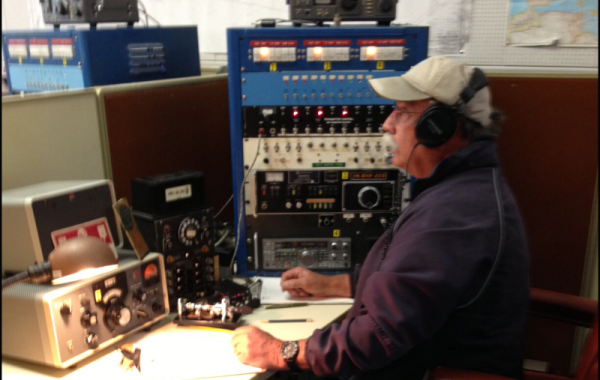
In fact, KPH did shut down in 1997 as part of the wind down of Morse code in ocean vessels. But some radio enthusiasts, including [Tom Horsfall] and [Richard Dillman], have brought the venerable station back to life. The radio squirrels, as they call themselves, dutifully send news and weather every Saturday to anyone interested in listening. They also exchange radio traffic, primarily with the SS Jeremiah O’Brien, a World War II-era ship parked nearby. N2FQ visited the station and operated the station on video, which you can see below. Or, check out the tour in the second video, below.

Continue reading “Inside America’s Last Morse Code Station”

Retro Gadgets: Pay TV In The 1960s

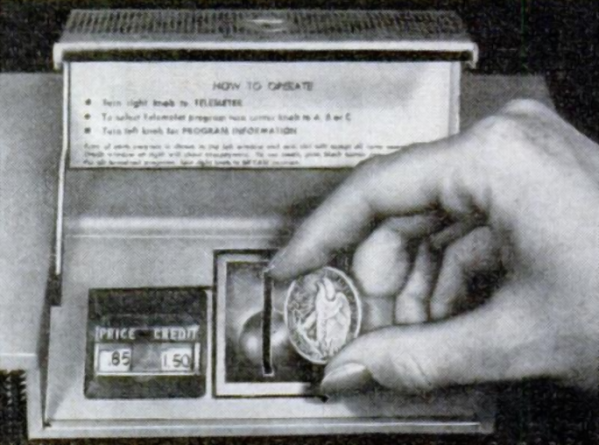
These days, paying for TV programming is a fact of life. You pay your cable company or some streaming service and the only question is do you want Apple TV and Hulu or would you rather switch one out for NetFlix? But back in the 1960s, paying for TV seemed unthinkable and was quite controversial. Cable TV systems were rare, and the airwaves were a public resource, so allowing someone to charge to watch TV on the public airwaves was hard to imagine. That was the backdrop behind the Telemeter — an early attempt to monetize TV programming that was more like a pay phone than a modern streaming service.

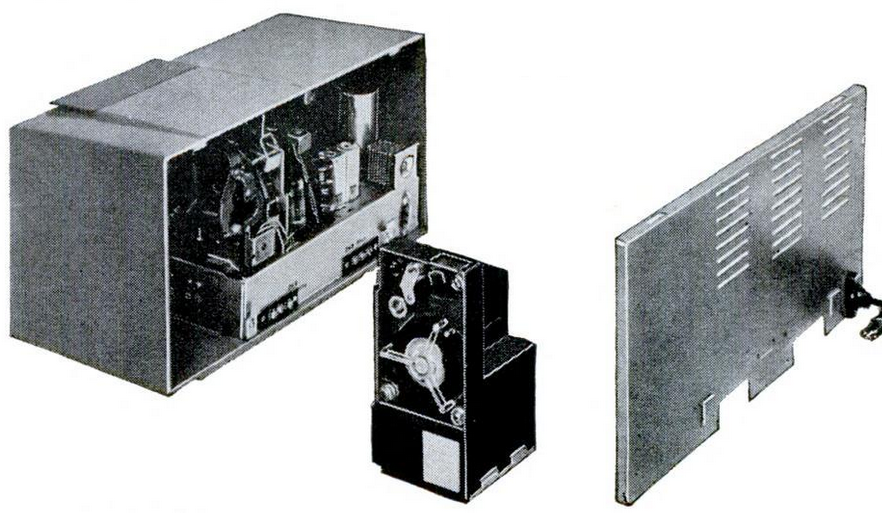
Rear view of the telemeter and coin box

[Lothar Stern] wrote about the device in the November 1959 issue of Popular Mechanics (see page 220). The device looked like a radio that sat on top of your TV. It added a whopping three pay-TV channels, and inside was a coin box, and — no kidding — a tape punch or recorder. These three channels were carried from a Telemeter studio over what appears to be a dedicated cable strung on existing phone poles.

Of course, TVs with coin boxes were nothing new. But those TVs were found in public places, airports, and hotels. The money was simply to turn the TV on for a set amount of time. This was different. A set-top box unscrambled channels delivered over a dedicated cable. Seems like old hat today, but a revolutionary idea in 1959.

Continue reading “Retro Gadgets: Pay TV In The 1960s”