Linux Fu: The Shell Forth Programmers Will Love

One of the most powerful features of Unix and Linux is that using traditional command line tools, everything is a stream of bytes. Granted, modern software has blurred this a bit, but at the command line, everything is text with certain loose conventions about what separates fields and records. This lets you do things like take a directory listing, sort it, remove the duplicates, and compare it to another directory listing. But what if the shell understood more data types other than streams? You might argue it would make some things better and some things worse, but you don’t have to guess, you can install cosh, a shell that provides tools to produce and work with structured data types.

The system is written with Rust, so you will need Rust setup to compile it. For most distributions, that’s just a package install (rust-all in Ubuntu-like distros, for example). Once you have it running, you’ll have a few new things to learn compared to other shells you’ve used. Continue reading “Linux Fu: The Shell Forth Programmers Will Love” →

Developing Warp Drive Might Take Antifreeze

In Star Trek, dilithium crystals — whatever those are — are critical to the operation of a starship’s warp drives. But a Texas professor thinks he can make a baby step towards a warp drive using ethylene glycol, which is commonly found in antifreeze.

While superluminal travel has been regarded as impossible for many years, recent work has suggested ways we might be able to circumvent the light-speed barrier. Unfortunately, all of these mathematical theories require energy and types of matter that we don’t know how to create yet. But [Dr. Chance Glen] believes that by shaping the energy in a specific way through a dielectric, the math can work out so that there’s no exotic negative energy required.

The experiment involves shooting RF energy into an antifreeze container and using a laser interferometer to detect gravity waves.  Of course, that will involve some very sensitive measurements to account for other tiny perturbations that might give false readings. As we’ve seen in the past, that’s a task easier said than done.

Does this make sense? Beats us. Our physics and math are too out of date to make a good guess about how much of this is real and how much is hype. Of course, if he does detect gravity waves, that will get us as close to warp drive as the invention of the telegraph got us to cell phones. Then again, you have to start somewhere.

If you want to know more about the state of rocket engines, including the nascent possibility of warp drives, we’ve discussed that before. Incidentally, if you think the experiment sounds a bit like the the Laser Interferometer Gravitational-wave Observatory (LIGO), you aren’t wrong.

LED Displays May Get Vertical Integration

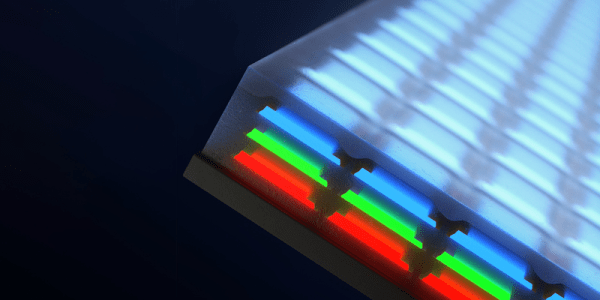
If you zoom into the screen you are reading this on, you’d see an extremely fine pattern of red, green, and blue emitters, probably LEDs of some kind. This somewhat limits the resolution you can obtain since you have to cram three LEDs into each screen pixel. Engineers at MIT, however, want to do it differently. By growing thin LED films and sandwiching them together, they can produce 4-micron-wide LEDs that produce the full range of color, with each color part of a vertical stack of LEDs.

To put things in perspective, a standard TV LED is at least 200 microns across. Mini LEDs measure upwards of 100 microns, and micro LEDs are the smallest of all. A key factor for displays is the pitch — the distance from the center of one pixel to the center of the next. For example, the 44mm version of the Apple Watch has a pitch of around 77 microns. A Samsung Galaxy 10 is just over 46 microns.  This is important because it sets the minimum size for a high-resolution screen, especially if you are building large screens (such as when you build custom video walls (see the video below for more about that).

Continue reading “LED Displays May Get Vertical Integration” →

MicroPython ESP32 IDE Makes Life Simpler

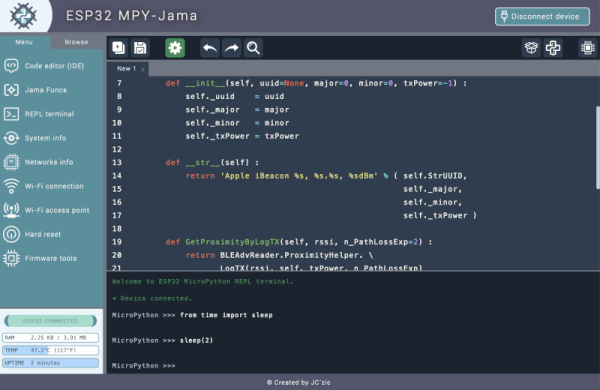
In theory, using MicroPython on the ESP32 is easy —  just flash an image and connect using a serial port. But that leaves a lot of things you still have to do. You need to move files between the two platforms. You’ll want to manage network configurations. You might want better editing and assistance, too. So there are a number of IDEs made to help you and one we recently noticed was MPY-Jama.

The IDE provides source code editing, of course. But it also allows you to do things like pull information about the network using a dashboard or connect to a WiFi network easily. You can even create your own AP with a simple interface.

Although the front part of the README mentions it is for Windows or Mac, if you scroll down you’ll find instructions for installing under Linux. The IDE is extensible using “Jama Funcs” and can handle the flashing operation from inside the IDE.

Of course, there is an IDE from Arduino (but not the Arduino IDE) that handles MicroPython. You can also find a rundown of several similar alternatives online.  If you need some inspiration for a MicroPython project, perhaps you’d like to play a game?

Spy Drone Propeller Makes For A Quiet PC

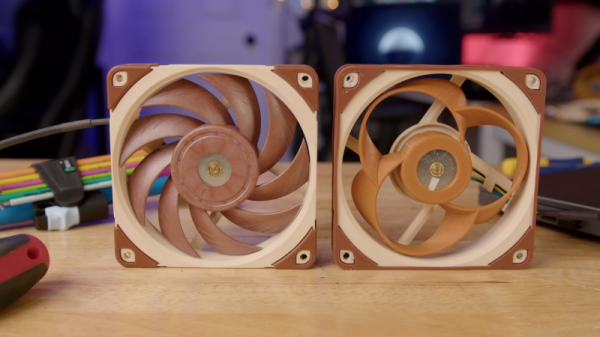
MIT recently announced its research on toroidal propellers to create quieter drones. That got [Major Hardware] thinking about noisy PC fans. The obvious solution was to adapt the toroidal shape for a PC fan. He was familiar with the idea from similar screws on boats that are commercially available. You can see his tests in the video below.

The shape of the blades on the MIT drones is visible in video and pictures, but there were no available 3D models. [Major] did a design and 3D printed the blades. Watching the comparison with a conventional fan using smoke was pretty impressive.

Continue reading “Spy Drone Propeller Makes For A Quiet PC” →

SDR Scanner Listens To Everything

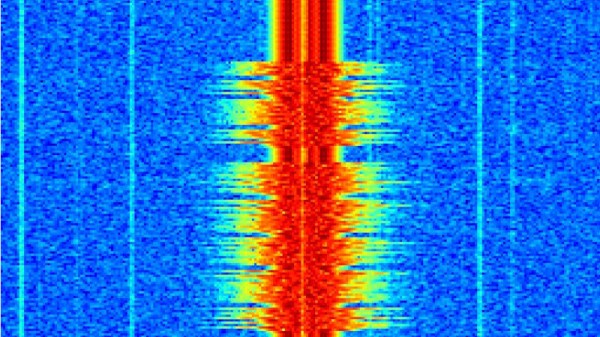
In the old days, scanners would listen to a bunch of channels in a round-robin fashion. If a signal breaks the squelch, the scanner stops and scanning continues scanning after a few seconds of inactivity. But with modern SDRs, you don’t have to listen to one channel at a time. You can listen to all of them. [Tech Minds] shows RTL-SDR Scanner on Linux to record up to 20 MHz of the band simultaneously. It records all the channels in the band of interest. The actual project is on GitHub.

Once recorded, you can use a web interface to listen to the channels and see some statistics about them. [Tech Minds] tried recording aircraft traffic. It worked, but the program doesn’t know how to demodulate AM yet so if you want to record the entire shortwave band, aircraft, or other AM sources, you’ll have to wait a bit before this software is ready for your use case.

If you need to run the program under Windows like [Tech Minds] did, you can use VMWare Workstation Player to get a free copy of Linux on Windows. We wondered if WSL version two might work, too, but we don’t know. Once you have Linux running, Docker makes the installation straightforward.  Since the interface is a web interface, you could probably run this on a small computer on the network and then access it at your leisure from another computer.

Of course, old-fashioned scanners were often used to listen to police and fire radios. Those have all gone trunked these days. This isn’t a new idea, but it did seem like a well-packaged solution.

Continue reading “SDR Scanner Listens To Everything” →

Arduino Does SDI Video With FPGA Help

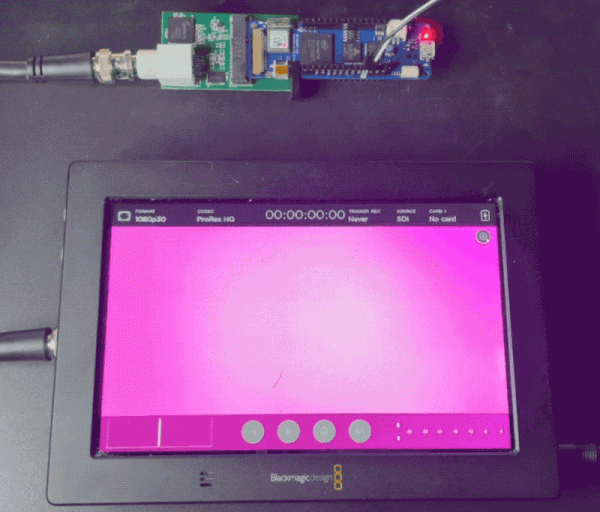
If you are running video around your home theater, you probably use HDMI. If you are running it in a professional studio, however, you are probably using SDI, Serial Digital Interface. [Chris Brown] looks at SDI and shows a cheap SDI signal generator for an Arduino.

On the face of it, SDI isn’t that hard. In fact, [Chris] calls it “dead simple.” The problem is the bit rate which can be as high as 1.485 Gbps for the HD-SDI standard. Even for a super fast processor, this is a bit much, so [Chris] turned to the Arduino MKR Vidor 4000. Why? Because it has an FPGA onboard. Alas, the FPGA can’t do more than about 200 MHz, but that’s fast enough to drive an external Semtech GS296t2 serializer which is made to drive SDI signals.

The resulting project contains the Arduino, the serializer, a custom PCB, and both FPGA and microcontroller code. While the total cost of the project was a little under $200, that’s still better than the $350 to $2000 for a commercial SDI signal generator.

If you want to play along, the files are out on GitHub. We used the Vidor back in 2018 when it first came out. If you need a quick start on FPGAs, there’s always our boot camp.