Vintage Tube Tester Teardown

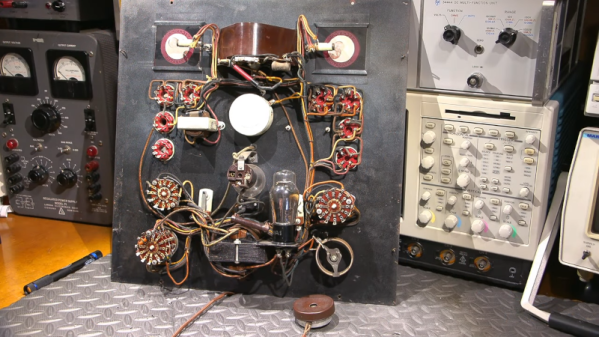
[Mr. Carlson] has an old-style 1940-era radio tube tester, the kind that used to inhabit grocery and drug stores. It is in amazing condition and he was kind enough to tear it down for us. The tester is a Model X from the Radiotechnic Laboratory in Evanston Illinois and, like [Mr. Carlson], we were amused that one of the indicators on the device is a Ouija board-like “doubtful” reading. When it lights up, it looks amazing.

This is much older than the old “TV tube testers” we remember as a kid, but the idea is the same: you have a bad radio or TV with tubes in it, it is a fair bet that the problem is a tube. Even if you don’t know much about electronics, you can carefully remove the tubes, drive over to the drugstore, test your tubes and buy a replacement for any that are bad. Uniquely, this tester even had a speaker you could use to listen to the tube’s output while testing.
Continue reading “Vintage Tube Tester Teardown”

Robot: Will Draw For Food

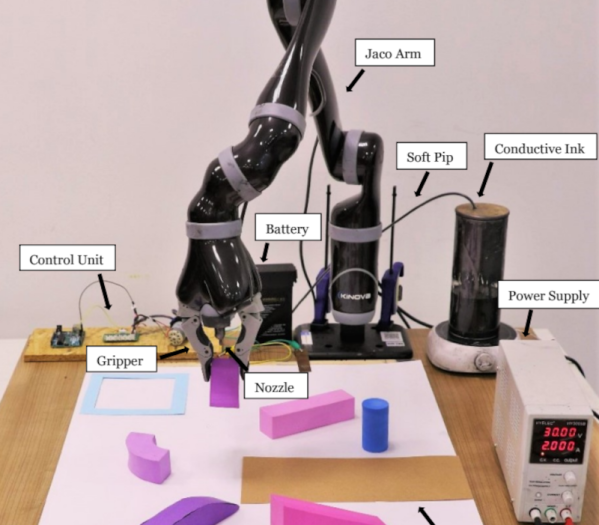
Biological systems often figure out the best ways to get what they need to survive. Now a robot created by researchers at Worcester Polytechnic Institute, Imperial College London, and the University of Illinois Urbana Champaign can make the same claim. The robot operates in front of a plate that has electrical terminals on one end and various obstacles between those terminals and the robot.

The robot can pick up and rearrange some of the items on the plate and then draws paths to the terminals using conductive ink. The effect is the robot gets to “eat” if it solves the connection puzzle.

Continue reading “Robot: Will Draw For Food”

C23 Programming For Everyone

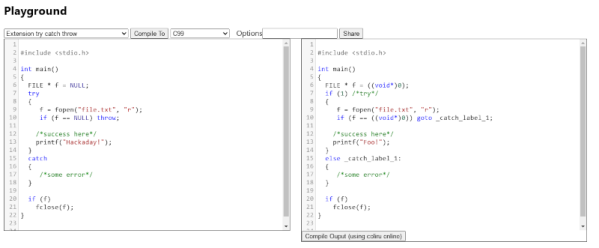
Here’s a history quiz: What architecture did the first C++ compiler target? Of course, it is a trick question. The original C++ — known then as C with classes — compiler wrote out standard C code that you then compiled for whatever your target was. This has a lot of advantages since C compilers are everywhere. Now we are seeing a similar approach to bring C23 to the world with Cake. Cake can translate C23 or other versions to C99 which you can then compile with normal compilers.

While the old C++ compiler, cfront, needed special steps to compile (since it was built using C++), you can build cake for Windows or Linux easily. However, it can also be built with emscripten and you can try it yourself in your web browser.

Continue reading “C23 Programming For Everyone”

Resin Cleanup: A Sticky Situation

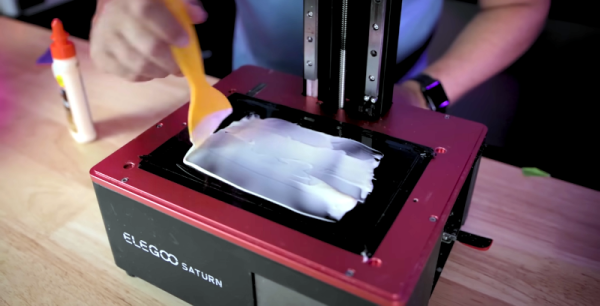
We’ll admit it. We like the results of resin 3D printing, but we don’t always care for the mess. We aren’t alone, and a common issue is to have drips of resin on your LCD screen — a potential disaster. You ought to have a screen protector, but yeah… you should back up hard drives, too. [Jessy] has the same problem and he has heard that you can easily clean cured resin from the screen using wood glue. Does it work? Check out the results of three glues in the video below.

We winced to see glue going on the screens. [Jessy] cured some resin on the screens deliberately for a test. He used Elmer’s wood glue, Gorilla wood glue, and Titebond II wood glue. While there is a bit of a price difference between the options, they are all fairly inexpensive.

Continue reading “Resin Cleanup: A Sticky Situation”

Floppy Disk Sings: I’m Big In Japan

The other day, a medical office needed my insurance card. I asked them where to e-mail it and they acted like I had offered them human flesh as an appetizer. “We don’t have e-mail! You have to bring it to us in person!” They finally admitted that they could take a fax and I then had to go figure out how to get a free one page fax sent over the Internet. Keep in mind, that I live in the fourth largest city in the United States — firmly in the top 100 largest cities in the world. I’m not out in the wilderness dealing with a country doctor.

I understand HIPAA and other legal and regulatory concerns probably inhibit them from taking e-mail, but other doctors and health care providers have apparently figured it out. But it turns out that the more regulations are involved in something, the more behind-the-times it is likely to be.

Continue reading “Floppy Disk Sings: I’m Big In Japan”

3D Printing For Textile Work

While it isn’t for everyone, some of the best creators we know are experts at working with textiles. While the art is ancient, it isn’t easy and requires clever tools. [Lauren] collected a few 3D prints that can help you with knitting, crochet, and even a knitting loom.

Some of the designs are pretty basic like the yarn bowl, or pretty easy to figure out like the simple machine for re-spooling wool. We were frankly surprised that you can 3D print a crochet hook, although the post does mention that breaking them is a real problem.

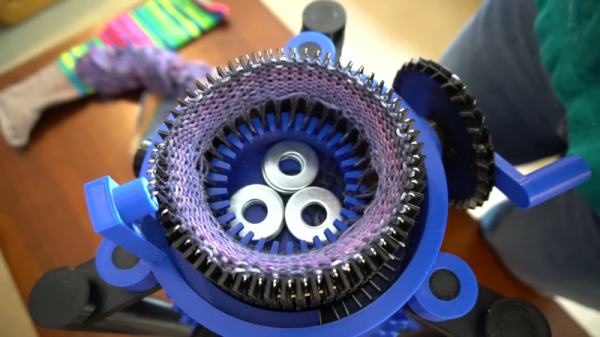
We were really impressed though, with the sock knitting machine. There are actually a few of these out there, and you can see a similar one in the video below. Of course, like a RepRap printer, it needs “vitamins” in the form of metal rods, fasteners, and the like. There’s also a  portable knitting loom which looked interesting.

We aren’t adept enough with fabric arts to know if these tools are serious contenders compared to commercial products, but we have to admit the sock knitting machine looks like it could be. We recently saw a sophisticated loom, although that might be a bit more than most people need. We have looked at open-source knitting machines, too. Of course, if you’d rather not create with textiles, you can always 3D print on them, instead.

Continue reading “3D Printing For Textile Work”

Full Transparency: Stronger FDM Prints

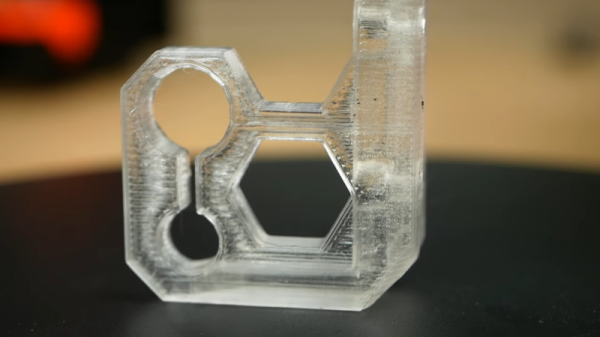
We always look forward to [Stefan’s] CNC Kitchen videos. They are usually useful, but always carefully thought out and backed with experimental data. His latest is about creating transparent and strong FDM prints. You normally don’t associate the FDM process with clear prints even with clear filament. The problem is the filament doesn’t lay down in a particular structure, so light scatters producing a sort of white color. However, [Stefan] found a post on Printables called “How to Print Glass” which changes the structure of the part and, of course, [Stefan] wanted to see if the process also led to stronger parts.

The process is slow and the basic idea is to use no top and bottom layers. The entire part is essentially infill. You also need to set the infill to go in the same direction for each layer. As [Stefan] mentions, there have been other efforts to make transparent parts, especially in vase mode. Of course, you can also get transparent parts using resin printing, although it isn’t always as easy as you might think.

Continue reading “Full Transparency: Stronger FDM Prints”