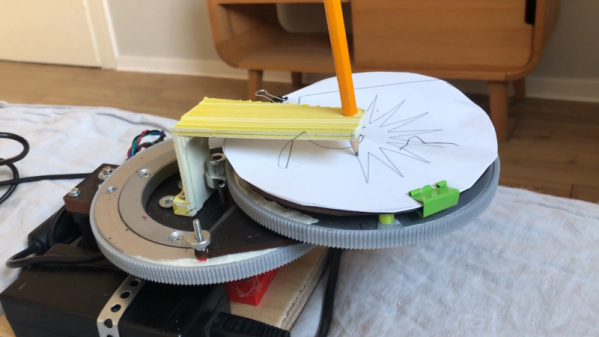
If you want to move a pen (or a CNC tool, or a 3D printing hot end) in the X and Y plane, your choices are typically pretty simple. Many machines use a simple cartesian XY motion using two motors and some sort of linear drive. There’s also the core-XY arrangement where two motors move belts that cause the head to travel in two directions. Delta printers use yet another arrangement, but one of the stranger methods we’ve seen is the dual disk polar printer which — as its name implies — uses two rotating disks.
The unique mechanism uses one motor to rotate a disk and another motor to rotate the entire assembly. The print head — in this case a pencil — stays stationary. as you can see in the video below.
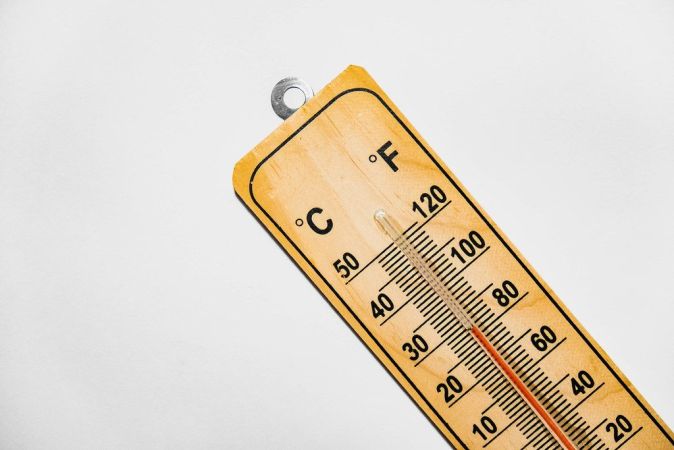
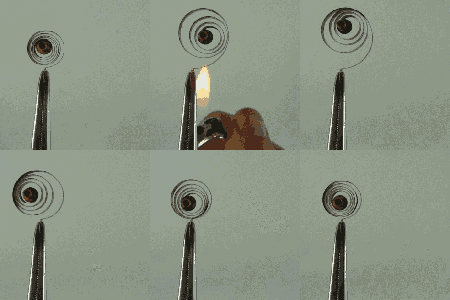
Measuring temperature turns out to be a fundamental function for a huge number of devices. You furnace’s programmable thermostat and digital clocks are obvious examples. If you just needed to know if a certain temperature is exceeded, you could use a bimetalic coil and a microswitch (or a mercury switch as was the method with old thermostats). But these days we want precision over a range of readings, so there are thermocouples that generate a small voltage, RTDs that change resistance with temperature, thermistors that also change resistance with temperature, infrared sensors, and vibrating wire sensors. The bandgap voltage of a semiconductor junction varies with temperature and that’s predictable and measurable, too. There are probably other methods too, some of which are probably pretty creative.
Bimetalic coil by [Hustvede], CC-BY-SA 3.0.You can often think of creative ways to do any measurement. There’s an old joke about the smart-alec student in physics class. The question was how do you find the height of a building using a barometer. One answer was to drop the barometer from the top of the building and time how long it takes to hit the ground. Another answer — doubtlessly an engineering student — wanted to find the building engineer and offer to give them the barometer in exchange for the height of the building. By the same token, you could find the temperature by monitoring a standard thermometer with a camera or even a level sensor which is a topic for another post.
The point is, there are plenty of ways to measure anything, but in every case, you are converting what you want to know (temperature) into something you know how to measure like voltage, current, or physical position. Let’s take a look at how some of the most interesting temperature sensors accomplish this.
There are at least two kinds of 3D printer operators: those who work hard to make their prints look better after they come off the bed and those who settle for whatever comes off the printer. If you are in the latter camp, you probably envy people who have smooth prints with no visible layer lines. But the sanding and priming and multiple coats of paint can put you off.
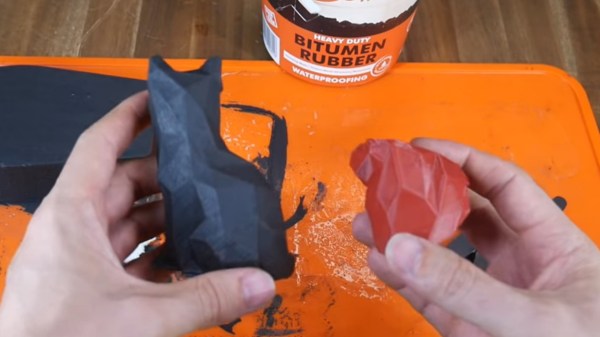
[Teaching Tech] has a few tricks that might change your mind. He shares his technique for using different coatings for 3D prints that provide good quality with a lot less effort. The coatings in question are polyurethane used for coating pickup truck beds and bitumen rubber used for waterproofing. In the United States, bitumen is known as asphalt, and both materials are relatively cheap, available, and safe to use.
According to the video you can see below, there’s no need to sand or prime the print. In addition to covering imperfections and sealing gaps, it produces watertight prints that have UV resistance and some measure of protection against heating.
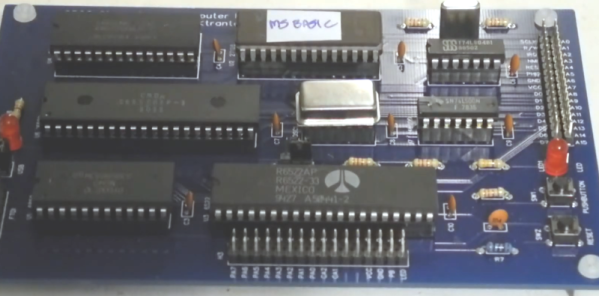
[Jeff] says that designing your own 6502 computer is a rite of passage, and he wanted the experience. His board can accept a real 6502 or the newer CMOS variant that is still available. There are a few modern conveniences such as USB power and provisions for using a USB serial port.
We are spoiled today with microcontrollers having everything in one package, but with this class of CPU you need your own memory, I/O devices, and other support chips. [Jeff] took a traditional approach, but picked components that are still easy to obtain. Some designs now push all the support functions to a more modern processor like an Arduino, which is very simple to do, but doesn’t feel as authentic, somehow.
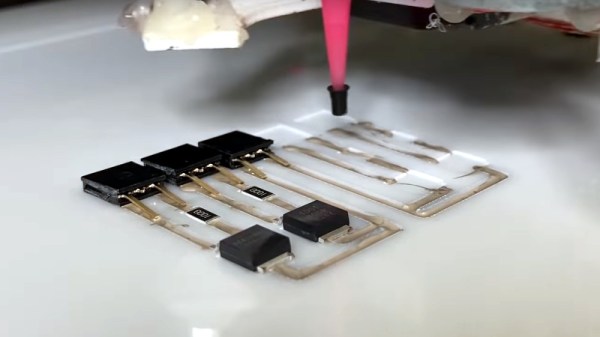
MIT’s Computer Science and Artificial Intelligence Lab (CSAIL) wants to convert laser cutters into something more. By attaching a head to a commercial laser cutter and adding software, they combine the functions of a cutter, a conductive printer, and a pick and place system. The idea is to enable construction of entire devices such as robots and drones.
The concept, called LaserFactory, sounds like a Star Trek-style replicator, but it doesn’t create things like circuit elements and motors. It simply picks them up, places them, and connects them using silver conductive ink. You can get a good idea of how it works by watching the video below.
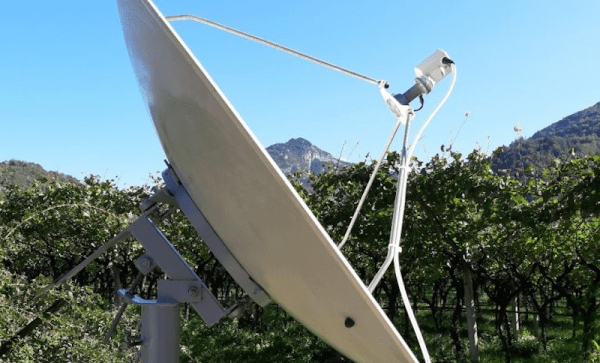
Modern life has its conveniences. Often, those conveniences lead to easier hacks. A great example of that is the rise of satellite television and the impact it has had on amateur radio telescopes. There was a time when building a dish and a suitable low noise amplifier was a big deal. Now they are commodity parts you can get anywhere.
The antenna in use is a 1.2-meter prime focus dish. Some TV dishes use an offset feed, but that makes it harder to aim for use in a radio telescope. In addition to off-the-shelf antenna and RF components, an AirSpy software-defined radio picks up the frequency-shifted output from the antenna. There is more about the software side of the build in a follow-up post. We liked that this was a pretty meaty example of using GNU Radio.
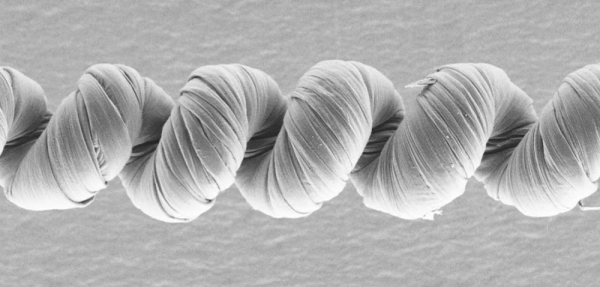
What’s just a bit thicker than a human hair and has ten times the capability of a human muscle? Polymer-coated carbon nanotube yarn. Researchers at the University of Texas at Dallas created this yarn using carbon nanotubes coated with a polymer and coiled with a diameter of about 140 microns.
Passing a voltage through the fiber causes the muscle yarn to expand or contract. Previous similar fibers have to do both actions. That is, they expand and then contract in a bipolar movement. The polymer coating allows for unipolar fibers, critical to using the fibers as artificial muscles.