Printing Soft Body Tissue

If you are like us, you tend to do your 3D printing with plastic or maybe–if you are lucky enough to have access to an expensive printer–metal. [Adam Feinberg] and his team at Carnegie Mellon print with flesh. Well, sort of. Printing biomaterials is a burgeoning research area. However, printing material that is like soft tissue has been challenging. In a recent paper, [Feinberg] and company outline a method called FRESH. FRESH uses a modified MakerBot or Printrbot Jr. printer to deposit hydrogel into a gelatin slurry support bath. The gelatin holds the shape of the object until printing is complete, at which point it can be removed with heat. If you don’t want to wade through the jargon in the actual paper, the journal Science has a good overview (and see their video below).

The gelatin is mixed with calcium chloride and gelled for 12 hours at low temperature. It was then turned into a slurry using an off-the-shelf consumer-grade blender. A centrifuge was used to remove most of the soluble gelatin. Printing inks were made with materials like collagen and fibrin. The FRESH process actually uses liquid  ink that gels in the gelatin.

The printer uses an open source syringe extruder found on the NIH 3D print exchange (they never say exactly  which one, though and we had trouble matching it from the pictures). In true hacker fashion, the printer prints its own syringe extruder using the stock one from ABS and PLA plastic. Then you simply replace the standard extruder with the newly printed one (reusing the stock stepper motor).

The paper describes printing items including a model of a 5-day-old embryonic chick heart, an artery, and a miniature human brain model. Another team of researchers in Florida have a similar system, as well.

We’ve talked about bioprinting before and even mentioned how to make your own inkjet-based bioprinter. The FRESH method looks like it is in reach of the hacker’s 3D printing workshop. We cringe to think what you will print when you can finally print body parts.

Continue reading “Printing Soft Body Tissue”

Listen To The Rain, Raspberry Pi Style

There’s an old proverb algebra teachers often recite: You have to use what you know to find out what you don’t know. The same could be said about sensors. For example, analog to digital converters use something computers are good at finding (like time) and use it to determine something they aren’t good at finding (like voltage). So how do you detect rainfall? If you are [lowflyerUK], you use the microphone in your web camera and a Raspberry Pi.

The idea was to reduce irrigation usage based on rainfall, so an exact measurement isn’t necessary. The Python code that analyzes the audio input is calibrated with three configuration parameters and attempts to remove wind noise. Even so, it needs to be in a room that gets a lot of noise from rainfall and ambient noise can throw the reading off.

The weather service is never going to adopt this system. Still, it is a great example of taking something you know and using it to get something you don’t know. If you want a more complete weather station, we have a few options for you.

Better Capacitors Through Nanotechnology

Traditionally, capacitors are like really bad rechargeable batteries. Supercapacitors changed that, making it practical to use a fast-charging capacitor in place of rechargeable batteries. However, supercapacitors work in a different way than conventional (dielectric) capacitors. They use either an electrostatic scheme to achieve very close separation of charge (as little as 0.3 nanometers) or electrochemical pseudocapacitance (or sometime a combination of those methods).

In a conventional capacitor the two electrodes are as close together as practical and as large as practical because the capacitance goes up with surface area and down with distance between the plates. Unfortunately, for high-performance energy storage, capacitors (of the conventional kind) have a problem: you can get high capacitance or high breakdown voltage, but not both. That’s intuitive since getting the plates closer makes for higher capacitance but also makes the dielectric more likely to break down as the electric field inside the capacitor becomes higher with both voltage and closer plate spacing (the electric field, E, is equal to the voltage divided by the plate spacing).

[Guowen Meng] and others from several Chinese and US universities recently published a paper in the journal Science Advances that offers a way around this problem. By using a 3D carbon nanotube electrode, they can improve a dielectric capacitor to perform nearly as well as a supercapacitor (they are claiming 2Wh/kg energy density in their device).

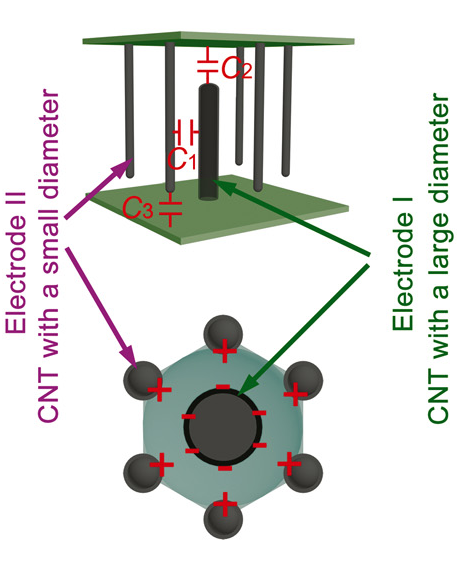
cap1The capacitor forms in a nanoporous membrane of anodic aluminum oxide. The pores do not go all the way through, but stop short, forming a barrier layer at the bottom of each pore. Some of the pores go through the material in one direction, and the rest go through in the other direction. The researchers deposited nanotubes in the pores and these tubes form the plates of the capacitor (see picture, right). The result is a capacitor with a high-capacity (due to the large surface area) but with an enhanced breakdown voltage thanks to the uniform pore walls.

cap2To improve performance, the pores in the aluminum oxide are formed so that one large pore pointing in one direction is surrounded by six smaller pores going in the other direction (see picture to left). In this configuration, the capacitance in a 1 micron thick membrane could be as high as 9.8 microfarads per square centimeter.

For comparison, most high-value conventional capacitors are electrolytic and use two different plates: a plate of metallic foil and a semi-liquid electrolyte.  You can even make one of these at home, if you are so inclined (see video below).

We’ve talked about supercapacitors before (even homebrew ones), and this technology could make high capacitance devices even better. We’ve also talked about graphene supercaps you can build yourself with a DVD burner.

It is amazing to think how a new technology like carbon nanotubes can make something as old and simple as a capacitor better. You have to wonder what other improvements will come as we understand these new materials even better.

Continue reading “Better Capacitors Through Nanotechnology”

Raspberry Pi Sense HAT Super Weather Dashboard

[InitialState] posted a great multipart tutorial about building what he calls a “Hyper-local Weather Dashboard.” In plain language, he created a Raspberry Pi-based web page that fuses weather data from Wunderground along with locally sensed weather data.

The tutorial has thee parts. The first part covers reading data from Wunderground using their developer’s API (you’ll need an API key; a free one is good for 500 queries a day). The second part covers using the Pi Sense HAT to measure local temperature, humidity, and pressure. The final part ties it all together using producing the hyper-local weather dashboard (whatever that really means).

We talked about the Sensor HAT earlier (and there’s more info in the video, below). Seems like those lights could do something, although that wouldn’t do you any good over a web interface. This is a good-looking project (and tutorial) and easy enough that it would be a good place to start
experimenting with the Raspberry Pi.

Continue reading “Raspberry Pi Sense HAT Super Weather Dashboard”

Kids And Hacking: The One Hour Egg Drop

In the last Hacking and Kids post, I talked about an activity you can do with kids when you don’t have a lot of time or resources. The key idea was to have fun and learn a little bit about open and closed loop control. One of the things I usually briefly mention when I do that is the idea of a design trade: Why, for example, a robot might use wheels instead of legs, or treads instead of wheels.

Engineers and makers perform trades like this all the time. Suppose you are building a data logging system. You want precise samples, large storage capacity, and many channels. But you also want a low cost and low power drain. You might also want high reliability. All of these requirements will lead to different trades. A hard drive would provide a lot of space, but is more expensive, less reliable, larger, and more power hungry than, say, an SD card. So there isn’t a right choice. It depends on which of the factors are most important for this particular design. A data logger in a well-powered rack might be well served to have a terrabyte hard drive, while a battery powered logger in a matchbox that will be up on the side of a mountain might be better off with an SD card.

We can all relate to that example, but it is pretty boring to a kid. You probably can’t get them to design a data logger, anyway. But if I have about an hour and a little prep time, I have a different way to get the same point across. It is a modified version of the classic “egg drop”, but it is simple enough to do in an hour with very little preparation time.

Continue reading “Kids And Hacking: The One Hour Egg Drop”

Why Should You Get A Ham Radio License?

Several of the authors you read on Hackaday are ham radio operators and we’ve often kicked around having a Hacker Chat about “Why be a ham today?” After all, you can talk to anyone in the world over the Internet or via phone, right? What’s the draw?

The Radio Society of Great Britain had the same thought, apparently, and produced a great video to answer the question. They mention the usual things: learning about technology, learning about people in other parts of the world, disaster communications, and radiosport (which seems to be more popular outside the United States; people compete to find hidden transmitters).

In addition, they talked a lot about how hams get involved with space communications, ranging from talking via satellites, to talking to people on the space station, to actually building small satellites. As the narrator says, there are “hundreds of ways to have techie fun” with ham radio.

One thing we noticed they showed but didn’t say a lot about, though, is the educational opportunities. You can learn a lot, and working with kids to help them learn is often very rewarding (and you usually learn something, too). Just to forestall the comments that this post isn’t hack related, we’ll note two things: there is a Raspberry Pi shown and just past the two-minute mark, there is a very clever hacked together Morse code key.

We talk a lot about ham radio, ranging from Arduino-based digital modes to putting together portable stations (you can see a similar one in the video, too). One other thing we noticed they don’t mention: it is generally much easier to get a license today than ever before. Most countries (including the United States) have abolished the Morse code requirements, so while some hams still enjoy CW (hamspeak for operating Morse code), it isn’t a requirement.

Video below.

Continue reading “Why Should You Get A Ham Radio License?”

Bluetooth Thermometer Minds Your Meats

The summer may have come to a close here in the USA, but any time of the year is a good time for grilling. In the colder weather, it’s a drag to have to stay near the hot grill to keep an eye on your burgers and franks. [Eric Ely] thought it would be smarter to have a meat thermometer that sent his phone the current reading via Bluetooth.

Instead of starting from scratch, [Eric] took an off the shelf electronic thermometer and removed its temperature probe (which was a thermistor). The hardware used an off the shelf Bluetooth board with a companion battery board and prototype board. If you can’t bear to cut up a good thermometer, you can get replacement probes that ought to work just as well.

In addition to the boards and the scavenged thermistor, [Eric] used a couple of resistors. One resistor is in parallel with the thermistor to improve the linearity of the device’s response curve. The second resistor forms a voltage divider that the Bluetooth board reads.

The software (using Node.js and C) is available on Github. The C program reads the temperature and pushes it out using JSON. Node.js provides a server that [Eric] can hit with his phone’s Web browser.

Sure, you can buy wireless thermometers, but what self-respecting hacker wants to carry around a store-bought box just to display meat temperature? Viewing it on your phone has much more street cred.  Of course, a real hacker isn’t going to cook on a conventional grill, either.

Continue reading “Bluetooth Thermometer Minds Your Meats”