Repairing An Old Heathkit ‘Scope

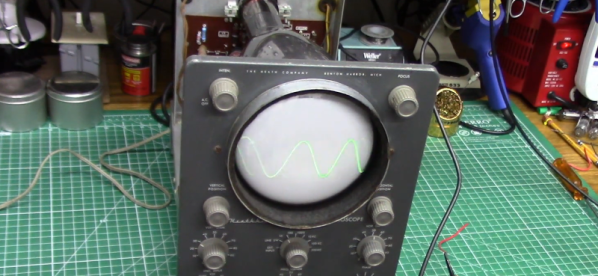
With so many cheap oscilloscopes out there, the market for old units isn’t what it used to be. But if you have a really old scope, like the Heathkit O-10 that [Ken] found in his basement, there is vintage cred to having one. [Ken’s] didn’t work, so a repair session ensued. You can see the results in the video below.

You can tell this is in an old scope — probably from the mid 1950s — because of its round tube with no graticle. Like many period scopes, the test probe input was just 5-way binding posts. The O-10 was the first Heathkit “O-series” scope that used printed circuit boards.

The device looked pretty good inside, except for a few dents. Of course, the box has tubes in it, so every power up test involves waiting for the tubes to warm up. [Ken] was very excited when he finally got a single green dot on the screen. That did, however, require a new CRT.

It wasn’t long after that he was able to put a waveform in and the scope did a good job of reproducing it. The unit would look good in an old movie, but might not be the most practical bench instrument these days.

These Heathkit scopes and their cousins were very popular in their day. The $70 price tag sounds cheap, but in the mid-1950s, that was about a month’s rent in a four-room house. While primitive by today’s standards, scopes had come a long way in 9 or 10 years.

Continue reading “Repairing An Old Heathkit ‘Scope”

Turn Your Phone Into A POV Hologram Display

It seems obvious once you think about it, but if you can spin your cell phone and coordinate the display with the motion, you can create a 3D display. [Action Lab] had used such a setup to make a display that you could view from any angle. After he showed it, a viewer wrote him to mention that if you spin the picture at the same rate, it will appear in 3D. The results look great, as you can see in the video below.

The spinning mechanism in this case is an inexpensive pottery wheel. Whatever you use, though, you need a way to match the speed of the graphics to the speed of the phone’s rotation. For this example, there are just a few pre-spun 3D models on a website. However, creating your own viewer like this wouldn’t be that hard. Even more interesting would be to read the phone sensors and spin the image in sync with the phone’s motion.

We keep hearing about awesome commercial 3D stuff coming out “any day now.” Meanwhile, you can always settle for Pepper’s Cone.

Continue reading “Turn Your Phone Into A POV Hologram Display”

Who’d Have Guessed? Graphene Is Strange!

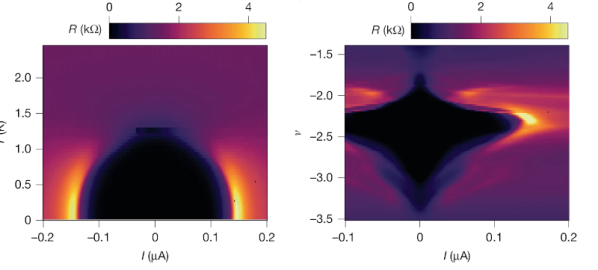
Graphene always sounds exciting, although we aren’t sure what we want to do with it. One of the most promising features of the monolayer carbon structure is that under the right conditions, it can superconduct, and some research into how that works could have big impacts on practical superconductor technology.

Past experiments have shown that very cold stacks of graphene (two or three sheets) can superconduct if the sheets are at very particular angles, but no one really understands why. A researcher at Northeaster and another at Harvard realized they were both confused about the possible mechanism. Together, they have started progressing toward a better description of superconductivity in graphene.

Continue reading “Who’d Have Guessed? Graphene Is Strange!”

Hackaday Podcast Episode 307: CNC Tattoos, The Big Chill In Space, And PCB Things

The answer is: Elliot Williams, Al Williams, and a dozen or so great hacks. The question?  What do you get this week on the Hackaday podcast? This week’s hacks ran from smart ring hacking, to computerized tattoos. Keyboards, PCBs, and bicycles all make appearances, too.

Be sure to try to guess the “What’s that sound?” You could score a cool Hackaday Podcast T.

For the can’t miss this week, Hackaday talks about how to dispose of the body in outer space and when setting your ship’s clock involved watching a ball drop.


Download the MP3 tariff-free.

Continue reading “Hackaday Podcast Episode 307: CNC Tattoos, The Big Chill In Space, And PCB Things”

T1 Is A RISC-V Cray

The crux of most supercomputers is the ability to operate on many pieces of data at once — something video cards are good at, too. Enter T1 (short for Torrent-1), a RISC-V vector inspired by the Cray X1 vector machine.

T1 has support for features, including lanes and chaining. The chip contains a version of the Rocket Core for scalar operations, but there’s no official support for using it. The project claims you could easily replace that core with any other RISC-V CPU IP.

Continue reading “T1 Is A RISC-V Cray”

A Great Use For AI: Wasting Scammers Time!

We may have found the killer app for AI. Well, actually, British telecom provider O2 has. As The Guardian reports, they have an AI chatbot that acts like a 78-year-old grandmother and receives phone calls. Of course, since the grandmother—Daisy, by name—doesn’t get any real phone calls, anyone calling that number is probably a scammer. Daisy’s specialty? Keeping them tied up on the phone.

While this might just seem like a prank for revenge, it is actually more than that. Scamming people is a numbers game. Most people won’t bite. So, to be successful, scammers have to make lots of calls. Daisy can keep one tied up for around 40 minutes or more.

Continue reading “A Great Use For AI: Wasting Scammers Time!”

Lorentz Cannon Fires Lightning

[Editor’s note: This video disappeared, but it has been archived here. We’re leaving the original links as-were in case they come back up.]

The aptly named [LightingOnDemand] has created a Lorentz cannon that can fire a lightning bolt. Honestly, as you can see in the video below, it looks like something from a bad 1950s science fiction movie. The inspiration was researchers using rockets trailing thin wires to attract lightning.

How does the tiny wire carry that much juice? It doesn’t, really. The wire vaporizes into plasma, and if the pulse is fast enough, the Lorentz force hold the plasma together. The rest is non-trivial high-voltage engineering.

Continue reading “Lorentz Cannon Fires Lightning”