A Collection Of Lightning Detectors

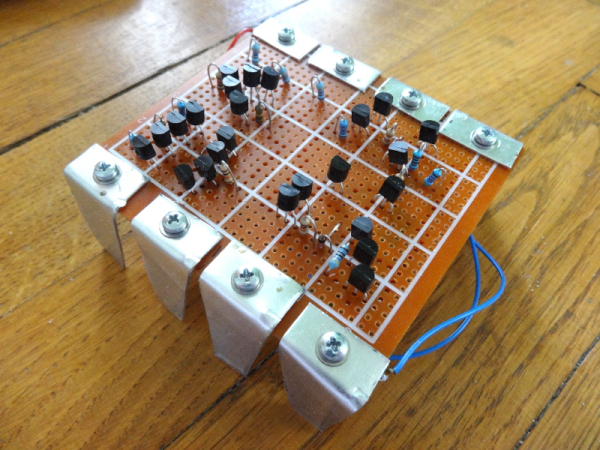
You would think detecting lightning would be easy. Each lightning bolt has a staggering amount of power, and, clearly, you can hear the results on any radio. But it is possible to optimize a simple receiver circuit to specifically pick up lightning. That’s exactly what [Wenzeltech] shows in a page with several types of lightning detectors complete with photos and schematics.

Just as with a regular radio, there are multiple ways to get the desired result. The first circuits use transistors. Later versions move on to op amps and even have “storm intensity” meters. The final project uses an ion chamber from a smoke detector. It has the benefit of being very simple, but you know, also slightly radioactive.

You might think you could detect lightning by simply looking out the window. While that’s true, you can, in theory, detect events from far away and also record them easily using any data acquisition system on a PC, scope, or even logic analyzer.

Why? We are sure there’s a good reason, but we’ve never needed one before. These designs look practical and fun to build, and that’s good enough for us.

You can spruce up the output easily. You can also get it all these days, of course, on a chip.
Record Changer Spins Round And Round

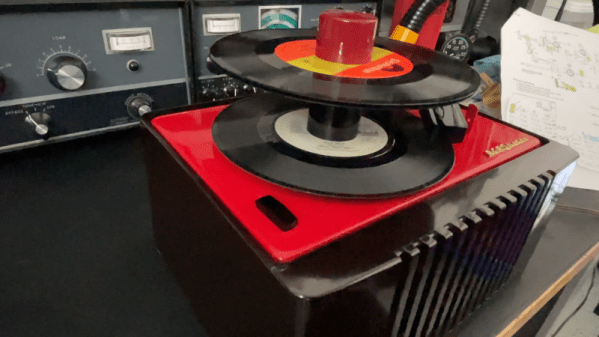
There was a time when all the cool kids had a 45 RPM record player. [RF Burns] picked up a 1950s-era player from  RCA. However, it needed a lot of work. The good news? We get to see the teardown and the result in a two-part video series, which you can see below. If you are looking for the schematic, you’ll have to wait for the second video.

These were made to be cheap, so there were many parts that needed replacement or, at least TLC. The automation of the record changer was all done with an eccentric wheel, which is satisfyingly low-tech. We were surprised that it still seemed to work after everything was cleaned up.

Inside were two active tubes and a rectifier tube to amplify the signal from the needle. A coat of paint made it look great, and a polarized power cord made it safer.

There was also an unamplified version of the player you can see at the end of the second video. All the same things except for the tube amplifier, of course.

If you are too young to have fond memories of 45s, here’s a primer on how records work. The record player we really want is mobile.

Robots Want The Jobs You Can’t Do

There’s something ominous about robots taking over jobs that humans are suited to do. Maybe you don’t want a job turning a wrench or pushing a broom, but someone does. But then there are the jobs no one wants to do or physically can’t do. Robots fighting fires, disarming bombs, or cleaning up nuclear reactors is something most people will support. But can you climb through a water pipe from the inside? No? There are robots that are available from several commercial companies and others from university researchers from multiple continents.

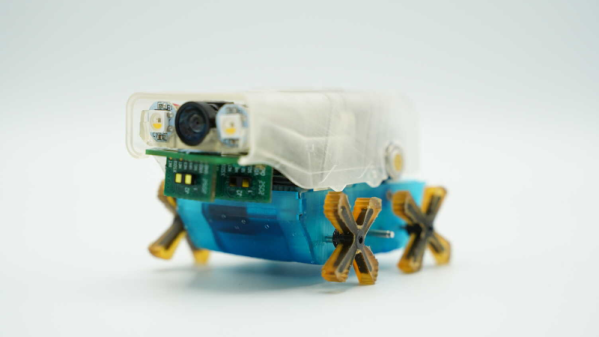
If you think about it, it makes sense. For years, companies that deal with pipes would shoot large slugs, or “pigs”, through the pipeline to scrape them clean. Eventually, they festooned some pigs with sensors, and thus was born the smart pig. But now that it is possible to make tiny robots, why not send them inside the pipe to inspect and repair?

Continue reading “Robots Want The Jobs You Can’t Do” →

Coroutines In C

It is virtually a rite of passage for C programmers to realize that they can write their own cooperative multitasking system. C is low-level enough, and there are several ways to approach the problem, so, like Jedi light sabers, each one is a little bit different. [Christoph Wolcher] took his turn, and not only is his system an elegant hack, if that’s not an oxymoron, it is also extremely well documented.

Before you dig in, be warned. [Christoph] fully admits that you should use an RTOS. Or Rust. Besides, after he finished, he discovered the protothreads library, which does a similar task in a different way that is both more cool and more terrible all at the same time.

Once you dig in, though, you’ll see the system relies on state machines. Just to prove the point, he writes a basic implementation, which is fine, but hard to parse and modify. Then he shows a simple implementation using FreeRTOS, which is fine except for, you know, needing FreeRTOS.

Using a simple set of macros, it is possible to get something very similar to the RTOS version that runs independently, like the original version. Most of the long code snippets show you what code the macros generate. The real code is short and to the point.

Multiprocessing is a big topic. You can have processes, threads, fibers, and coroutines. Each has its pros and cons, and each has its place in your toolbox.

Citizen Science Is All Fun And Games

You are probably familiar with initiatives like Seti@Home, where you donate unused computer power to some science project that needs computer cycles. [Jeff Yoshimi] wants to borrow your most powerful computer: your brain. The reason: cancer research.

[Jeff’s] recent book, Gaming Cancer, has three examples: Eterna, Foldit, and Nanocrafter. All three make games out of creating biological molecules. With Foldit, you create proteins in a bonsai-like fashion. EteRNA is more like Sudoku for RNA. Nanocrafter used DNA strands as puzzle pieces, although it is no longer operational. Their website, amusingly, looks like it was taken over by a slot machine site and a probably AI-generated text tries to convince you that slot machines are much like fusing DNA strands.

What can these projects do? Eterna’s open vaccine challenge used gameplay to help design RNA molecules for vaccines that don’t require ultra-cold storage, and the results drove improvements in real-life vaccines.

There have been several science fiction stories that center on the idea that a game of some sort might be an entrance test to a super-secret organization (The Last Starfighter or Stargate: Universe, for example). Maybe a future science game will trigger scholarship or job offers. It could happen.

We like citizen science. Zooniverse does a good job of making it fun, but maybe not to the level of a game. You can make contributions in space, or even right here on Earth.

Die Cut Machine Makes Portable Metal Cuts

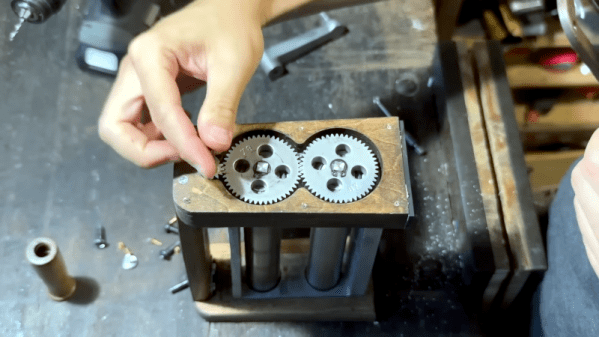
[Kevin Cheung] likes to upcycle old soda cans into — well — things. The metal is thin enough to cut by hand, but he’d started using a manual die-cutting machine, and it worked well. The problem? The machine was big and heavy, weighing well over 30 pounds. The solution was to get a lightweight die cutter. It worked better than expected, but [Kevin] really wanted it to be more portable, so he stripped it down and built the mechanism into a new case.

The video below isn’t quite a “how-to” video, but if you like watching someone handcraft something with a lot of skill, you’ll enjoy it. It also might give you ideas about how you could use one of these cutters, even if you don’t bother building a nice case for it.

We’ve seen cutters that use computer control, but they aren’t inexpensive. They will, however, make the same kind of cuts. But these manual die cutters are very inexpensive, and you simply have to find a way to make the die. You can easily make them for cutting paper, and, with the right materials, you can make the kind you see in [Kevin]’s video, too.

We have to admit, carrying the gizmo into a public place seemed to make a lot of people happy. So maybe portability is a good goal. But either way, you can have some fun with a machine like that.

If you want to cut paper, these work great. If you want paper to make the cuts, we have just the thing for you.

Continue reading “Die Cut Machine Makes Portable Metal Cuts” →

The 555 Writ Large

Few electronic ICs can claim to be as famous as the 555 timer. Maybe part of the reason is that the IC doesn’t have a specific function. It has a lot of building blocks that you can use to create timers and many other kinds of circuits. Now [Stoppi] has decided to make a 555 out of discrete components. The resulting IC, as you can see in the video below, won’t win any prizes for diminutive size. But it is fun to see all the circuitry laid bare at the macro level.

The reality is that the chip doesn’t have much inside. There’s a transistor to discharge the external capacitor, a current source, two comparators, and an RS flip flop. All the hundreds of circuits you can build with those rely on how they are wired together along with a few external components.

Even on [stoppi]’s page, you can find how to wire the device to be monostable, stable, or generate tones. You can also find circuits to do several time delays. A versatile chip now blown up as big as you are likely to ever need it.

Practical? Probably not, unless you need a 555 with some kind of custom modification. But for understanding the 555, there’s not much like it.

We’ve seen macro 555s before. It is amazing how many things you can do with a 555. Seriously.

Continue reading “The 555 Writ Large” →