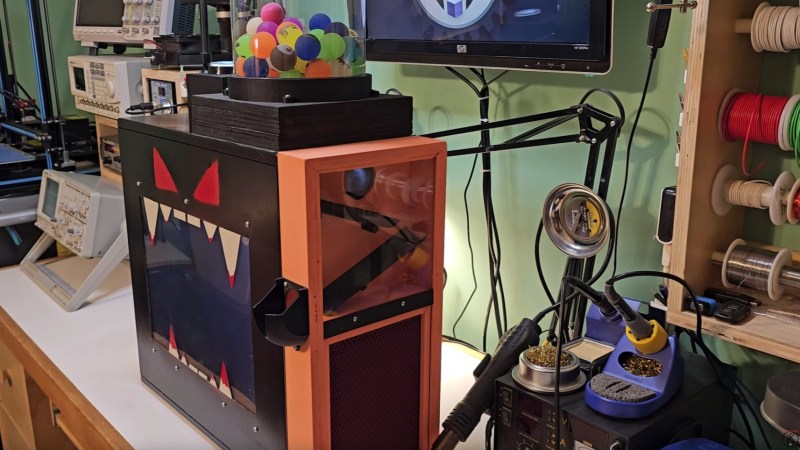
A photo of the vending machine sitting on an electronics workbench

Building A Halloween Vending Computer That Talks

Our hacker from [Appalachian Forge Works] wrote in to let us know about their vending machine build: a Halloween vending computer that talks.

He starts by demonstrating the vending process: a backlit vend button is pressed, an animation plays on the screen as a synthetic voice speaks through attached speakers, the vending mechanism rotates until a successful vend is detected with a photoelectric sensor (a photoresistor and an LED) or a timeout of 10 seconds is reached (the timeout is particularly important for cases when the stock of prizes is fully depleted).

For a successful vend the prize will roll out a vending tube and through some ramps, visible via a perspex side panel, into the receptacle, as the spooky voice announces the vend. It’s the photoelectric sensor which triggers the mask to speak.

Continue reading “Building A Halloween Vending Computer That Talks”

RedBox In The 80s: Meet The VHS Vending Behemoth

Redbox was a company with a moderately interesting business model—it let you rent DVDs from automated kiosks. It’s an idea so simple it’s almost surprising it didn’t appear sooner. Only, it did—all the way back in the VHS age!

Meet the Video Vendor. YouTuber [SpaceTime Junction] was able to track down one of these rare machines, which apparently formerly served an Ohio rental outlet called Kohnen’s. It’s a monstrous thing that stands taller and about three times wider than traditional vending machines, and it could hold up to 320 tapes in its robotic magazine. It’s got lashings of woodgrain, a green-on-black CRT, and the beautiful kind of clicky keys that went away after the 1980s.

[SpaceTime Junction] has a bunch of videos up on the machine, and you even get to see it powered up.  It’s a little difficult to see what’s going on, because the machine is something like nine feet wide and it’s all shot in vertical video. There isn’t a whole lot of content on these obscurities out there, so this is a great place to start. Apparently, there were recently a hundred or more of these found living in a Texas warehouse according to Reddit, so we might see more of these popping up online soon. [SpaceTime Junction] has toured that facility, too.

You can read more about the fall of Redbox, or the cleanup afterwards, in our prior coverage.

Continue reading “RedBox In The 80s: Meet The VHS Vending Behemoth”

Big Candy Is Watching You: Facial Recognition In Vending Machines Upsets University

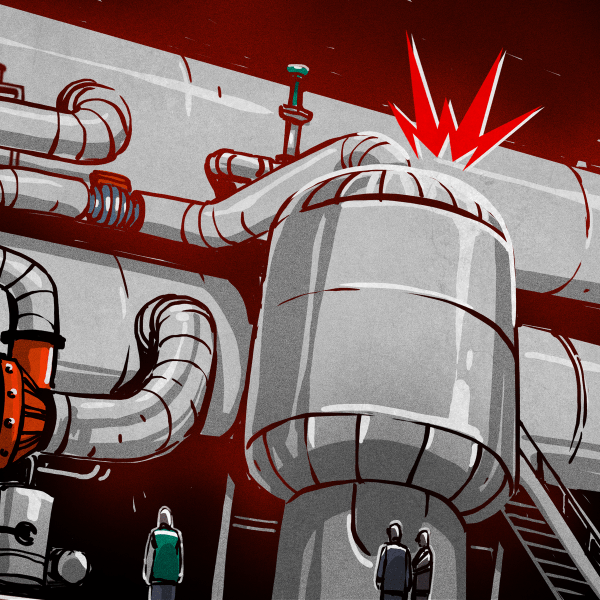
Most people don’t think too much of vending machines. They’re just those hulking machines that lurk around on train stations, airports and in the bowels of school and office buildings, where you can exchange far too much money for a drink or a snack. What few people are aware of is just how these vending machines have changed over the decades, to the point where they’re now collecting any shred of information on who interacts with them, down to their age and gender.

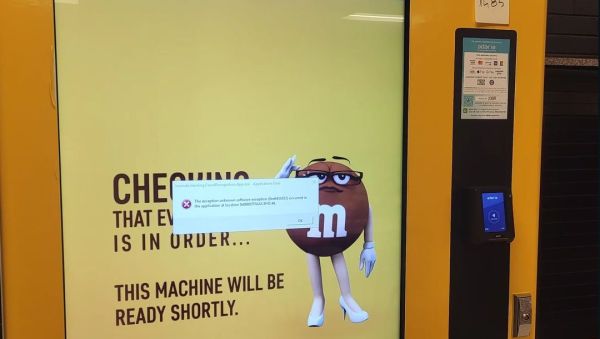
How do we know this? We have a few enterprising students at the University of Waterloo to thank. After [SquidKid47] posted a troubling error message displayed by a campus M&M vending machine on Reddit, [River Stanley] decided to investigate the situation. The resulting article was published in the February 16th edition of the university’s digital newspaper, mathNEWS.

In a bout of what the publication refers to as “Actual Journalism”, [Stanley] found that the machine in question was produced by Invenda, who in their brochure (PDF) excitedly note the many ways in which statistics like age, gender, foot traffic, session time and product demographics can be collected. This data, which includes the feed from an always-on camera, is then processed and ‘anonymized statistics’ are sent to central servers for perusal by the vending machine owner.

The good news is that this probably doesn’t mean that facial recognition and similar personalized information is stored (or sent to the big vaporous mainframe) as this would violate the GDPR  and similar data privacy laws, but there is precedence of information kiosks at a mall operator taking more liberties. Although the University of Waterloo has said that these particular vending machines will be removed, there’s something uncomfortable about knowing that those previously benign vending machines are now increasingly more like the telescreens in Orwell’s Nineteen Eighty-Four. Perhaps we’re already at the point in this timeline were it’s best to assume that even vending machines are always watching and listening, to learn our most intimate snacking and drinking habits.

Thanks to [Albert Hall] for the tip.

This Vending Machine Is For The Birds

The early bird may get the worm, but [Stephen Chasey’s] birds only get to eat if they are smart. He’s created a vending machine for bird feeding. While this is a classic and simple exercise for a microcontroller, [Stephen’s] design is all op amps and 555 timers. The feeder comes on when it detects a warm body and waits for something to drop through a hole. Birds don’t have coins, so the hole will accept anything that will trigger the IR sensor within. In response, it dispenses a few peanuts. Rodents and squirrels won’t figure out the machinery, and so they can’t pilfer the peanuts meant for the pigeons — or other birds, even if they don’t start with the letter P.

A PIR sensor detects a warm body. A 555 keeps the system going for about 24 seconds after the last PIR event. Pairs of IR LEDs and phototransistors act as sensors that look through heat shrink tubing, which is, apparently, IR transparent. When a virtual coin drops through the hole, one of the sensors picks it up and starts another 555, which turns on a vibration motor. Another sensor watches for a nut to drop, which stops the motor. It also will time out after 11 seconds.

Continue reading “This Vending Machine Is For The Birds”

Historical Hackers: Hero Builds Vending Machines

We tend to think of mechanical contrivances as products of the industrial revolution and true automation as something computers handle. Yet even before computers, automation existed — using timing motors and cams and other mechanical contraptions. But it might surprise you to know that there was actually some sophisticated automation going way back. Really way back, invented in a world without computers, CAD software, or even electricity. For example, around 50 AD an inventor named Hero — sometimes known as Heron — built machines powered by steam and wind. His inventions included vending machines and music players.

It is hard to imagine what kind of music player or, indeed, vending machine you could build in 50AD. Some of Hero’s inventions were used in temples to, for example, dispense holy water. Others were used in theater to do things like automatically lighting a fire or creating thunder effects. There was even an entirely automated puppet show that used knotted ropes to put on a ten-minute production with no human assistance.

Continue reading “Historical Hackers: Hero Builds Vending Machines”

Using A Vending Machine Bill Acceptor With Arduino

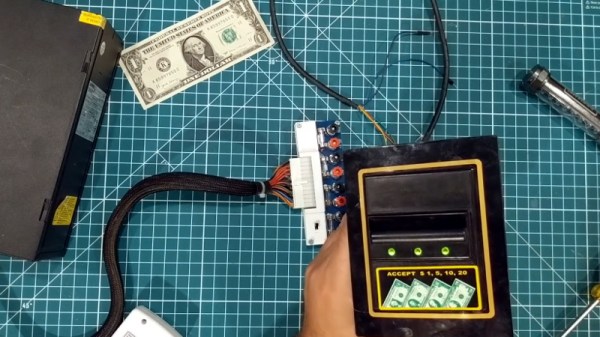
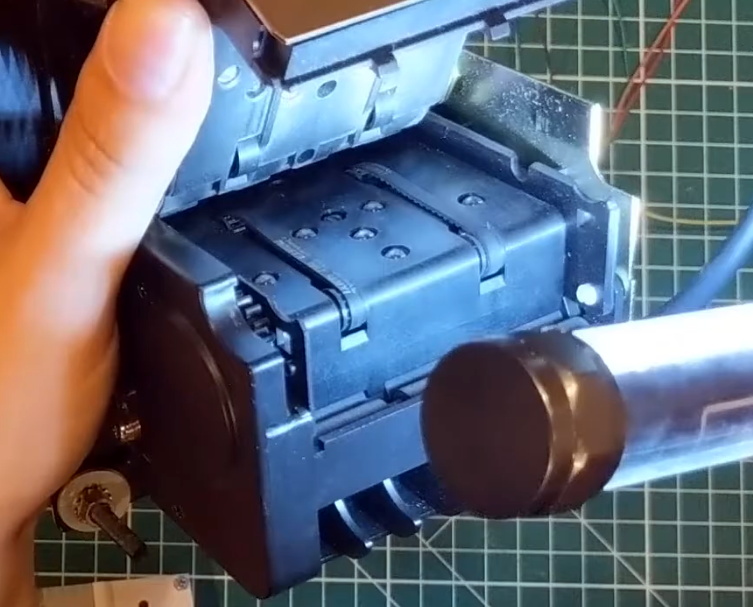
We’ve all seen, and occasionally wrestled with, bill acceptors like the one [Another Maker] recently liberated from an arcade machine. But have you ever had one apart to see how it works? If not, the video after the break is an interesting peak into how this ubiquitous piece of hardware tells the difference between a real bill and a piece of paper.

But [Another Maker] goes a bit farther than just showing the internals of the device. He also went through the trouble of figuring out how to talk to it with an Arduino, which makes all sorts of money-grabbing projects possible. Even if collecting paper money isn’t your kind of thing, it’s still interesting to see how this gadget works on a hardware and software level.

As explained in the video, a set of belts are used to pull the bill past an array of IR LEDs. The hardware uses these to scan the bill and perform some dark magic to determine if it’s a genuine piece of currency. [Another Maker] notes that these readers actually need to receive occasional firmware updates to take into account new bill designs. In fact, the particular unit he has is so out of date that it won’t accept modern $5 bills; which may explain how he got it for free in the first place.

Years ago we saw one of these bill acceptors used to make a DIY Bitcoin ATM. Of course back then, a few bucks would get you a semi-reasonable amount of BTC. These days you would skip the paper currency and do it all digitally.

Continue reading “Using A Vending Machine Bill Acceptor With Arduino”