A Doorbell Loud Enough To Wake The Dead

really_loud_doorbell

[Ed Nauman] runs a machine shop, which we imagine can be quite loud at times. Sick of never hearing the doorbell when he was busy working on things, he decided that the solution to his problem was a new doorbell…an incredibly loud doorbell.

His Really Loud Doorbell (RLD for short) is actually a pretty simple device. We imagine he could have wired up an old alarm bell instead, but where’s the fun in that? The doorbell was built using a PIC16F876 uC, which is used to control the air flow through a pneumatic valve. When someone rings his doorbell, the pneumatic actuator pulses up and down, rapidly striking a piece of 1/4” thick steel pipe. As you can see in the video below, it is quite loud and likely to cut through any shop noise without much trouble.

We have seen some extremely loud doorbells before, but we figured that at least a handful of you work in similar environments – have you implemented any inventive ‘notification’ systems in your workspace? Let us know in the comments.

[via Adafruit Blog]

Continue reading “A Doorbell Loud Enough To Wake The Dead”

An Even Simpler Smartphone Garage Door Opener

We have seen smartphone garage door openers in the past, but [Lou’s] Hack is beautiful in its simplicity. His door opener tackles the problem without using computers, Arduinos, wireless modules or even any smartphone based applications. For this project all that is needed is a Bluetooth headset and a single transistor. The door opener uses the Samsung HM1100 Bluetooth headset, which [Lou] has done significant testing on to show that his creation is quite secure and will not open the door unexpectedly.

When this headset connects to a phone it produces a beep from the earbud, so [Lou] removed the speaker and replaced it with a transistor. Now he can use the voltage spike produced by the amplifier before the beep as his switching signal. By wiring the transistor in parallel with the door button inside his garage he is able to open the door wirelessly by connecting then right away disconnecting from the headset. This setup is apparently perfectly secure as the only way to initially link your phone with the headset is to be inside the garage. Check out the video after the break for build instructions and a demonstration.

Continue reading “An Even Simpler Smartphone Garage Door Opener”

BlinkM Smart Garage Door Opener

garage_indicator

Calling Canada home, Hackaday reader [TheRafMan] has seen his share of bitterly cold winters. He also knows all too well how hard it is to get his cars started in the morning if somebody happens to leave the garage open. After the door was left open overnight for the second time this last winter, he decided that it was time to add an indicator inside the house that would alert him when the garage had not been closed .

Inspired by our BlinkM Arduino coverage a short while back, his circuit incorporates a BlinkM as well as several other components he already had on hand. He disassembled the garage door switch situated in the house and fit the BlinkM into the switch box once he had finished programming it. A set of wires was run to the BlinkM, connecting it to both a power supply located in the garage as well as the magnetic switch he mounted on the door.

The end result is a simple and elegant indicator that leaves plenty of room for expansion. In the near future, he plans on adding an additional indicator strobe to let him know when the mail has arrived, not unlike this system we covered a few months ago.

Stick around to see a quick video demonstration of his garage door indicator in action.

Continue reading “BlinkM Smart Garage Door Opener”

Doorbell Hack Makes Coworkers Less Annoying

doorbell_wav_player

Hackaday reader [Sprite_tm] works in an office building that used to house several businesses, and as a remnant of the previous configuration, a doorbell sits in the hallway just outside his office. Several of his coworkers get a kick out of ringing the doorbell each time they enter the office. While not annoyed at the practice, he was getting tired of the same old “ding-dong” and decided to shake things up a bit.

He wanted to modify the doorbell to play random sounds when triggered, but he was pressed for time as it was March 31st, and he wanted to get it installed for April Fools’ Day. Without any real plan or bill of materials in mind, he pieced things together with whatever he happened to have sitting around.

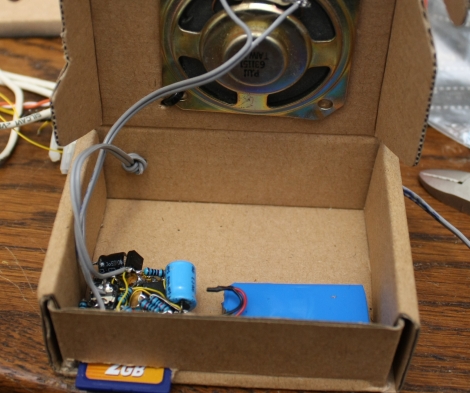
He used a design borrowed from Elm-chan in order to play wav files from an SD card with an ATTiny85, and used an L293 H-Driver as an improvised sound amplifier. After sorting out some power-related problems, and configuring the circuit to be as stingy with its battery as he could, he declared the project complete. He originally aimed to deadbug everything on the metal sleeve of the SD card socket (which is awesome), but considering the size of the speaker and the battery he selected for the project, he ended up stuffing everything into a cardboard box.

We don’t care too much about how he packaged it, we just wanted to know what his co-workers thought of his doorbell augmentation. In the end, they loved it, but we imagine this doesn’t do anything to discourage any of them from hitting the doorbell multiple times a day.

Stick around to see a quick video of his doorbell hack in action.

Continue reading “Doorbell Hack Makes Coworkers Less Annoying”

Growling Doorbell Lets You Know Guests Have Arrived

wireless_doorbell_hack

[Sean] was screwing around online looking for nothing in particular when he came across a mailbox hacked to notify the homeowner when the mail had been delivered. Since his mail is delivered via a slot in the door, he had no use for the hack as is, but something similar soon came to mind.

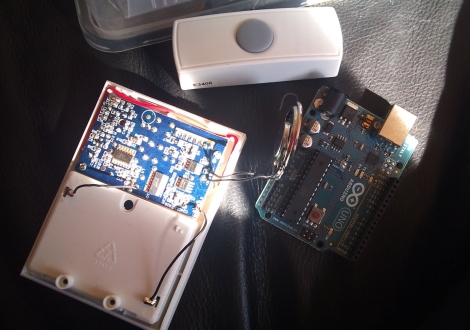
His dog isn’t too keen on visitors, and he figured that he could save himself a bit of grief (and a lot of unnecessary barking) if he were to wire up his doorbell to notify him of guests via his iPhone. He stopped by the local hardware store and picked up a wireless doorbell. It was quickly disassembled and wired up to an Arduino he had set aside for a different project. Tweaking some code he found online, he soon had the doorbell talking with the Arduino and was ready to interface it with his iPhone. He decided that he wanted to deliver notifications to his phone via Growl and found a Perl script online that was close to what he needed. A few tweaks later, and he had a Growling doorbell.

As you can see in the video below, it works, though there seems to be a bit of a delay in the notification. We don’t think that it would be enough to send his visitors packing before he made it to the door, but the lag can likely be reduced with a few small modifications.

As for the post that started this whole thing, we’re pretty sure this is it.

Continue reading “Growling Doorbell Lets You Know Guests Have Arrived”

Smartphone Operated Garage Door Is Beginning Of Arduino Home Automation System

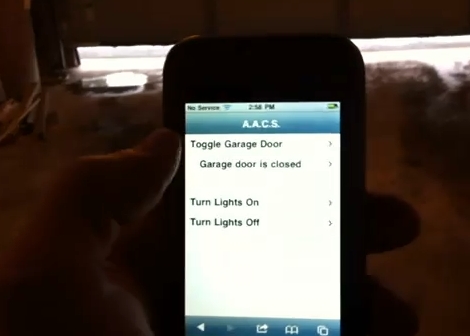
[Tim] is showing off the first step in his home automation projected with this smart-phone garage door interface. In the video after the break you can see him open and close the garage door with the touch of a button. There’s also an open or closed indicator that he can check when away from home.

An Arduino takes care of a portion of the control for this project. Like the post we saw yesterday, he’s using PHP code on a webpage to manipulate the Arduino via its USB connection in order to open and close the door using a relay. The door status is also monitored by the Arduino and sent to the PC over the serial connection. The computer uses a Python script to monitor the incoming data and update a text file which is merged into the web interface using a PHP include. Future plans for the system include adding control for heating and air conditioning systems.

If you’re looking to do something like this but wirelessly here’s some advice on ditching the Arduino and using an XBee module instead.

Continue reading “Smartphone Operated Garage Door Is Beginning Of Arduino Home Automation System”

Yet Another Cat Door

Cat Flap Fever

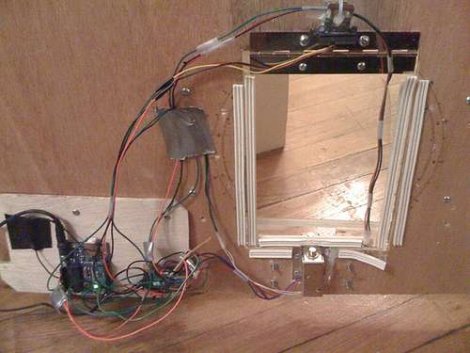
RFID cat flaps are one of those projects we see all of the time. They are generally pretty simple to rig up, not too expensive, and have a good “wow” factor for any non-technical friends or family, not to mention tremendously useful. Why did we decide to share this one? Well, for one, it is simple. It doesn’t tweet, email, or text message, it just gets the job done. Two, it is excellently documented, including a detailed parts list and a step by step schematic just about anyone could use to build their own. [landmanr] does mention that he recommends some sort of project enclosure to protect the electronics from damage, which would be bad for the poor cat stuck outside.