Combo Lock Uses Relays And Logic Gates

logic-combo-lock

Here’s a really fascinating circuit that implements a combination lock using relays and logic gates. Even with the schematic and written explanation of how it works we’re still left somewhat in the dark. We’ll either pull out some paper and do it by hand this weekend, or build it chunk by chunk in a simulator like Atanua. Either way, the project sparked our interest enough that we want to get elbow deep into its inner workings.

From the description we know that it uses a combination of CD4017, CD4030, CD4072, and CD4081 chips. You’re probably familiar with the 4017 which is a decade counter popular in a lot of project. The other chips provide XOR, OR, and AND gates respectively. The relays were chosen for two purposes. One of them activates when a correct combination has been entered, effectively serving as the output for the combo lock. The other two are for activating the clock and affecting a reset if the wrong combination is entered.

It makes us wonder if this would be incredibly simple to brute force the combination by listening for sound of the reset relay activating? It’s hard to tell from the video after the break if you can discern a wrong digit from a right once just based on sound.

Continue reading “Combo Lock Uses Relays And Logic Gates”

Another Way To Look At Charlieplexing

Charlieplexing is a technique that allows you to drive a larger number of LEDs than wouldn’t be possible with the same number of I/O pins on a traditional multiplexed matrix. If we lost you there just think of it as lots of blinky lights connected to a small number of pins. It works by leveraging the one-way nature of a diode. Current will only flow through an LED in one direction so if you hook up your display in a clever way you can drive multiple LEDs from one I/O by switching the polarity of that pin between voltage and ground. [M.Rule] recently looked at using Charlieplexing with LED modules. His conceptual approach to the problem is different from those we remember seeing before and it’s worth a look.

Instead of just using the formula to calculate how many LEDs he can drive [M.Rule] is using a table of I/O pins to establish how many and in what order these displays can be connected. Each colored set of blocks represents an LED module. The graphic above shows how 18-pin can be utilized. He even filled in the unused pin combinations with input buttons.

Hackaday Links: Sunday, April 7th, 2013

hackaday-links-chain

Let’s wind down the weekend with some projects that didn’t quite warrant their own feature, but we think they’re still worth a look.

First up is a quick tip on cracking the lids on those hard to open jars of food. [Jason] says just grab about a foot of duct tape and the lid will come flying off. And while you’re searching for that roll of tape why not grab some foil tape to build a cooking oven. [Gabriel] built this solar oven by covering curved wedges of cardboard with foil tape and combining them to form a parabolic reflector.

Next we’ve got a trio of hacks that will come in useful in your home shop or at the local Hackerspace. Organization is key, and here’s a resistor storage system that uses #6 envelopes [via Reddit]. Also useful is the tip from [Felix] about using a tile saw to get clean cuts on your circuit boards. And if you’ve ever been plagued by a laser cutter job that doesn’t fully sever the material [Dan] wrote a guide on using a fence so that you can reposition the piece for another run.

Finally, we’re hoping we weren’t the only ones that didn’t realize the Raspberry Pi has an unpopulated footprint for a reset button. Now we’ve got to figure out if it’s okay to leave the PSU plugged in (based on it’s current consumption while the RPi is in power down) and hack together some sort of TV-based reset circuit for our RPi XBMC setup.

Solar Powered Robot Mows Your Lawn While You Chill Indoors

We’ve heard quite a number of radio ads lately trying to sell an automatic lawn mowing robot (like a Roomba for your grass). But wouldn’t it be a lot more fun to hack your own from an existing lawnmower? That’s what [Daniel Epperson] did. In fact, the project has been ongoing for years. But he wrote in to share the latest development which adds solar charging capabilities to the robot mower.

First off let’s discuss the fact that this is not an electric lawnmower. This is the Prius of lawnmowers, bringing together hybrid technology to cut the grass with the gasoline powered motor, and to propel the rig with electricity. [Danny’s] worked hard to shoe-horn just about every feature imaginable (other than autonomy) into the thing, and that’s why the batteries can be charged from mains, an alternator powered by the gas motor, and now from the PV panel mounted on top of it. Get the entire project overview in his roundup post.

This a wireless video feed and the mower is driven by remote-controlled. So you can give your yard a trim without getting sweaty. After the jump we’ve embedded a clip of an earlier revision demonstrating that remote control. If you’re not interest in having all the features you could simply build an analog version.

Continue reading “Solar Powered Robot Mows Your Lawn While You Chill Indoors”

Acoustic Bass Guitar Uses Water Jug And Two Strings

water-bottle-acoustic-guitar

It’s easy to dismiss this one at first glance. But once you hear [Tychsen81] playing the thing you’ll want to know more.

He posted the demonstration way back in 2009. It wasn’t until a year later that he filmed the particulars of how the thing was made. The strings are actually bass guitar strings, an A and D string that are tuned down to E and A to play along with Black Sabbath’s “Ironman”. The neck is made out of two boards. One serves as the fingerboard, which is fretless. The other is mounted under that in order to provide negative space for the bridge while keeping the strings at the right height for the fingerboard. The water bottle helps to amplify the sound and that’s why the bottom end of the strings pivot on the bridge, pass through the neck, and are anchored on the bottom edge of the bottle.

We’ve embedded both the demo and the build videos after the break.

If this gets you thinking about making your own instruments you will also be interested in the Whamola.

Continue reading “Acoustic Bass Guitar Uses Water Jug And Two Strings”

Making PLA Stick To A 3D Printer Build Platform By Using Hairspray Or An Acetone ABS Slurry

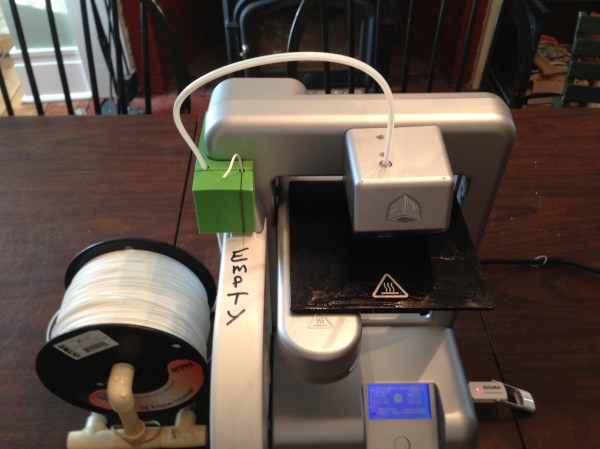
[Chris] has been having some real problems getting PLA to stick to the build platform of his Printrbot. This is of course not limited to this brand of printers, and affects all extruder-based hardware using the PLA as a source material. He came up with a couple of ways to fix the problem.

The first is something we’re quite familiar with. The image above shows [Chris] applying a thin layer of hairspray to the platform. This is a technique the we use with our own 3D printer. The sheets of paper are used as a mask to help keep the sticky stuff off of the threaded rod. For more info on the hairspray trick [Chris] recommends that you read this article.

The second technique uses a slurry made from saturating a bottle of acetone with ABS leftovers. In the clip after the break he shows off a glass jar of the solvent with scraps from past print jobs hanging out inside. After a couple of days like that it’s ready to use. He takes a paper towel, wets it with the solution, and wipes on a very small amount. He does mention that this will eventually eat through the Kapton tape so apply it rarely and sparingly.

Continue reading “Making PLA Stick To A 3D Printer Build Platform By Using Hairspray Or An Acetone ABS Slurry”

Rolling Your Own Minimal USB To Serial Arduino Programmer

usb-to-serial-programmer

[Hans Peter] wanted to move away from using full Arduino boards in his projects. One of the components he rarely used after the development stage is the USB hardware. Once the firmware is flashed to the chip he didn’t need it any longer. So he tried his hand with some really small SMD parts by building this USB to serial Arduino programmer.

The chip he went with isn’t the FTDI part we’re used to. Instead of using an FT232RL, he opted for its smaller cousin the FT230x. This chip doesn’t fully implement the communications protocol of the 232, but it does work with AVRdude and that’s all that really matters. Above you can see [Hans’] creation next to the official Arduino USB-to-serial programmer. He used the same connection scheme, but went with an edge connector for the USB instead of using a mini-B jack.

It’s pretty impressive to see his prototyping work with the 16-pin QFN package. He soldered it dead-bug style to a couple of SIL pin headers in order to test it on a breadboard. The first board he assembled was too loose in the USB port, but he added some tape to the back to make it thicker, and coated the edge connector traces with a bit of solder and that did the trick.