Putting The BBC In Seattle

radio

Among great British traditions, there’s tea, knowing how to lose an empire, tea, Parliament, big ben, tea, incalculable wit, Parliament, big ben, tea, and BBC radio. While Britons in foreign lands may not be able receive BBC radio over the airwaves, there is the remarkable BBC iPlayer that allows online streaming of all those awesome BBC radio stations. Unfortunately, moving away from the Prime Meridian means the BBC radio schedule deviates from the schedule ordained by divine right. In Seattle, for example, a Friday evening comedy would be broadcast in the middle of the afternoon. Basically, it’s like listening to  Prairie Home Companion on Saturday morning. It just feels wrong.

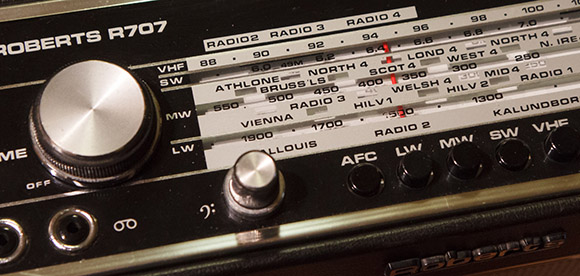
[Adam] came up with a clever solution to this problem. Yes, it’s really just a Raspberry Pi-powered web radio, but there’s a twist to this build: everything from BBC radio is buffered and time shifted. A program that airs at noon in London will now play on [Adam]’s radio at noon in Seattle.

The hardware portion of the build is an exceedingly British radio which [Adam] deftly modified to include an auxiliary input. The software portion of the build uses ffmpeg, mplayer, and a PHP script to stream the iPlayer audio to a file, wait 8 hours (or whatever the offset from GMT is), and start playing the audio.

In the end, the time shifted BBC radio works perfectly, and even caught the attention of a few people at BBC Radio 4. [Adam] was interviewed about his project, and was even able to listen to his interview several hours later.


Listening In On Weather Balloons With RTL SDR

sonde

Every day, twice a day, over 800 weather balloons are launched around the world at exactly the same time. The data transmitted from these radiosondes is received by government agencies and shared with climatologists and meteorologist to develop climate models and predect the weather. Near [Carl]’s native Auckland, a weather balloon is launched twice a day, and since they transmit at 403 MHz, he decided to use a USB TV tuner to receive data directly from an atmospheric probe.

The hardware portion of this project consisted of building a high gain antenna designed for 162 MHz. Even though the radiosonde transmits at 403 MHz, [Carl] was easily able to receive on his out-of-band antenna.

For the software, [Carl] used SDRSharp and SondeMonitor, allowing him to convert the coded transmissions from a weather balloon into pressure, temperature, humidity, and GPS data.

A Pirate Box For Sharing Files

This is [illwill]’s Pirate Box, the newest addition to the network over at NESIT, the Meriden, CT hackerspace.

A pirate box is a completely anonymous wireless file server, kind of like a wireless version of a dead drop. It’s the perfect device for transferring files at a LAN party or hackerspace. The guts of [illwill]’s portable server comes from an old Fonera router NESIT had lying around. After installing OpenWRT, connecting a few batteries, and finding a wonderful lunch box / treasure chest enclosure on ebay, [illwill] had a portable file server perfect for sharing files.

The pirate box isn’t connected to the Internet. Instead, users can connect to each other and the 16GB USB drive by simply connecting to the router’s WiFi and opening up a browser. All web page requests are redirected to the Pirate Box page, where users can chat and share files. The folks at NESIT uploaded a few public domain files to their pirate box, but they’re anxiously waiting to see what files other users will upload.XVID.AC3.HQ.Hive-CM8.

Finally, TI Is Producing Simple, Cheap WiFi Modules

Ever responsive to the hobbyist market, Texas Instruments is releasing a very inexpensive, very simple WiFi module specifically designed for that Internet of Things.

The TI SimpleLink TI CC3000 WiFi module is a single-chip solution to putting 802.11b/g WiFi in just about every project you can dream up. Just about everything needed to put the Internet in a microcontroller is included in this chip – there’s a TCP/IP stack included on the chip, along with all the security stuff needed to actually connect to a network.

The inexpensive micocontroller WiFi solutions we’ve seen – including the very cool Electric Imp – had difficult, or at least odd, means of putting WiFi credentials such as the SSID and password onto the device. TI is simplifying this with SmartConfig, an app running on a phone, tablet, or PC that automagically takes care of setting up a link in a wireless network.

Best of all, the CC3000 only costs $10 in quantities of 1000. Compare that to other Internet of Things WiFi solutions, and it looks like we might be seeing and easy and cheap way to connect a project to the internet this year.

Hackaday Retro Roundup: Ultraportables Edition

front

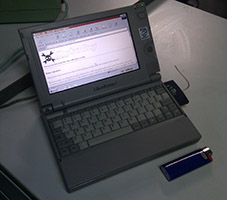
A few months ago, we rolled out an updated Hackaday, a badly needed new layout replacing the HTML and CSS that had remained unchanged since 2004. Of course a few people didn’t like change and complained about slow load times. We’ve experienced a slightly slower load time as well, so we’ll just wait until the year 2020 when our computers are many times faster and our Internet is provided by Google Fiber. Until then, our pokey battlestations and vintage computers can still check out a few classic hacks on our retro site. Here’s a few retro successes – Hackaday readers who pulled out their old tech and loaded up the retro site – that have come in over the past weeks and months.

Continue reading “Hackaday Retro Roundup: Ultraportables Edition”

Building An Inexpensive Squeezebox Client Replacement

squeezebox-replacement-built-on-the-cheap

[Andrew] is a fan of the audio quality provided by the Squeezebox hardware. Like many he was unhappy to hear that the devices were being discontinued, but he figured out a way to build a Squeezebox client clone for less than he could have bought an original.

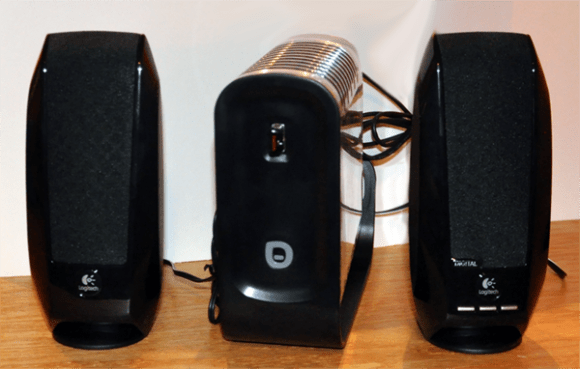
He set several goals for the build. Most notably he wanted the system to be low-power, noiseless, and to support audio quality of at least 96 kHz at 24 bits. What he came up with is the Pogoplug seen in between the two speakers above. It can be acquired for under $20 and it runs embedded Linux. Another member of the Squeezebox community had been working on a custom distro called SqueezePlug to turn these types of devices into Squeezebox clients. After flashing the distro and tweaking the settings [Andrew] has accomplished his goals. The one caveat is the lack of an audio out port. Above he’s using some cheap USB speakers, but higher-fidelity is possible by choosing a more expensive external USB device.

This will work nicely with that Squeezebox server you built from a Raspberry Pi.

Veronica VGA Board Finalized

veronica-vga-board-finalized

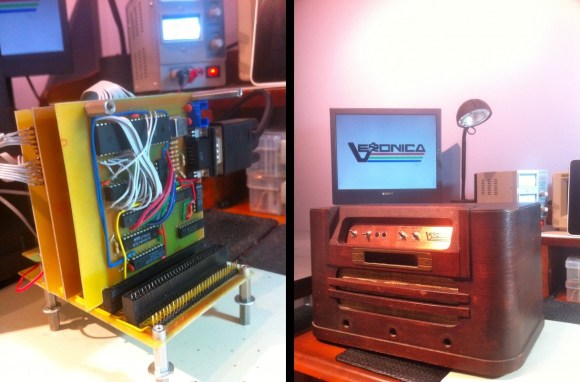
The latest update in the Veronica 6502 computer project is this finalized VGA board which now has a home in the machine’s backplane.

We’ve been glued to the updates [Quinn Dunki] has been posting about the project for many months now. Getting the GPU working proved to take quite a bit of time, but we learned a ton just by following along. The video output had humble beginnings way back in March. That breadboarded circuit got complicated very quickly and that was before it was even interfaced with the CPU. As you can see from the image above, etching and populating the GPU board really cleans up the build. We’re sure it’s robust enough to move around at this point. We wonder if she’s planning on showing it off at a Maker Faire or another geeky gathering?

It really has become clear how wise [Quinn] was to design a backplane board early on. It plays right into the modular concept. She was even smart enough to include that SIL pin header on the near side of the board which was used heavily while prototyping this video module.