Hacking The Peggy

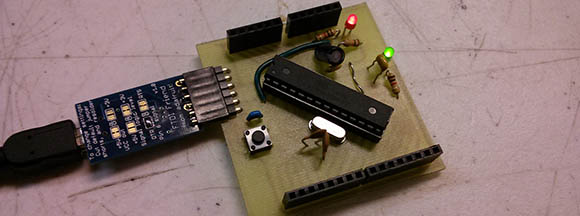
Evil Mad Scientist Laboratories received an email from someone who wanted to hack their Peggy kit. This LED matrix kit has been featured on Hack a Day in the past, and provides hardware to set up a 625 LED matrix.

This user built an external array of LEDs that they wanted to drive with the Peggy hardware. There are a few options for making this happen. The first one is to run wires from each of the 625 LED footprints on the board. Each has an anode and cathode, so that makes for a total of 1250 wires to run. It turns out that people have actually done this with the Peggy in the past, using very fine wire.

EMSL suggests wiring the rows and columns instead. This way, only one wire is needed for each row and column, allowing a 25×25 LED grid to use 50 wires instead of 1250. They also explain how to expand the grid to a 30×20 LED matrix. It’s a good explanation of how the kit works, and how it can be expanded.

Photo [oskay]

Measuring A Pulse With Infrared Light

The next time you’re unfortunate enough to make your way to a hospital, emergency room, or urgent care clinic, you’ll be asked to attach a small pulse monitor to your finger. The device the nurses clip on to one of your remaining digits is called a photoplethysmographic sensor, and basically it is able to read your pulse through reflected light. In the search to find out how these devices actually work, [Raj] sent in a great tutorial covering the theory behind photoplethysmographicy, and also built a simple device to detect a pulse without using a microcontroller.

These photoplethysmographic sensors operate by shining light into someone’s flesh – usually a finger or ear lobe – and recording the light reflected back to the source. The volume of blood in the finger will have an effect on the amount of light reflected back, and makes for a perfect way to automatically measure someone’s heart rate.

To build his device, [Raj] used a TCRT1000 reflective optical sensor. Inside this sensor is an infrared LED and a phototransistor. Of course with a finger over the sensor there is a ton of noise both from ambient light and the base rate of reflected light from a piece of flesh. [Raj] filtered this out, leaving only the small variations in the amount of reflected light, thus creating a very simple – and very inexpensive – electronic pulse meter.

Raspy Juice Gives You Serial Ports And Servo Control

Up next on the continual march of expansion boards for the Raspberry Pi is the Raspy Juice, a board designed to break out the GPIO pins on the Raspberry Pi into servo, serial, and other miscellaneous connections.

The Raspy Juice features an ATMega168A microcontroller connected to the Raspberry Pi as an I2C slave device. Not only does the addition of a microcontroller add analog inputs to the Raspberry Pi, but also RS232 and RS485 serial connections, a real-time clock, and four JST plugs for hobby servos.

Because the Raspberry Pi can be powered from the GPIO header, the creator, [NTT] added a buck regulator so batteries or solar cells can be used to power the Raspberry Pi.

The Raspberry Pi is a terribly awesome robotics platform, but sadly limited by its capability to drive motors and servos natively. The Raspy Juice adds some much-needed capability to the Raspberry Pi, and we can’t wait to see a robot take its first steps with this expansion board.

Simple Concepts Behind Complex Coilguns

Coil guns use electromagnetic coils to propel a metal projectile. On the surface they may look rather complicated. But when you break down the concepts it’s pretty easy to learn. If you’ve ever thought of dabbling in this field this lengthy coilgun primer will be a great help.

The basic concept of a coilgun comes in three parts: the coil, the voltage source, and the switch that combines the two. In the build above you can see two spools of wire on the clear barrel of the gun. These make up a pair of accelerators which connect to those huge black capacitors supplying the voltage. The switch they used can’t really be seen but from the article we know it’s a Thyristor; a Silicon Controlled Rectifier (2N6504).

In the video after the break you can see these three parts coming together for a test firing. This is the first step in a longer journey. To achieve higher projectile velocities you must add coils, as in the image above. But spacing and timing quickly complicate the simple concept. But if you can work out all the kinks you end up with some pretty great hardware.

Continue reading “Simple Concepts Behind Complex Coilguns”

Ugly Upgrade Keeps The Tunes Playing Longer

[Sam] picked up a Sansa Clip audio player to listen to some tunes while working on projects. He liked the fact that he could run the Rockbox alternative firmware on the device, but thought the 15 hour battery life needed some improving. He swapped out the stock cell with a larger Lithium cell for a long life of 50-60 hours. It’s an upgrade fom 300 mAh to 1100 mAh, but as you can see, the size of the replacement made for some interesting case modification.

The battery swap required more than just taking one battery out and putting in the other. [Sam] is using a cellphone battery as the replacement and he didn’t want to have issues with the internal circuitry. He took the cell out of its plastic enclosure, removing the circuit board in the process. That PCB is the charging circuit, which he replaced with the one from the stock battery. After insulating the cell with a layer of Kapton tape he soldered it to the MP3 player and did his best to adhere all the parts to each other.

Sure, its ugly, but that makes it right at home on the work bench.

Building A Recirculating Infusion Mash System For Your Brewing Pleasure

If you’re into all-grain brewing a little automation goes a long way. [Tom Hargrave] had his eye on a Recirculating Infusion Mash System (RIMS) but the price tag kept him from pulling the trigger. Recently he bit the bullet and built his own small and inexpensive RIMS for use with the 10 gallon cooler he uses as a mash tun.

Mashing is the part of brewing process that collects sugars from the milled grains. Water needs to move through the grain mash and should be kept within a narrow temperature window. This RIMS hardware does that automatically by combining a pump, the heating element from an electric water heater, and a temperature sensor. The wooden disc fits on the top of the mash tun and tubing lets the pump move the liquids as needed. The one thing missing from this build is the PID controller to automate the process. After the break we’ve embedded a video from a separate project that shows off how the PID control would work with a system like this one.

If you’re into automated home brewing you’ll also like this mini-batch brewing setup.

Continue reading “Building A Recirculating Infusion Mash System For Your Brewing Pleasure”

VISUALIST – A Hardware Visual Effects Synthesizer

[Berto] wrote in to tell us about the visual effects synthesizer he built. It works as a pass-through for a video signal, rendering crisp clean images into a more psychedelic flavor like the one seen above. On the one hand this does a dishonor to the high-quality video devices we carry around in our pockets these days. On the other hand it will make some really interesting background video at a party or at your local dance club.

This is not a filter for a PC, or an FPGA-based processing system. A set of analog parts alter the incoming composite video (NTSC or PAL formats) and pipes the result to a television or projector. [Berto] included controls to alter the effects. They’re mounted on a panel and everything is given a home inside of a handy carrying case. Check out the video clip after the break to get a better idea of the video manipulations this things can pull off.

Continue reading “VISUALIST – A Hardware Visual Effects Synthesizer”