Electronically Controlled NFC Tag

P1010393

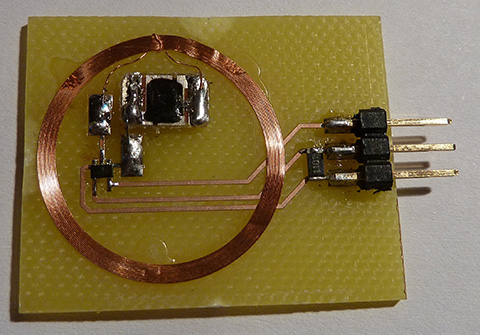
[Per] is replacing his car stereo with a Nexus 7 tablet. It’s a great modification to add GPS, navigation, and a good music player, but [Per] wanted to pause his tunes and tell the tablet to go to sleep with an NFC tag. This means building a an NFC tag he can turn on and off, an interesting problem to say the least.

The easiest way to do this is with a CMOS switch, but a chip like a 74HC4066 is overkill for a project this simple. What [Per] needed was a single CMOS switch, something he found and fabbed a board for.

Now, with a press of a button, [Per] can activate his NFC tag and pause the music in his new stereo. Check out the video of this electronically controllable tag after the break.

Continue reading “Electronically Controlled NFC Tag”

ATTannenbaum

attiny

It’s that special time of year again where the smell of baking cookies fill the house and shopping mall parking lots are filled with idiots and very angry people. [Kevin] thought it would be a good idea to build an LED Christmas tree and ended up building a great looking tree that’s also very simple.

In the video, the imgur album, and the github, [Kevin] shows us the simplest way to make a color-changing LED Christmas tree. The circuit uses LEDs to drop the voltage and to provide a nice glow around the base of the tree. After that, it’s just an ATtiny13 and some LEDs in a very nice freeform circuit.

Of course, if LED Christmas trees aren’t your thing, [hb94] over on reddit created an LED menorah. Pretty nifty he used an 8-position DIP switch for the circuit. Let’s just hope someone gave him a soldering iron for the last night of Hanukkah.

Beautiful Tube Amp Uses A TV Tube

tube-amp-i

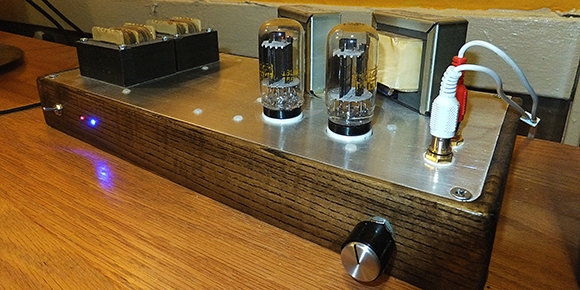
Most audio tube amps we see use common tubes – usually a 12AX7 for the preamp and one of the more common power tubes such as an EL34.[Daniel], on the other hand, decided to build his own audio tube amp with a 13EM7, a tube originally used for a television’s vertical oscillator. The resulting project is a wonderful stereo amp that sounds really good, to boot.

[Daniel] picked up the idea of using a 13EM7 tube from [Fred Nachbaur]’s MiniBlok SET amplifier. This very tiny 1-watt tube amplifier uses a single tube originally designed for use in old, old televisions. The secret behind this build is the fact this tube is actually two triodes in one package; one side of the 13ME7 has tons of gain but not much power, making it perfect for a preamp. The other side has a lot of power, useful for delivering two watts of power into a speaker.

After [Daniel] etched a few boards for his amp, he milled out a piece of wood for the chassis. When everything was mounted he had an awesome looking stereo amplifier that also sounds great.

Displaying Text On Random Strings Of Christmas Lights

lights

With the help of a microcontroller, a few strings of GE Color Effect Christmas lights can be easily turned into a fully programmable LED strip, or if you are so inclined, a huge RGB LED display. [Hubbe] had a few strings of these Color Effect Christmas lights, but didn’t want to spend the time arranging his light strings in an array simply to get a programmable display. His solution to this problem – the Chaos Display – turns strings of Christmas lights randomly thrown on a tree into a fully programmable display capable of displaying text and images.

[Hubbe] was inspired by QC Co-Lab’s light wall powered by GE Color Effect lights. Having a huge RGB LED display is very cool, but requires building a frame for each of the Christmas light pixels. [Hubbe] had a different idea – just throw the lights on a tree and use a web cam to figure out where each Christmas light is on the display.

The actual build consists of six strings of Color Effect lights. After throwing them on the tree, [Hubbe] set his phone on a tripod to record an image for each individual light. With some computing power, he was able to create a virtual display made of tangled strings of Christmas lights.

You can see a video of [Hubbe]’s work after the break.

Continue reading “Displaying Text On Random Strings Of Christmas Lights”

Click to embiggen

[Bunnie] Builds A Laptop For Himself, Hopefully Us


[Bunnie Huang], creator of the Chumby and artisan of chips and electrons, is building his own completely open source laptop. It’s called the Novena, and is powered by a quad-core ARM CPU, it’s got enough bells and whistles to make any hacker happy including an on-board FPGA, dual Ethernet ports, and enough GPIO pins to do some crazy, crazy stuff.

[Bunnie]’s laptop is an attempt to create a completely open-source laptop capable of some light code development, and web browsing. Every single chip on [Bunnie]’s laptop has a datasheet available (without requiring an NDA, unlike the Raspberry Pi), meaning this laptop might be the beginning of a completely open source laptop.

Officially, this laptop is a one-off project made just for [Bunnie]. He’ll be spending the next few months validating all features on the board and making a proper case. [Bunnie] says a few people may be interested in their own Novena (smart one, that guy), so he might consider a Kickstarter campaign in a few months. Don’t expect it to be cheap, but if you’d like to try your hand at making your own, all the files are up on the Novena wiki.


Solving A Rubick’s Cube With LEGO And Popsicle Sticks

solver

We’ve seen automated Rubick’s Cube solvers before, but never one that has garnered as many awards as [James]’ popsicle stick and LEGO Rubick’s Cube solver.\

To keep the project complexity down, [James] opted not to use a webcam to detect the color pattern on each face of the cube. Instead, he wrote a little Python app to manually enter the pattern on each face before letting his algorithm loose on the cube and calculating how to solve it.

So far, [James] has seen a huge amount of success from his project. He entered it in the New Zealand Brightsparks competition netting him $1000. This competition led to a win in the Realize the Dream science competition where he won a major prize and an entry into the International Taiwan Science Fair held early next year. An awesome accomplishment from a budding hacker, and we can’t wait to see what he comes up with next.

You can check out a video of [James]’ cube solver after the break.

Continue reading “Solving A Rubick’s Cube With LEGO And Popsicle Sticks”

Adventures In Mold Making And Making Your Own Enclosures

case

The folks at SC-3000 survivors have been working on a cartridge capable of storing dozens of games for the ancient Sega SC-3000 computer. The PCB works beautifully, but making a case for their cartridge left them with few options. They could use a 3D printer or simply collect a whole bunch of used cartridge cases, but making their own mold for a cartridge case was the best solution.

To create the mold for their multicart enclosure, the SC-3000 survivors first took an old, used case and made a silicone mold. While the first attempt at mold making was encouraging, several problems began to crop up due to the lack of vent holes and wiggling the mold before the resin had set. Before long, a proper technique to make resin casts was developed: use lots of resin, and don’t apply pressure or rubber bands to a curing mold.

We’re always impressed by what can be done with a few sheets of plastic, some Bondo, and the inordinate amounts of patience and sandpaper we see with other case mods and enclosure builds. the SC-3000 survivors put together an enclosure that rivals any Bondo build, and we’re happy they put out this tutorial.