A LEGO Turing Machine For [Alan]’s Centennial

2012 is the 100-year anniversary of [Alan Turing]’s birth, and to celebrate the centennial, [Jeroen] and [Davy] over at Centrum Wiskunde & Informatica in The Netherlands built a Turing machine out of LEGO.

A Turing machine is an extremely simple device, but is still able to compute everything your desktop can. The machine is generally described as an infinite paper tape with a read/write head. On this paper tape, the numbers ‘1’ and ‘0’ are written. By precisely defining what the Turing machine should do when it comes across a ‘1’ or ‘0’, its able to do the same calculations as a laptop, albeit at a much slower rate.

The LEGO Turing machine has a series of pins signifying each bit. These pins are moved underneath a read/write head containing a light sensor and robotic arm. When a pin is down, the camera sees a dark spot signifying one state. When the pin is up, light reflects off a white LEGO piece signifying another state.

[Jeroen] and [Davy] built an IDE for their Turing machine, so if you’ve got a few LEGO NTX bricks lying around you can grab the Git and build your own. Check out the mini documentary after the break.

Continue reading “A LEGO Turing Machine For [Alan]’s Centennial”
Fast And Easy Solder Paste Stencils

If you’re making your own boards with SMD parts, you might want to get a solder paste stencil. Usually made of laser-cut mylar or extremely thin steel, these stencils allow you to squeegee solder paste onto your board’s pads and make assembly a whole lot easier. [Rochey] needed a stencil for a board he was working on, and lacking a laser cutter he turned to what he had available – a few bits of plastic and a CNC machine.

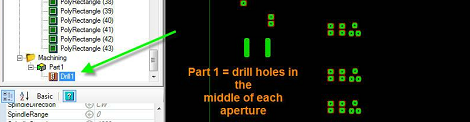
[Rochey] began making his stencils out of laminating pouches and an xacto knife. This worked well, but it was time-consuming, and a bit fiddly when cutting 1 mm square holes. To speed up the process, [Rochey] put one of these laminating pouches on his CNC machine, exported the ‘Top Cream’ layer in Eagle to the CNC software of his choice, and had his machine attack the plastic with a 1 mm drill bit.

To [Rochey]’s surprise, everything went as planned; in five minutes, he had a stencil with perfectly accurate holes that masked off everything but the SMD pads.

Thanks [Fabien] for sending this one in.

Putting Scores Of Arduinos On The Internet With One Router

Like many hackers of late, [Rick] has been experimenting with connecting Arduinos to the Internet with a disused WiFi router and an installation of OpenWRT. Unlike his fellow makers, [Rick] thought it would be wasteful to dedicate a single router to one Arduino project, so he used a small, low power wireless module to connect up to 30 Arduinos to the Internet.

Just as in a few recent builds (1, 2), [Rick] found an old Fonera router sitting in a box at his local hackerspace. After installing OpenWRT, [Rick] connected a very small wireless module to the router’s GPIO pins and patched the firmware to put an SPI bus on the router.

Now, whenever [Rick] wants to connect an Arduino project to the Internet, all he needs is a $4 radio module. This radio module connects to the router, and the router handles the networking requirements of up to 30 DIY projects.

If you’re looking to build an Internet-enable sensor network, we honestly can’t think of a better or cheaper way of going about it. Nice job, [Rick].

Emulating Mac System 7 On An Android Device

Over on the 68kmla forums, a website dedicated to old Macs built before 1994, [zydeco] released his Android port of Mini vMac, a Macintosh Plus emulator that puts the power of a Motorola MC68000 processor and System 7 on any computer.

Unlike the original Macintosh, or the subsequent revision that bumped the RAM up to 512 kilobytes, the Mac Plus was actually useful. With the addition of a SCSI port and support for 4 Megabytes of RAM, it’s not only possible to browse the Internet, but also act as a server. There’s a reason [Sprite_tm] chose to rebuild one of these classic, all-in-one machines to act as a home server; they really do epitomize the elegant computers from a more civilized age.

68kmla user [FlyingToaster] even went so far as to put a Mac Plus in his nook touch. With this, he’s got a full-blown installation of System 7 running on an e-ink screen, complete with LemmingsGauntlet, and Tetris.

It should be possible to plug this emulated box into the Internet. Unfortunately, experience tells us it won’t be a very pleasant browsing experience outside Hackaday’s retro edition.

Lucid Dreaming Mask Marries Economy With Comfort

Here’s an effort to make a cheap lucid dreaming mask that is also comfortable. The idea is in response to the goggles we saw in April (which would not be too comfortable to sleep in) and the wildly successful Remee (which has an $80 target price).

The mask itself is sewn from a child’s fleece blanket. Inside is a piece of foam cut from some recreation mat. You know, those squares made for a play area that connect together like a jigsaw puzzle. You may have already spotted the Arduino in the image above, but the project is designed to run from an AVR chip embedded in the foam. The design only uses three LEDs, which may or may not work for you — we’d guess it depends on how they line up with your eyes. The video after the break does a great job of illustrating each point in the construction.

If you’re looking for something less soothing and more recreational you could always try out these trippy goggles.

Continue reading “Lucid Dreaming Mask Marries Economy With Comfort”

DIY EMG Uses An Audio Recorder

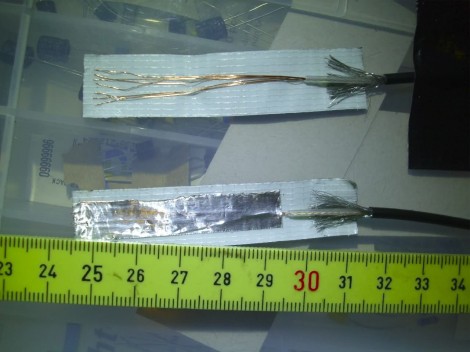
[Ericdsc] is looking to capture the electrical impulses of his muscles by using an EMG. He went through several prototypes to find the right recipe for sensors to pick up the electrical signal through his skin. Above you can see the version that worked best. Each sensor is made starting with a piece of duct tape and laying out a patch of stripped wire on it. A 5cmx1xm piece of aluminum foil then covers this, and second smaller piece of foil covers the cable’s shielding (not pictured here). This will stick to your skin to hold the sensor in place after applying a dab of sugar syrup to help make a good electrical connection.

In this case, an audio recorder is taking the measurements. [Ericdsc] had been having trouble sleeping and wanted to find out if he’s restless in bed. The audio recorder can log hours of data from the sensors which he can later analyze on the computer. Of course, it wouldn’t be hard to build your own amplifier circuit and process the signals in real-time. Maybe you want to convert that mind-controlled Pong game over to use abdominal control. You’ll have a six-pack in no time.

Hackaday Links: June 17, 2012

Portal gag-video

These guys make your own video editing chops look just plain sad. They put together a video demonstrating the portal gun in real life.

Unleashing the beast

We have this problem all the time. The noise regulations were preventing [Massimiliano Rivetti] from letting the true voice of his Ferrari be heard. He hacked into the control system and can now adjust it via iPhone to roar with power. [Thanks Claudio via openPicus]

Music so bad you want to throw something

Here’s a novel way to include the worker bees in music selection around the office. A piezo element was attached to the back of a framed poster and when you throw something at it, the next track is played. We really loved the demo video for this one. [Thanks Calum via DontBelieveTheHype]

Acrylic frame for a CNC machine

[Jake] wrote in to show off his progress on a CNC build. He’s got a frame made of acrylic and some other materials. It’s not up and running yet, but what he’s got so far looks very nice.

Helo built for one

All we can think with this one-man helicopter is failure of those propellers. At least with an ultralight plane you can glide to a gentler crash-landing. [Thanks Filespace]