Tablet-controlled Disco Droid

disco_droid_adk_control

We have seen a few neat Google ADK projects pop up since its announcement a few weeks back, and this one is already on the list of our favorites.

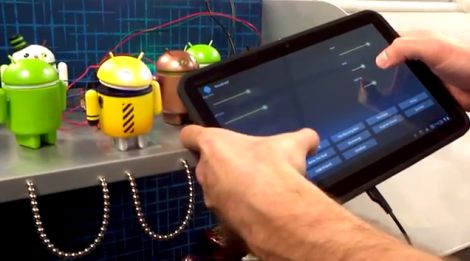
YouTube user [chrisjrelliot] has put together a great hack demonstrating the ADK’s power and how easy it can be to control devices in real time with an Android-powered device.

He hacked apart an Android figure (naturally) and fitted it with some LED eyes as well as four servos. The servos are used to rotate the head, body, and arms of his Disco Droid, all of which can be controlled via his Android-powered tablet. As you can see in the video below, he is able to control the Droid’s actions in real time with a few simple swipes of his finger. One thing we did notice is that his tablet is not connected to anything via wires, so we are assuming that there’s a Bluetooth module hidden away somewhere in the mix.

While the video is a bit short on details, [Chris] promises that source code and build plans will be published in short order.

[youtube=http://www.youtube.com/watch?v=jwvkJVUECrg&w=470]
RFID Shower Time Logger

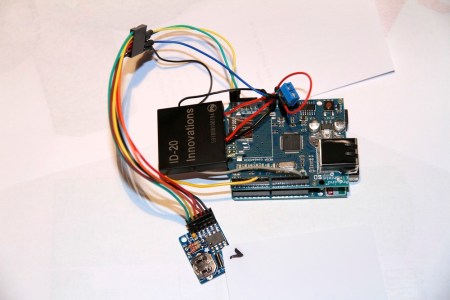
Paul, as he describes himself, is “a student without a big budget,” which might have been part of the inspiration for this hack .  Paul wanted to see how much time he was spending under the shower each day, so came up with this monitoring device using the ever-awesome Arduino processor and a RFID tag that many of you are certainly familiar with.  One simply waves the tag in front of the reader to start the timer, and waves it again to stop it.

One may not, however, be familiar with “thingspeak” and “weatherspark“, two other important elements of this hack.  Thingspeak is “an open application platform designed to enable meaningful connection between things and people,” and was used to interface the weather data on weatherspark with the shower monitor.  This was to help figure out if there was a connection between outside temperature and the length of showers taken.

The results of this experiment should be interesting, so hopefully some will be published soon!

[via hackedgadgets]

Another Smarter Water Heater Timer

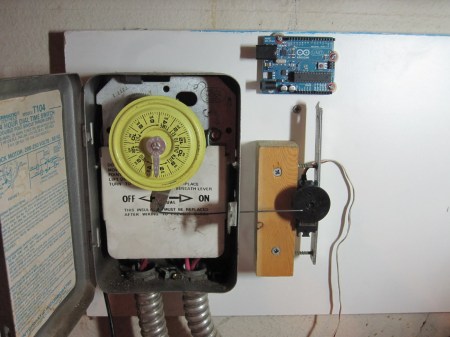
When notes stuck to the water heater failed [Ryan] decided to whip up “the world’s most expensive 240V relay” using a servo, a real time clock and of course an Arduino. All in an attempt to save a buck or two thanks to LA’s “Time-of-Use program”.

Using a protoshield Ryan soldered up a RTC module using the DS1307 chip. On board he added some LED’s and switches including a holiday switch keep the heater off, a next cycle button when you need some hot water and to hell with the expense, and a pulsing blue LED.. for no reason at all. The board flips the mechanical switch using a servo and piano wire, simple but effective. We wonder how many days/weeks it will take for it to offset its expense?

Hacking Into Your Router’s Administrative Interface

zte_zxdsl_router_hack

[Arto] recently upgraded his home Internet subscription from an ADSL to VDSL, and with that change received a shiny new ZTE ZXDSL 931WII modem/wireless router. Once he had it installed, he started to go about his normal routine of changing the administrator password, setting up port forwarding, and configuring the wireless security settings…or at least he tried to.

It seems that he was completely unable to access the router’s configuration panel, and after sitting on the phone with his ISP’s “support” personnel, he was informed that there was no way for him to tweak even a single setting.

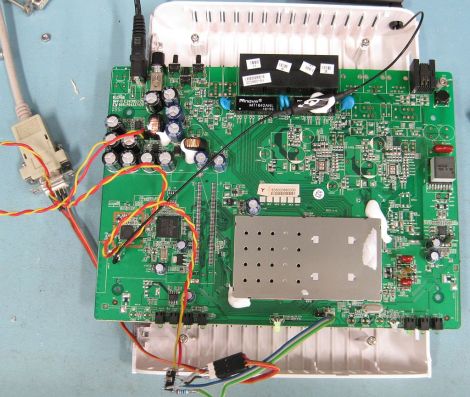
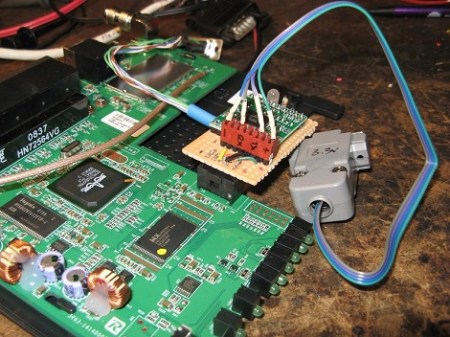
Undaunted, he cracked the router open and started poking around. He quickly identified a serial port, and after putting together a simple RS232 transceiver, was able to access the router’s telnet interface. It took quite a bit of experimentation and a good handful of help from online forums, but [Arto] was eventually able to upload an older firmware image to the device which gave him the configuration tools he was looking for.

Aside from a few Ethernet timeout issues, the router is now performing to his satisfaction. However, as a final bit of salt in his wounds, he recently read that the admin panel he was originally seeking can be accessed via the router’s WAN interface using a well-known default password – frustrating and incredibly insecure, all at the same time! He says that he learned quite a few things along the way, so not all was lost.

Compaq Portable III Rises Again For A Noble Cause

[Autuin] found a Compaq Portable III destined for the scrap bin at Free Geek Vancouver. Upon seeing it he realized that it still had some fight left in it — perfect to go up against the tyranny of hipsters and their shiny Macbook Pros at his local coffee shop.

Unfortunately, being a 286, the computer couldn’t do much. He could take the usual route; which is to remove all the internals, and use the vast amount of space to fit a more modern computer inside. However, he decided to go a different path and save the internals, leaving it in original working order. The computer didn’t have enough power to browse the web, but it had just enough room to fit a small single-board computer inside, to which he could connect through serial. He hasn’t taken it down to the coffee shop yet, but we’re hoping for a few horrified hipsters and a full mission report when he does.

Thanks to [Alec Smecher] for the tip.

Turning A Router Into An APRS Gateway

[Chris Kantarjiev] is an amateur radio enthusiast (call sign K6DBG) and does a lot with the APRS. We think his build, turning a WRT54gl router into an APRS gateway will be very useful for the APRS tracker builds we’ve been covering.

Setting up an Internet Gateway, or igate, on APRS usually requires a ‘real’ computer. [Chris] didn’t like that idea, so he took aprs4r, igate software for embedded devices, and pruned it down to fit on the 4MB of flash and 16MB of RAM in the WRT.

The actual APRS hardware is connected though headers soldered onto the WRT54gl’s board which go to a small PIC-Based TNC. [Chris] argues that the APRS ‘backbone’ is great, but there aren’t enough nodes on the network for full coverage. We thing this would be a great way to put cheap hardware out in the wild to cover those gaps in the APRS network.

Check out the video for a rundown of the modded WRT54g after the break. If you’re interested amateur radio, Field Day is coming up in just 2 weeks. Find a local club and check out what’s possible with amateur radio.

Continue reading “Turning A Router Into An APRS Gateway”

Repairing A Broken Microwave Keypad

microwave_keypad_fix

[Alexandre Souza] needed a microwave pretty badly, but he didn’t have a lot of cash on hand. He located one for a great price, but once he got home he found that things weren’t working quite like they should be (Google translation).

After some investigation, he narrowed the problem down to a bad keypad membrane. Unfortunately for him, this model of microwave was never sold in Brazil (who knows how it got there) and the only membrane he could track down had to be shipped in from the US at a cost of $80.

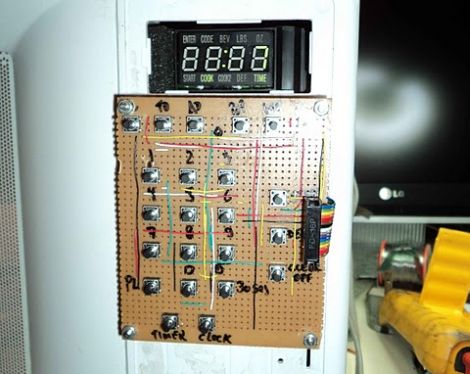
Rather than pay such a high price for a simple membrane, he opted to fix the microwave himself. He dismantled the control panel and thoroughly traced the keypad matrix to get an understanding of which pins toggled which functions. With a piece of protoboard and almost two dozen push buttons in hand, he built his own keypad and wired it directly into the microwave’s control board.

With labels written in marker it might not be the nicest looking thing you have ever seen, but it works a treat and is a great money-saving hack.