Building A Better Clock To Drive You Insane

[youtube=http://www.youtube.com/watch?v=YpqFU4SGe1Y&w=470]

[Simon] came up with an improved version of Lord Vetinari’s clock that begs to be installed in waiting rooms around the world.

Last week, we were introduced to a real-life Vetinari Clock that keeps regular time but ticks at irregular intervals. It’s a great way to turn someone’s mind into porridge, but the original build broke after a few weeks because of some limitations in the clock drive. [Simon] built a very minimal circuit does away with these problems.

Just as in the first build, a microcontroller pulses the second hand motor once every second. As for the random component of this build, the microcontroller has a puts 32 bytes into a 128 byte array. The array is checked 4 times a second, and if the byte is 1, the second hand is incremented. If the byte is 0, time stops for a little bit. [Simon] included the schematic, board layout and code if you’d like to build one yourself.

There are a few drawbacks to this design; the pattern of ticking and not ticking is hard-coded into the microcontroller. Even though the 32 second long pattern shouldn’t be noticeable by watching the clock, it’s not an entirely random solution. Judging from the comments on the original build, using radioactive decay to increment a second might be a bit uncalled for.

We would like to see a second hand that stops when you look at it though. Facial recognition, anyone?

Remote-controlled VMUSIC2 Audio Player

ir_controlled_vmusic2_audio_player

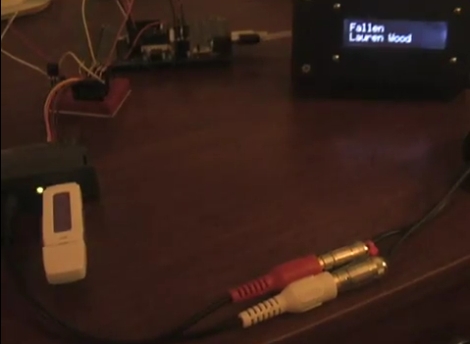
[Ron] was looking for a way to play his MP3s around the house without having to use his computer. He also wanted the ability to remotely control his tunes with an old camcorder remote he had sitting around – not exactly a feature you would find in an off the shelf personal audio player.

Ultimately, he decided to construct his own remote-controlled audio player using a VMUSIC2 audio module, which can decode MP3s from any standard USB drive. The VMUSIC2 is controlled by a Propeller demo board, which also handles receiving and decoding IR signals from his camcorder remote. While he was originally dumping ID3 tag data to his computer for debugging purposes, he recently added an LCD screen for displaying song information in a more useful manner.

The MP3 player seems to work pretty well if the video below is any indication, though it’s begging for a nice enclosure to tie things together. We like the project so far, so we’re sure [Ron] won’t fail to impress when it’s completely finished.

Continue reading “Remote-controlled VMUSIC2 Audio Player” →

Slick Music Synchronized Light Show Uses UV LEDs And Water

music_synchronized_light_show

[mike6789k] wanted to spice up his dorm room, so he built a cool music synchronized light show that struck us as being very well thought out. We have seen similar music-based visualizations before, but they tend to be pretty basic, relying on volume more than actual audio frequencies to trigger the lighting.

[mike6789k] didn’t want to build “just another” synchronized light show, and his all-analog approach gives a true representation of the music being played instead of just flashing lights along with the beat. Using a trio of simple filters, he broke the audio signals down into three distinct frequency bands before being driven through a high gain transistor to power a set of LEDs.

We were pretty impressed at how bright the display was given that he is using UV LEDs, but the 1W diodes seem to have no problem lighting up the place when aimed through the UV-reactive water, as you can see in the video below.

If you’re looking to make something similar for your next party, the folks over at Buildlounge were able to wrangle a schematic out of [mike6789k], which you can find here.

Continue reading “Slick Music Synchronized Light Show Uses UV LEDs And Water” →

Cheap Ikea Camera Boom Ensures Shake-free Video

ikea_webcam_jig

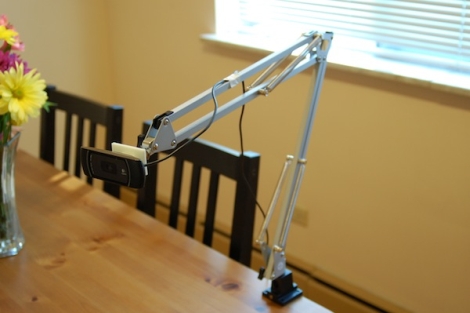
[Chris] recently got himself a nice web cam for documenting his Makerbot builds, and much like [Dino], he was looking for a way to get a bird’s-eye view of the action while keeping the camera nice and steady. While [Dino] ventured off to the hardware store, [Chris] tried a few different options that included tape, before heading off to Ikea to see what he could find.

$9 and a few Swedish meatballs later, he was on his way home with a “TERTIAL Work Lamp” that can be mounted on virtually any desk-like surface. He had to remove most of the web cam’s useless mounting hardware, doing the same with the lamp’s light fixture. He put together a small bracket in Google Sketchup, which he then printed out using his Makerbot.

It fit perfectly, and now he can get steady video of his Makerbot prints every single time.

Sweet Octocopter Takes The RED Epic To New Heights

red_epic_octocopter

So you’ve got a $40k+ RED Epic video camera and you need to get it from all the way down here to all the way up there. Sure, you could rent an expensive crane and take your shots from above that way, but why bother with that when you can fly instead?

German video effects company OMStudios decided that it was up to the task of finding a crane alternative, so they built a crazy octocopter drone to get the camera up to where they needed it. Figuring that if four rotors is good eight is even better, the group’s octocopter lifts the camera to heights of up to 150 meters, which is pretty impressive considering the weight of its payload.

While we might be a little hesitant to trust such an expensive camera to a glorified RC helicopter, it actually looks pretty solid from the video. Besides, we’re pretty sure these guys know what they are doing since they have a RED camera in the first place.

[via Engadget]

Continue reading “Sweet Octocopter Takes The RED Epic To New Heights” →

Garage Door Monitoring And Control Using A Dedicated Android Phone

[Sean] happened to have an extra Android phone sitting around and wanted to see what type of home automation he could use it for. One simple hardware modification, and some apps from the Android Market let him monitor and control his garage door remotely.

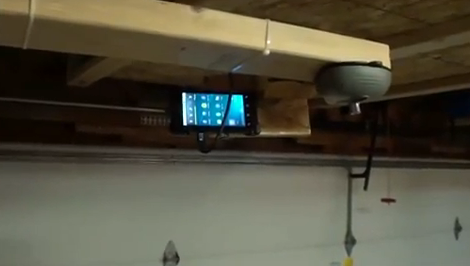
The hardware modification is a hack we’ve already looked at. The BTmate uses a Bluetooth headset with an added transistor to short the connections on your garage door opener. The only issue is that you need to be within range for the Bluetooth to work. [Sean] adds a layer of abstraction by using two Android phones. One is permanently mounted in the garage and handles the Bluetooth connectivity, while the other uses VNC to tunnel in anywhere he has an Internet connection.

But why stop there? He knew that this one feature was overkill, and added a second which the phone was perfect for. Since it has its own camera, he used the tinyCam app to create a webcam server. This even allows him to turn the LED on and off for a better view in dim light conditions. See [Sean’s] demonstration after the break.

Overkill? Maybe, but if you’ve got a phone with a broken LCD, this might be just the thing to give it a new purpose.

Continue reading “Garage Door Monitoring And Control Using A Dedicated Android Phone” →

Send A Satellite Into Space For $300

There’s a new Kickstarter campaign that promises to launch a personalized satellite into orbit for 300 bones.

The KickSat project is headed by [Zac Manchester], [Mason Peck], [Justin Atchison] and a few more contributors hailing from Cornell University. Their goal is to launch a CubeSat filled with hundreds of postage stamp-sized satellites and release these ‘Sprites’ into low Earth orbit.

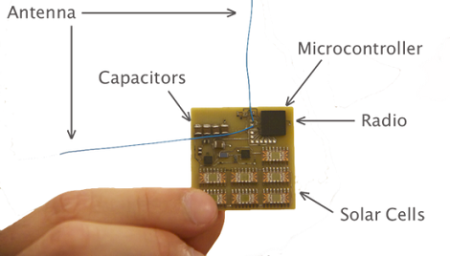
The Sprite concept has been in development for a while now and has been featured on IEEE Spectrum. The tiny satellites are simple PCBs with a microcontroller and a radio powered by solar cells and capacitors. The first version of the Sprite is designed to beam down a few bytes of data – just a unique identifier and a Kickstarter backer’s name. Future versions will undoubtedly include more advanced sensors such as cameras, thermometers, and very tiny particle detectors.

The KickSat team will use the funding from the Kickstarter campaign to test and integrate the systems. The team hopes to hitch a ride on one of NASAs many CubeSat launches, but if they get funding from 400 people, they’ll get to fly on a commercial launch by early 2013.

We were wondering about the amazing amount of space junk this KickSat/Sprite build will produce, but the team says not to worry: The Sprites fly in a pretty low orbit and will reenter the atmosphere a few weeks after being deployed. Not bad, considering Sputnik orbited for only 3 months.