Heathkit Is Back From The Dead

Although now it’s impossible for a DIY nut to build electronics for less money than a factory, this wasn’t always the case. For 45 years, Heathkit produced inexpensive kits for just about everything. Heathkit closed it’s kit business in 1992, but now they’re back. They’re starting out with a few DIY kits at first, namely an ultrasonic garage parking assistant and a wireless swimming pool monitor.

Heathkit is calling all builders to submit their ideas for future kits. While this comeback rings of some other outlets with a rich heritage, Heathkit is still remembered fondly; Barry Goldwater jetted out to the Heath HQ twice a year for kits. Not many people are that attached to Realistic and Optimus gear.

If you’re wondering about the kind of stuff Heathkit offered, feel free to check out the 1984 catalog that features computers with 128kB of RAM available for only $1899.00 (yes, a very competitive price)

Tip ‘o the hat to [Jeffrey Bail (N1BMX)].

High Voltage: Using Enclosed Relays For HV Switching


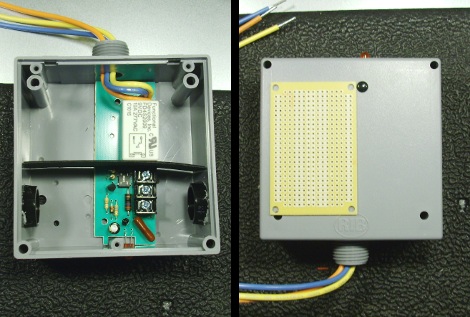
After seeing many projects that use microcontrollers to switch mains voltages [Rob Miles] decided to share his preferred method. The shots you see above are an enclosed relay, part number RIBTU1C manufactured by Functional Devices Inc.

This in itself is not the full control scheme that he uses, but it takes care of the bulk of the hardware. He uses a triggering circuit based on a 555 timer (PDF). [Rob] mentioned that if you shop around, you can get the relay, 555 timer, and other components for under $15. This is a great solution for the money when you consider that you get an enclosure meant for handling high voltage and a nice terminal block to which you can connect the mains wiring. The relay itself can be triggered by a 9V battery via the transistor in the control circuit.

Notice the protoboard in the image above. There’s plenty of room for your driver circuit to rest inside the box, protected by that barrier from the HV circuitry. Check out the rest of the images he sent us after the break.

Continue reading “High Voltage: Using Enclosed Relays For HV Switching” →

Meet Radio Shack’s New Parallax Lineup

It looks like Radio Shack is pretty serious about their new found commitment to their focus on the DIY, inventor, creator and geek demographics. [Ken Gracey], Parallax forum guru, put up a post on the Parallax stuff that will be sold at Radio Shack. Everything is priced, “below spousal approval level,” but no word on what those prices are.

Here’s the (probably not conclusive) list we gleaned from the pics: 2-axis joystick, gyroscope, GPS, compass and altimeter modules, an infrared sensor, 2×16 backlit LCD, BASIC stamp 2 board, and an XBee 2-pack that we assume would be priced above girlfriend approval levels.

We’re curious about how many (and in what quantity) of these items will be stocked at the East Nowheresville strip mall, and again there’s no mention of improving the selection of individual components.

At Hack A Day, we were thinking how amazing a Radio Shack ‘component vending machine’ would be. A modified pick and place machine that will dole out caps, resistors, other components, and has the potential to be competitive with online stores. Anyone feel like sending that suggestion in?

Project 25 Digital Radios (law Enforcement Grade) Vulnerable To The IM-ME

Would you believe you can track, and even jam law enforcement radio communications using a pretty pink pager? It turns out the digital radios using the APCO-25 protocol can be jammed using the IM-ME hardware. We’ve seen this ‘toy’ so many times… yet it keeps on surprising us. Or rather, [Travis Goodspeed’s] ability to do amazing stuff with the hardware is what makes us perk up.

Details about this were presented in a paper at the USENIX conference a few weeks ago. Join us after the break where we’ve embedded the thirty-minute talk. There’s a lot of interesting stuff in there. The IM-ME can be used to decode the metadata that starts each radio communication. That means you can track who is talking to whom. But for us the most interesting part was starting at about 15:30 when the presenter, [Matt Blaze], talked about directed jamming that can be used to alter law enforcement behavior. A jammer can be set to only jam encrypted communications. This may prompt an officer to switch off encryption, allowing the attackers to listen in on everything being said to or from that radio.

Continue reading “Project 25 Digital Radios (law Enforcement Grade) Vulnerable To The IM-ME” →

DIY RC Sensor Board

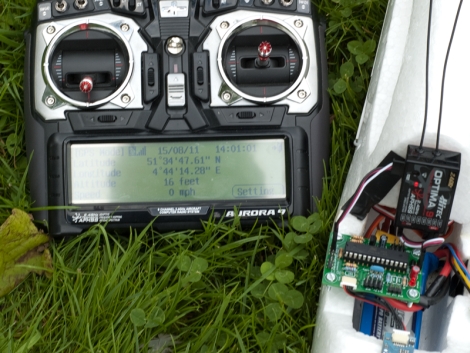
diy_telemetry_sensor_board_hitec_aurora

Along with hobby electronics, flying RC planes is one of [Diederich’s] favorite hobbies. When out in the field, he prefers to use an Aurora 9 radio controller, and while the remote is great, he was a bit disappointed in Hitec’s telemetry sensor lineup. He says that the sensors are pretty decent, though limited, and he was positive he could build a better telemetry solution.

His sensor board is completely open source, and comes with a long list of features. First and foremost, it emulates all of the messages that can be sent to the radio controller by Hitec’s off the shelf models, making it a simple drop-in replacement. He uses an ATMega8L microcontroller to run the show, including all sorts of input pins and connectors to support GPS as well as voltage and current monitoring.

He has made a DIY kit available for purchase online, but all of the sensor’s schematics and a BOM are available for free, should you desire to roll your own.

We love seeing DIYers show up manufacturers in this way, especially when they share the goods with their fellow hobbyists. Nice job!

Robotic Artist Listens To Your Criticism

[Ben Grosser] built an interactive painting robot that’s pretty far removed from the LED and Arduino builds we usually see. The robot is adapted from one of the many CNC routers we’ve featured over the years. The control system is written in Python and uses genetic algorithms and a microphone to decide what to paint next.

Robot artists have been around for decades now. When [Harold Cohen] exhibited his robotic artist AARON, gallery patrons lined up to watch a robot paint. The paintings were originally just a monochrome line drawing that was later colored in by [Cohen]. [Ben] made his robot paint directly onto canvas with oil paints, so there’s no question of what the computer intends the final product to be.

[Ben] came up with a really neat build, but we’re wondering about having this robot artist on display inside a cavernous exhibition hall. Surely the echos from the servos and stepper motors would be picked up by the mic and interpreted by the painting algorithm. Barring some control systems, it would probably be the robot’s commentary on its own decent into madness.

Check out a video of the robot in action after the break, followed by a violin/robot duet the shows how the audio is interpreted.

Continue reading “Robotic Artist Listens To Your Criticism” →

Gyroscope-based Smartphone Keylogging Attack

smartphone_keylogging_with_gyroscopes

A pair of security researchers have recently unveiled an interesting new keylogging method (PDF Research Paper) that makes use of a very unlikely smartphone component, your gyroscope.

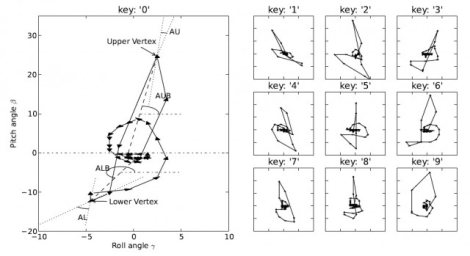
Most smart phones now come equipped with gyroscopes, which can be accessed by any application at any time. [Hao Chen and Lian Cai] were able to use an Android phone’s orientation data to pin down what buttons were being pressed by the user. The attack is not perfect, as the researchers were only able to discern the correct keypress about 72% of the time, but it certainly is a good start.

This side channel attack works because it turns out that each button on a smart phone has a unique “signature”, in that the phone will consistently be tilted in a certain way with each keypress. The pair does admit that the software becomes far less accurate when working with a full qwerty keyboard due to button proximity, but a 10 digit pad and keypads found on tablets can be sniffed with relatively good results.

We don’t think this is anything you should really be worried about, but it’s an interesting attack nonetheless.

[Thanks, der_picknicker]